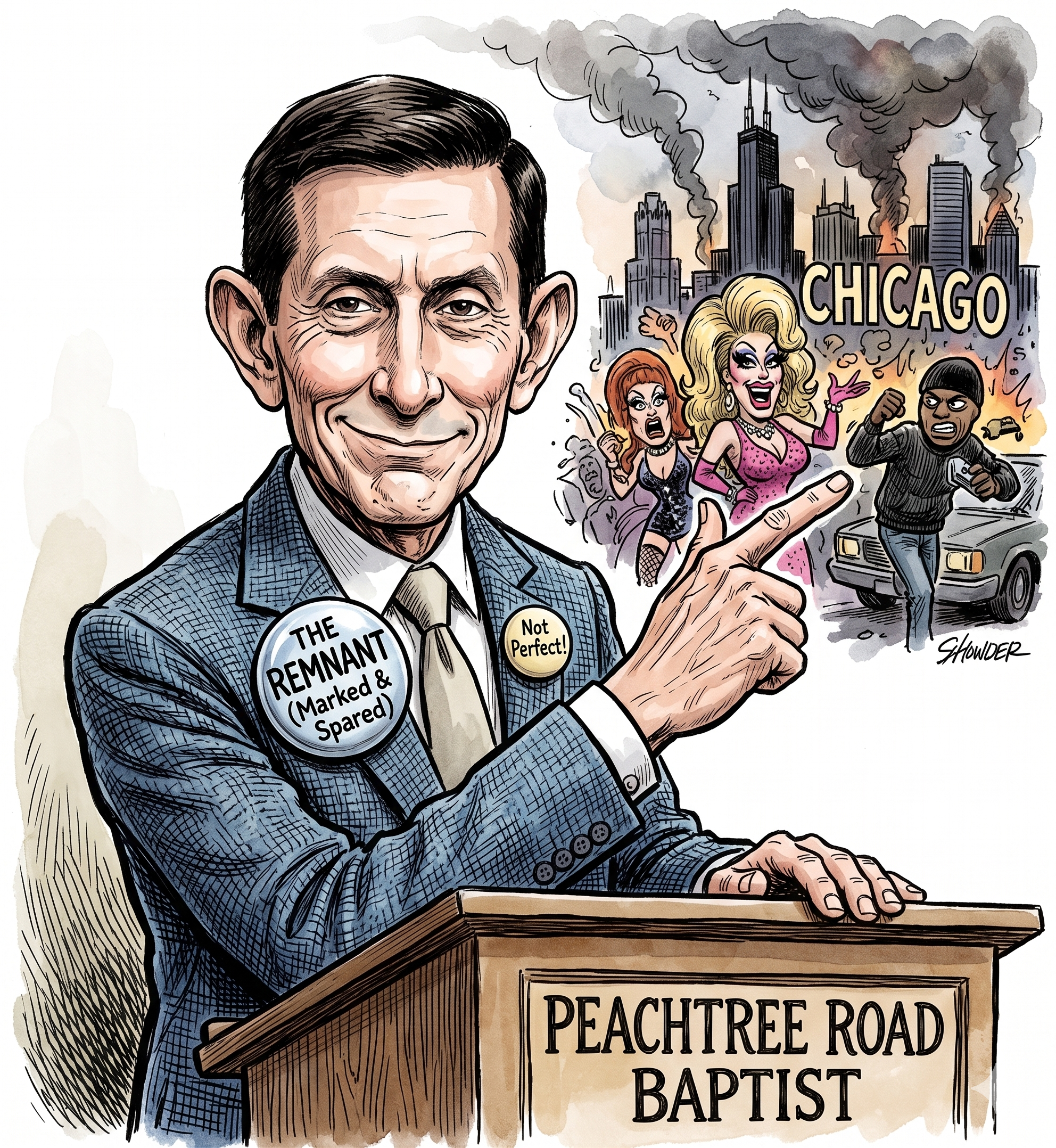
Notes on a sermon delivered at Peachtree Road Baptist Church on 12/07/2025 The full sermon can be viewed on Youtube
This Sunday evening service at Peachtree Road Baptist begins with a bit of stagecraft. The service begins with stagecraft. Pastor Jay Reed performs the role of the relatable protagonist, teasing the front row about a stray hair on his jacket. “I’m kidding… You people are so gullible,” he chuckles, followed by several minutes of patter about his microphone audio, color-coordinated Bible and tie, and a friend’s pronunciation of “again.” The atmosphere is almost vaudevillian.
This is the Sanitized Fundamentalist™ at his most effective: disarming through affability before framing a “Malevolent World” through “Straight Truth.” By the time Reed stops narrating his wardrobe, the congregation has been conditioned to see his upcoming provocations as mere “plainspokenness” rather than the systematic dismantling of human agency.
In this installment of his series on parenting, Reed attempts to navigate complementarianism. His goal is to define “Rock Solid Daughters” as “Palace Pillars” (Psalm 144:12)—a metaphor he interprets not as structural strength, but as static, selfless support. The unintended genius of his exegesis is the “Competence Gap” argument: to elevate the man as the head of the home, Reed drags him through the mud of biological ineptitude. The result is a sermon that humiliates men to demand female submission—a rhetorical high-wire act as impressive as it is incoherent.
The “Day of Peril”: Domesticating the Resistance
“The children are being born into an environment of peril. Okay. Now, you may think, well, we live in the United States. We’re not an environment of peril. Yes, you are. Yes, you are.”—Pastor Jay Reed
Reed opens with Psalm 144, immediately bridging the gap between ancient Israel’s military conflicts and suburban Georgia. He claims modern America is an “environment of peril,” a premise designed to make the congregation feel besieged. Without this specter of external threat, his demands for rigid, antiquated gender roles would be harder to swallow.
This premise braces everything that follows. The congregation is meant to feel besieged. Without the specter of external threat, Reed’s subsequent demands for rigid conformity to antiquated gender roles will be much harder to swallow for his modern audience.
“Our government is not a friend of Christianity… there’s a lot of levels of intermediate governance that are still just and bureaucracy that has been totally captured. Okay? And it’s occupied territory.”–Pastor Jay Reed
This language is tactical. By positioning the congregation as a resistance movement in “occupied territory,” Reed delegitimizes any secular authority—be it law or social progress—that contradicts him. Compliance with the state becomes a matter of tactical avoidance rather than moral value. If your children are born into “peril,” parenting becomes a high-stakes operation requiring radical, insular safety measures.
The Restrained Revolutionary (Or: Why Jesus Isn’t a Hippie)
“The Jesus from the Bible was not a hippie out to promote world peace…he is the prince of peace and he’s the king of peace… He wasn’t an anti-establishment guy um speaking truth to power. That’s not what he was. He was the son of God. He was the power.”–Pastor Jay Reed
At first glance, this seems like a non sequitur. Reed has just finished explaining that the government is a malevolent occupying force, and now he’s pivoting to refute… hippies? This ignores that fact Rome executed Jesus with the label “King of the Jews” nailed above his cross. However, acknowledging Jesus as a threat to power would invite his followers to be threats too—and Reed needs subjects, not revolutionaries.
This results in “Submissive Stasis.” Parishioners are told the world is hostile (distrust external voices), but also that Jesus wasn’t anti-establishment (don’t be a rebel). This leaves only one safe space: the church power structure, where peace is found through submission to the pastor’s interpretation of divine roles.
“We find peace through submission… his life was one of great restraint.”–Pastor Jay Reed
But to understand how Reed extends this “restrained omnipotence” doctrine to justify absolute female submission to masculine authority, we must first witness his extended humiliation of the Christian man—a creature who—by Reed’s telling, can barely dress himself.
The Biology of Destiny: Square Cells and Strategic Incompetence
“God created men and women differently. Our capabilities are different. Our outlooks are different. Our reactions are different.”—Pastor Jay Reed
This opening thesis is technically true: humans do possess different capabilities. But Reed isn’t discussing individual variation. As he shifts from theology to biology, what appears to be a fair observation becomes the scaffolding for claims that become increasingly dubious.
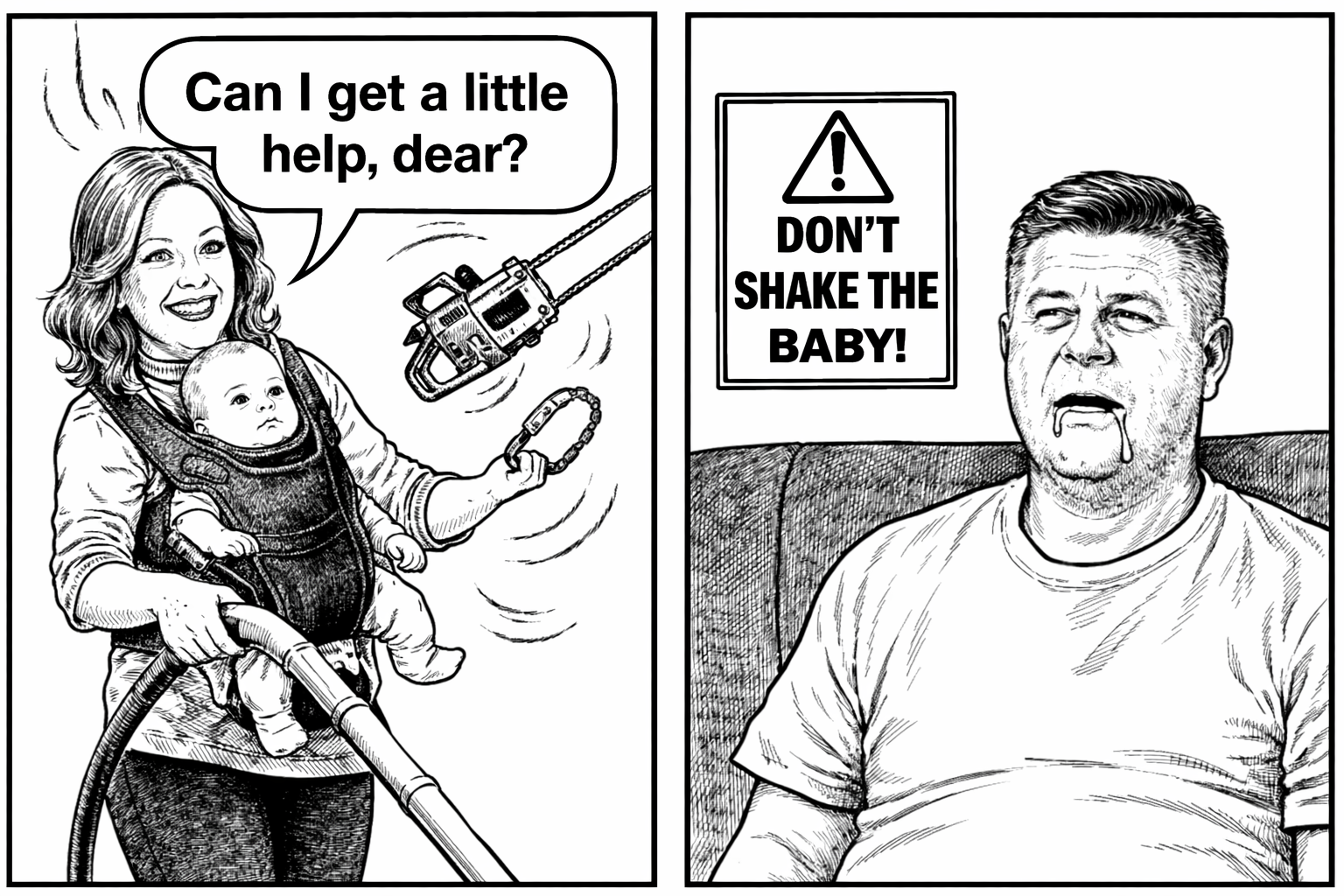
“Men cannot multitask. Terrible. We are terrible. In fact, when we do get something right domestically, we clean something up, we cook something, we do something with the children, we look at our wives like, ‘Give me a gold star.’”—Pastor Jay Reed
This is “Strategic Incompetence”: claiming biological incapacity to avoid labor. Reed isn’t just excusing men from chores; he is constructing a framework where male inadequacy becomes female obligation. It’s not laziness, it’s a design flaw feature. He’s also claiming male trait as universal. The Apostle Paul’s “This one thing I do” becomes not spiritual focus but neurological constraint.
“She’s over there juggling flaming chainsaws. I do that every day. Yeah, I know.”—Pastor Jay Reed
Enter the paradox. Reed validates female competence (“juggling flaming chainsaws”) while simultaneously arguing that this competence obligates women to accept the burden of domestic chores permanently. You’re so much better at this than we are, which is precisely why you must continue doing it.
“Men are not near as good at guilt as women. My wife can feel guilty about something that happened in a dream.”—Pastor Jay Reed
This observation, delivered as humor, extends “competence gap” to emotional intelligence, framing guilt as a female-specific frequency. If women are “wired” for guilt, the moral burden of the home falls solely on the wife. The man’s emotional distance isn’t a character flaw; it’s just his testosterone. Conveniently, Reed’s biology exempts men from both the dishwasher and the work of moral self-reflection.
“Women have round fat cells… that’s why they have a more curved appearance. Men have fat cells that are more square, that are more defined.”—Pastor Jay Reed
I had to look this up. Not because I believed for one second it was factually accurate (it obviously isn’t), but because I had to figure out where Reed was getting this from. Apparently, this claim has long been a staple of fundamentalist marriage literature. It stems from a 1978 study by Nürnberger and Müller about cellulite formation. That study found differences not in cell shape but in the orientation of connective tissue fibers that hold fat in place. In women, these fibers run perpendicular to the skin (creating chamber-like structures that can bulge outward). In men, they run in a criss-cross pattern (creating a more stable mesh). Somehow, this study on why some women are more prone to cellulite dimples on the skin surface above fat deposits has morphed into a common IFB myth that fat cells themselves have different shapes in men and women. Not to get too far into the weeds here, but the scientific explanation for this connective tissue difference relates to female human superior capacity for fat storage. Through my research I’ve been assured this particular biological adaptation has no impact on physical strength, endurance, professionalism, or the ability to load a dishwasher.
“Women cannot jump up in the air and kick men in the head… choreography… There is a difference between a woman hitting a man and a man hitting a woman. Those aren’t the same things between a woman. There’s a difference between a horse kicking you and a man kicking you.”–Pastor Jay Reed
The comparison of a man’s kick to a horse’s kick is where my mild second-hand embarrassment began to give way to real concern. Reed isn’t just arguing that men are stronger than women (a claim that has statistical support). He’s arguing that this strength differential has metaphysical significance. Men possess “greater violence,” therefore, they are the “natural” protectors and leaders.
This is might-makes-right theology. Physical dominance = spiritual authority. But notice what it implies about male nature: men are inherently dangerous. Their strength is not just protective capacity but latent threat. This is a subtext that will soon move to the forefront of this sermon with alarming candor.
“If there’s a noise in the basement, you recognize that difference. You need to go down and check that out… I’m in my nighty night clothes, cutting the pie with my handgun, and I can’t come up till I’ve checked under the bed and in the showers and in all the closets.”–Pastor Jay Reed
This is Reed’s understanding of male utility. The same man who can’t multitask, who demands gold stars for vacuuming, who sits in “nighty night clothes” watching football, suddenly has a defined role when violence becomes necessary.
The image is simultaneously self-deprecating and self-aggrandizing. Reed presents himself as ridiculous, yet the language betrays a different self-conception. “Cutting the pie” is tactical terminology used by trained personnel. Reed isn’t just checking the basement; he’s conducting a small-unit operation in his own home.
Reed frames this as a burden (“How is that my job?”) while simultaneously casting himself the hero in its execution. It’s a remarkably uneven trade: women provide constant, invisible labor that makes daily life function. Men provide the willingness to kill an intruder who will statistically never arrive. What about the other 99.9999% of life?
The Nursery: Where Strategic Incompetence Becomes a True Threat
“There aren’t a lot of men working at daycares. Thank God. That’d be a disaster. We don’t have men in the church nursery, man… I go like two steps near that and I just turn around and walk the other way. I do not. And I know, listen, women, I know that it’s hard for you. It’s impossible for us.”—Pastor Jay Reed
This is where Reed’s pseudo-anthropology reaches its most troubling conclusion. He argues that men are “impossibly” unsuited for childcare. When women find childcare “hard,” it’s merely difficulty. Whereas caring for children is apparently impossible for men.
But why? Reed (father of six, by the way) explains:
“When you’re at the labor or the delivery wing of the hospital, they have signs on the wall that says, ‘Don’t shake babies.’ Just they’re everywhere. Don’t shake the baby. Don’t shake the baby. Like, why would they have to say that? You let that thing cry for about four hours. You’re looking for answers. Stop. Don’t shake the baby. Nothing else worked.”—Pastor Jay Reed
The casual horror of this statement deserves emphasis. Reed is describing a scenario where a man, faced with a crying infant, naturally progresses toward violence. Not as an aberration but as an unavoidable or expected response.
To be clear: shaken baby syndrome is a real and devastating form of child abuse. Those hospital signs exist because sleep deprivation, frustration, and the relentless assault of infant crying can push any caregiver to a breaking point. Both men and women have harmed infants this way, though statistically men commit the majority of these cases, just as men statistically commit the majority of all violent crimes.
But Reed isn’t discussing the complex factors that contribute to male violence and child abuse. He isn’t advocating for intervention or support. He’s casually normalizing male violence as biological inevitability. Men don’t choose violence; they’re simply wired for it
Strategic Incompetence is weaponized into something far darker: abdication of moral responsibility. Reed frames male violence toward children not as a failure of character or self-control, not as a crime requiring intervention and accountability, but as an unavoidable consequence of male nature. Men aren’t responsible for managing their own aggression; and they can’t be trusted to care for infants.
“Men, we have testosterone. We like horsepower. We like machines and automation and guns.”—Pastor Jay Reed
Finally, Reed attributes the “shaken baby” impulse to testosterone, equivalent to love of machinery and guns.
Yet, these same creatures—too dangerous for the nursery and too simple to vacuum—are the divinely ordained “heads” of the household. Male authority becomes a birthright that requires no competence or earned trust.
At this point, the sermon’s incoherence becomes too pronounced to treat as accidental. Reed cannot plausibly believe all of the things he is saying at once. He cannot sincerely maintain that men are biologically incapable of safely caring for infants, functionally helpless in domestic life, and yet uniquely qualified to exercise unquestioned authority over women and children. The contradiction is not a byproduct of sloppy thinking; it is a product of rhetorical necessity.
The humor functions as camouflage. By presenting male incompetence as self-deprecating comedy, Reed is able to say what he cannot state outright: that domestic labor is beneath men, that women exist to absorb it, and that male authority must remain untouched by either failure or scrutiny.
Reed’s caricature of the drooling, domestically useless man is a false humility. Reed does not actually relinquish power in these moments. By lowering the bar for male contribution to the floor, he ensures that authority can never be conditioned on reciprocity, competence, or service. Men may be ridiculous, dangerous, or disengaged, but they are never disqualified.
In this light, the sermon’s jokes are not incidental. They are the mechanism by which its real claims are smuggled past resistance.
Demography as Destiny: The Empty House and the Corporate Prize
Having established male incompetence as biological fact, Reed now frames any female desire to escape this arrangement as civilizational threat. This is where the sermon shifts from pseudo-science to apocalyptic demographics.
“We have a real problem in the Western world. We’re not having babies, mainly the women… South Korea has a birth rate of about .75. That’s a civilization that’s on its way out. You have to have at least 2.1.”—Pastor Jay Reed
Reed presents declining birth rates as civilizational collapse and slow-motion suicide of societies that have abandoned their God-given design. His primary evidence is South Korea, where birth rates have plummeted below replacement level. But before analyzing his actual argument, it’s worth noting what Reed doesn’t discuss: why this is happening.
South Korea’s birth rate crisis has been extensively studied by demographers, economists, and sociologists. The causes include: extreme work culture that makes work-life balance nearly impossible, astronomical housing costs in major cities, inadequate childcare infrastructure, persistent wage gaps and workplace discrimination against mothers, and cultural expectations that make childrearing incompatible with women’s professional advancement.
In other words, the South Korean birth rate collapse is happening precisely because of rigid gender roles and economic structures that punish women for having children. But Reed frames it as happening despite the abandonment of traditional roles. The causality runs exactly backward from reality, but I doubt Reed’s congregation is any more aware of this data than he is. So, he again offers these factual errors safely unchallenged.
“What happened? Well, we told women that if we kept women in the home that that was repressive, that you would not be fulfilled.”—Pastor Jay Reed
Notice the rhetorical structure. Reed says “we told women” as if he’s describing a conspiracy inflicted upon women rather than a movement that women initiated and enthusiastically embraced. He also mis-represents feminist advocacy for choice as a false dicotomy: “…kept women in the home…you would not be fulfilled.” There’s neither middle ground nor feminine agency here.
This framing puts an interesting spotlight on Reed’s female congregants. Many of the women listening likely agree wholeheartedly with his message. They’ve built meaningful lives as wives and mothers. They’ve found genuine fulfillment in domestic roles. But here’s what Reed doesn’t acknowledge: for most women raised in the IFB ecosystem, the “choice” between career and family was never actually available.
In Independent Fundamentalist culture, women are typically discouraged from pursuing accredited higher education. Tiny church schools like Peachtree Road Baptist Academy (where about two dozen young people currently attend) offer unaccredited high school diplomas. While many of his congregants do work, the pathway to highly skilled and enviable professional careers was foreclosed long before they reached adulthood. So when Reed warns against the “corporate prize” and the “empty house,” the majority of women nodding along from his pews aren’t rejecting careers they could have pursued; they’re affirming a choice that was largely made for them by the very system Reed structurally enforces.
This makes Reed’s rhetoric particularly effective. To the small minority of women in his congregation who did have educational access outside the IFB cul-de-sac and chose domesticity, his message offers spiritual validation. But to the majority who never had the choice, his message transforms obligation into the illusion of agency, and reframes systemically imposed limitations as spiritual virtue.
Feminism’s Malicious Intent
“I know what the world says, but they’re wrong and they’re wicked. They’re not just misguided, they’re malevolent… When they tell a young lady that you will not be fulfilled unless you climb a corporate ladder.”–Pastor Jay Reed
This is Reed’s escalation from disagreement to demonization (and once again misrepresenting the movements that allowed women equal access to financial indepedence and highly skilled careers as an eschewment of motherhood). The people promoting education and career opportunities for women aren’t misguided, they’re malevolent. They’re actively seeking to harm women.
“How many young women have sold their childbearing years away from some corporate prize? And when they got done, they had a pretty decent retirement and a plaque with their name on it and a gold watch and an empty house.”—Pastor Jay Reed
The “empty house” functions as Reed’s ultimate warning, complete with a haunting image of the barren professional woman looking back on a wasted life. Never mind that this woman has financial security, professional respect, and presumably relationships beyond the walls of her house. In Reed’s framework, without children, her life is literally empty.
But what about the woman who has children but finds motherhood unfulfilling? What about the woman trapped in an abusive marriage with the incompetent brute Reed spent the last twenty minutes describing? What about the woman whose children grow up and leave, and she realizes she built her entire identity around a role that had an expiration date?
Reed’s “empty house” cuts only one way. The professional woman’s loneliness is a spiritual failure; the housewife’s loneliness is never mentioned.
The Low Bar of Male Superiority
“You’ve been told that success equals being equal to or better than a man. Why would you want to be one of us? Have you looked at your husband lately? The dude can stare at a wall and be happy.”Pastor Jay Reed
Reed has spent significant time establishing that men are simple, incompetent, and emotionally stunted. They can’t multitask. They don’t feel guilt. They can stare at walls and feel fulfilled. And now he’s saying: Why would you want to be equal to that?
But if men are so simple, incompetent, and easily satisfied, why are they in charge?
“Society is failing. The kingdom of God is just fine… My message is biblical. Theirs is satanic.”–Pastor Jay Reed
As usual, Reed leaves no middle ground between his opinions and Satan’s deception. You either accept his specific interpretation of gender roles, or you’re aligned with the devil himself.
The Cornerstone’s Burden: Support Without Projection
“The power of the cornerstone is not the power of projection. It’s the power of support… When a woman’s power is projected, she loses her greatest strength.”—Pastor Jay Reed
Reed finally deigns to provide scripture to support his “biblical” message. He reads Psalm 144:12, where David prays that “our daughters may be as cornerstones, polished after the similitude of a palace.” Reed deploys this image with conviction: women are most powerful when they’re providing support rather than seeking visibility.
“The power of the cornerstone is not the power of projection. It’s the power of support.”—Pastor Jay Reed
In Psalm 144, the cornerstone an elegant metaphor for daughters. Cornerstones were essential to ancient buildings—they set the alignment, bore tremendous weight, and gave structural integrity to the entire edifice. Reed wants his female congregants to see themselves as these foundational elements: critical, valuable, but fundamentally hidden.
“We don’t pick up cornerstones and throw them at people… They don’t put cornerstones in trebuchets and shoot them out at the enemy.”—Pastor Jay Reed
This isn’t exegesis. This is a stand-up bit used to launder a prior conclusion. As a reminder the Psalm says ““That our sons may be as plants grown up in their youth; that our daughters may be as corner stones, polished after the similitude of a palace …”
If he were applying the metaphor evenly: Plants aren’t “leaders” either. Plants don’t “project power.” Plants are literally stationary, rooted, dependent on cultivation.
To correct Reed’s selective emphasis, and to enlighten rather than misdirect: The Hebrew word translated “cornerstones” in Psalm 144:12 is זָוִיֹּת (zaviyyot). This term doesn’t refer to the massive foundation stone buried beneath a building. It refers to carved pillars or ornamental corners in palaces. There are visible, decorative, structural elements that give a building its grandeur and shape.
These weren’t hidden support mechanisms. They were on display. They were the architectural features that proclaimed a palace’s magnificence. They “projected” in the most literal sense, extending outward from the structure, defining its boundaries and proclaiming its significance.

Moreover, the text specifies these pillars are “polished” (ḥaṭubot)—carved with skill and finished for beauty. This isn’t rough stone buried in the dirt; this is craftsmanship meant to be seen. This makes Reed’s claim that cornerstones don’t “project” not just exegetically wrong but inept. The entire purpose of a cornerstone was to project alignment throughout the structure.
Reed’s interpretation requires transforming visible, decorative, boundary-setting pillars into invisible, buried, static support stones. He needs the metaphor to contain women within the home, so he strips it of its actual meaning. He also does this while side-stepping the question of how sons aka plants grown up in their youth are beter suited to the trebuchet than “cornerstones.”
The Brawling Woman Redux
“It is better to dwell in the corner of a housetop than with a what? Brawling woman in a wide house… This woman is not supporting. She’s attacking… Interesting, fellas. It just says, ‘Go hide in the corner. Don’t fight back.’”—Pastor Jay Reed
Reed’s use of Proverbs 21:9 and 25:24 reveals his interpretive method: find proof texts that support the desired conclusion, strip them of context, and present them as comprehensive theology.
The Proverbs verses about contentious wives are practical observations about difficult domestic situations. They’re not theological treatises on the nature of female power or divine design for gender roles. They’re saying: “Life with a quarrelsome spouse is miserable.” This is universal.
But Reed transforms “don’t be quarrelsome” into “any assertion of female will is brawling.”
“Women are much better arguers. You have a much better command of the facts… and you fight unfairly because just about the time we remember something and we’re going to get it right and we’re going to score a point, you change a subject.”—Pastor Jay Reed
Women don’t win arguments because they’re right. They win, supposedly, because their superior articulation, better memory, and logical agility are tools of manipulation deployed against well-meaning but slower-thinking men.
“Her husband is known in the gates when he sitteth among the elders of the land. How in the world does a husband’s position have anything to do with a woman being virtuous? She supports him.”—Pastor Jay Reed
Reed moves to Proverbs 31, a troublesome text for complementarians because the Proverbs 31 woman is remarkably autonomous. She considers fields and buys them. She makes business decisions. She perceives that her merchandise is good. She speaks with wisdom. She opens her mouth with the law of kindness.
So Reed does what he must: he ignores that part. Instead he focuses on one verse—Proverbs 31:23, and makes it load-bearing. The husband is “known in the gates” when he sits among the elders. Reed interprets this as proof that the wife’s virtue is measured by her husband’s public standing.
Let’s examine the context Reed is clearly choosing to ignore. Proverbs 31. The passage begins by asking, “Who can find a virtuous woman? For her price is far above rubies.” It’s her value that’s being celebrated. Her husband trusts in her (verse 11). Her children and husband praise her (verse 28). She’s the one who “opens her mouth with wisdom” (verse 26). She’s the one who “looks well to the ways of her household” (verse 27).
The reference to her husband being “known in the gates” is one passing verse in a passage primarily celebrating her wisdom, business acumen, strength, and dignity. To read verse 23 as proof that a woman’s entire identity should be derived from her husband’s position is not merely an interpretive difference, it’s distortion.
“The world says that a powerful woman is the woman who achieves great things in the corporate and political world when you are equal to or exceed men. That’s what they say. Here’s what the Bible says. Your ability to be a great lady is based upon your ability to support greater and greater weights.”—Pastor Jay Reed
Female greatness, in Reed’s theology, is capacity for burden. Not achievement. Not influence. Not creativity or leadership or innovation. Greatness is measured by how much suffering you can endure without complaint.
The Masculinity Virus and the Lean Soul
“We’ve succumbed to the masculinity of women virus… Ladies, you can live the projection life if you want to, but your soul will be lean.”—Pastor Jay Reed
The “masculinity of women virus” is apparently any woman who seeks achievement, visibility, or leadership. Reed pathologizes female ambition as a corruption infecting culture. Reed then borrows the threat “your soul will be lean,” from Psalm 106:15, where God “gave them their request, but sent leanness into their soul.” The context in Psalms is Israel demanding meat in the wilderness whereby God gave them what they wanted but it spiritually impoverished them.
Reed’s application: Women who pursue careers might achieve their goals, but God will ensure their souls suffer for it. Success will taste like ashes. They’ll have everything they wanted and nothing they needed.
The Fortress Complete: Tribal Validation and Martyrdom
Having delivered his message about female submission and male incompetent headship, Reed concludes with what might be called his victory lap—a series of reflections on his own courage and his congregation’s faithfulness.
“Thank you for being the kind of church… that we can preach straight Bible truth. There are churches you could never say what I said tonight. You just couldn’t.”—Pastor Jay Reed
As Reed congratulates his congregation for their willingness to endure his message, I’m struck by his disingenuity. Consider the joking and self-deprecating padding he packaged this “straight Bible truth” in. This reveals true insecurity. Knowledge that this message of “truth” doesn’t sit well with his audience, despite their prior inoculations.
“I don’t want a man of God to ever stand in my pulpit and worry about whether or not he can say something that’s biblical. Once we start trimming here, it makes it a lot easier to trim the next.”—Pastor Jay Reed
This is the Slippery Slope Defense: any modification to Reed’s teaching begins an inevitable slide toward total apostasy. Question his reading of Proverbs 31? You’re on the path to denying biblical authority. Suggest that women might have gifts for pastoral ministry? You’re trimming the Bible to fit culture.
But this reveals an interesting vulnerability in Reed’s system. If one’s theology is so fragile that questioning peripheral claims threatens the whole structure, perhaps the structure wasn’t built on rock to begin with.
“You young men of God… develop the fortitude in your heart to preach the whole counsel of God. Every bit of it. Don’t be shy. They may kill you, but don’t be shy.”–Pastor Jay Reed
They may kill you.
Let’s sit with this hyperbole for a moment. Social boundary-policing is now an act of supreme courage. Reed is telling these young men that narrowing female ambition, devaluing female competence, and ensuring female invisibility is not cruel or reductive. It’s brave.
Here’s the benefit of this persecution complex, which feeds on itself. The more offensive the message, the more reaction it generates. The more reaction, the more “proof” that the world hates the truth. It’s a closed loop that actually requires causing offense to maintain its internal logic.
The Human Cost of Standing in the Gap
Reed’s sermon on “Rock Solid Daughters” is a perfect example of Sanitized Fundamentalism™ in its execution: disarming humor, pseudo-science, misappropriated Scripture, and spiritual threat. It preaches male incompetence to excuse a mandate for female submission. It celebrates female capability only to insist that capability be exercised invisibly, in service of male ambition.
The human cost is not abstract. Women in Reed’s congregation face an impossible bind: told they’re more competent than men (better multitaskers, better arguers, more conscientious), and for this reason obligated to permanent domestic service to their inept overlords. Pursue education, career, or financial independence? God will punish you with a “lean soul.” Stay home but feel unfulfilled? Your dissatisfaction proves you need more submission. Question the system? You’re “brawling.”
Men receive equally damaging messages. They’re biologically incapable of basic functional tasks, even emotional intelligence. They’re so dangerous around crying babies that hospital signs must warn them not to commit murder. Yet despite this comprehensive incompetence, they’re supposedly equipped to be household “heads,” making major decisions about finances, children’s education, and spiritual direction.
The resulting marriages are built on complementary dysfunction. True partnership—where authority is earned through wisdom rather than gender, where vulnerability and strength are shared rather than divided by anatomy—becomes impossible.
Children raised under this theology receive profoundly distorted messages about their masculine and feminine identities. Girls learn their intelligence is a problem to manage rather than a gift to develop. Boys learn emotional incompetence is biologically inheritance rather than a character flaw. The girl who wants to be a doctor, the boy who wants to be a nurse, the daughter with gifts for leadership, the son with gifts for nurturing—Reed’s theology has no place for these children except as cautionary tales.
The most damning aspect of Reed’s system is its unfalsifiability. Woman thrives in a career? Her soul is “lean” (even if she seems fulfilled). Woman struggles at home? She needs more submission (even if she feels oppressed). Woman questions the system? She’s “brawling” (even if her questions are valid). Man is incompetent at domestic tasks? It’s biology (even if many men successfully nurture and multitask). Every outcome confirms the thesis.
This is not theology. This is a closed system that uses Scripture the way a drunk uses a lamppost.
The cornerstone metaphor—misread, decontextualized, and weaponized—perfectly encapsulates the disgrace of Reed’s own headship. Reed claims he’s protecting women from a “malevolent” world that wants to steal their childbearing years and leave them with empty houses. But his protection functions as imprisonment. The fortress he’s built doesn’t keep danger out. It keeps women in. And by the time they realize they’re not supporting the structure but trapped beneath it, Reed will have moved on to his next “straight Bible truth,” congratulating himself on his courage while the people inside can only enjoy the illusion of agency.
Note: This analysis represents the author’s subjective interpretation of the sermon delivered on the date mentioned above. For further details, please see my full [Legal Disclaimer]



Leave a Reply