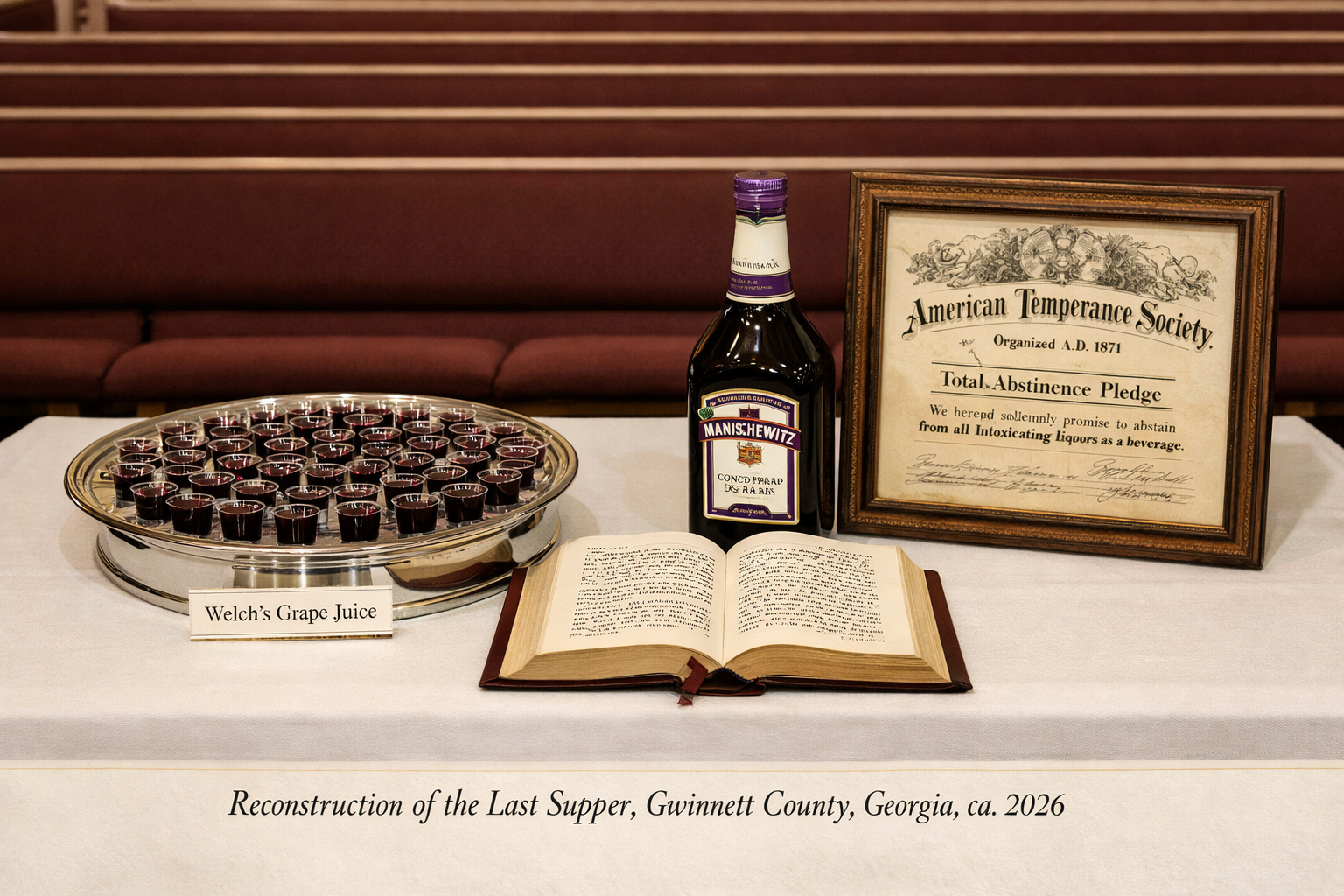
A Baptist pastor walks into a sermon about alcohol and emerges with Donald Trump, the Kennedy curse, a chatbot with opinions on sobriety, and a Two-Wine Theory that requires Jesus to have broken Passover tradition for the benefit of nineteenth-century American temperance activists. The Bible, as usual, had other plans …
Notes on a sermon delivered at Peachtree Road Baptist Church on 04/12/2026 The full sermon can be viewed on Youtube
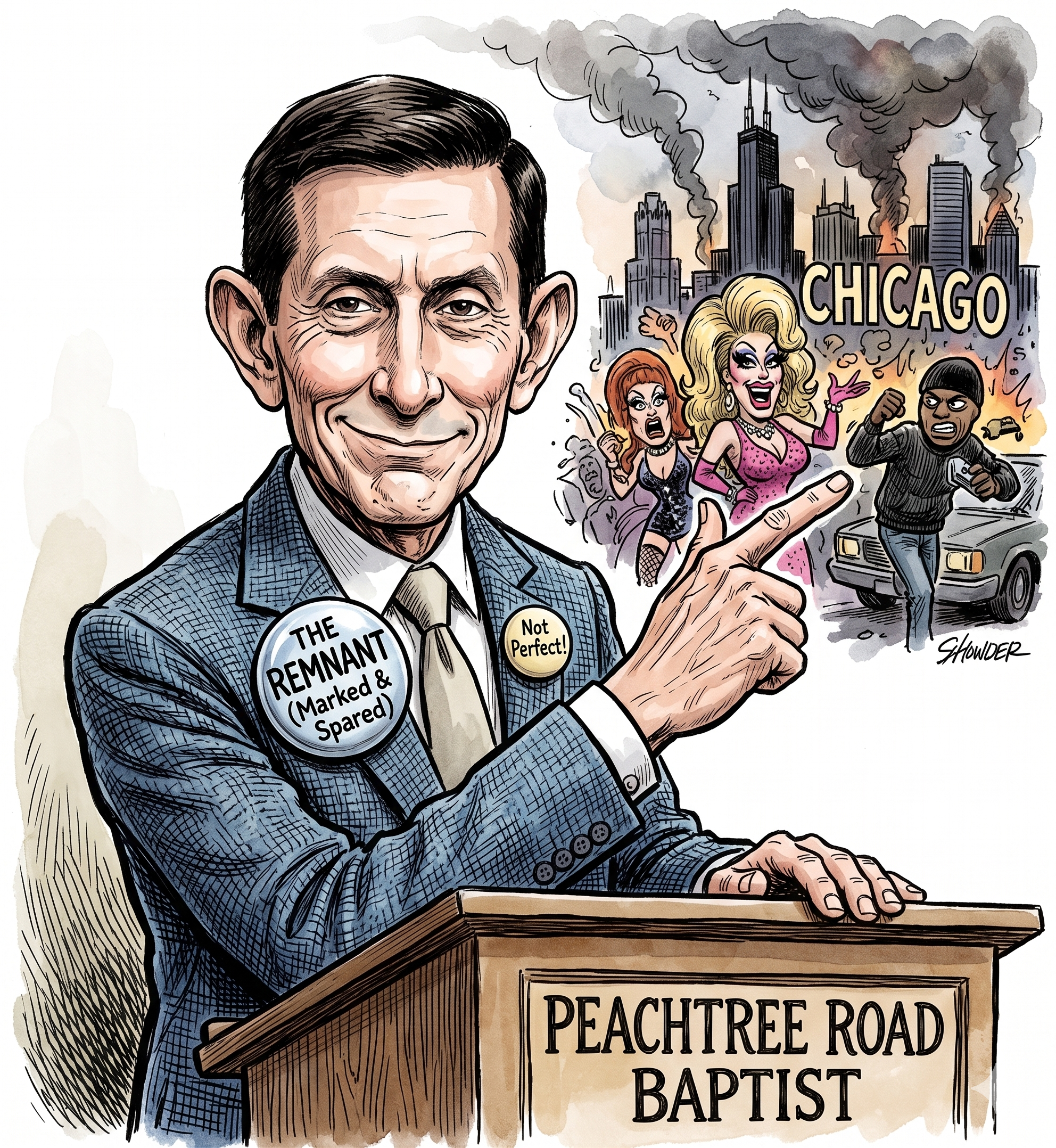
Let us begin with a brief orientation for those joining us for the first time. Peachtree Road Baptist Church is an Independent Fundamental Baptist congregation located in Gwinnett County, Georgia, in a suburb that looks exactly like every other suburb and contains a Chick-fil-A approximately every four hundred feet. The building itself is red brick with a white-shingled roof, a formal portico held up by four white columns, a central white door, and a two-tiered steeple with arched openings. The tall, narrow windows along the sides come to Gothic points, as if the architect were nodding at eight centuries of Christian architecture while keeping one eye on the HOA guidelines. It looks, in other words, exactly like what a church is supposed to look like; which is either reassuring or the first clue that you are dealing with a place that knows the value of looking the part. Inside, there is a coffee area. There are padded pews. There are men in suits and women in skirts and a general atmosphere of cheerful, decisive certainty about absolutely everything. The pastor is Jason Reed—Jay, to the congregation—a compact, square-jawed man whose preaching style sits somewhere between a high school football coach and a prosecuting attorney who has already decided you are guilty and is now simply laying out the paperwork.
I have been attending these services for some months now, in the capacity of what I can only describe as an interested naturalist. The fauna is consistent. The ecosystem is stable. And tonight, on the evening of April 12th, Pastor Jay has announced that we are going to deal with what he calls Third Rail Theology: The Big Three. Smoking, drinking, and gambling.
He will not get to smoking or gambling. He knows this going in. We all know this going in. Jay is, among his many qualities, a man who has never met a rabbit hole he didn’t want to live in.
On Drinking: A Sermon in Three Parts, None of Which Are Smoking or Gambling
Before the formal sermon begins, Jay is already warming up the crowd with what I can only describe as a motivational throat-clear. The Holy Spirit lives in you, he tells us, permanently and irrevocably. You cannot evict him. You are sealed. This is, for the record, a fairly mainstream Reformed-adjacent position on eternal security, and it is largely uncontroversial across conservative evangelical Protestantism. I note it because Jay is about to spend the next hour building an argument that is considerably less mainstream, and it is useful to know that we started in reasonable territory before we got on the train.
He pivots. We are going to talk about The Big Three. Smoking, drinking, and gambling. This was once understood, Jay tells us. In the golden era of Independent Baptist Christianity—which is apparently located at some point in the mid-twentieth century, the temporal equivalent of Narnia, always winter but also always a potluck—everyone simply knew that these things were wrong. You didn’t have to argue about it. The preacher said it; you said amen; we all went home.
He locates the decay. The modern church, he explains, “is for everything and against nothing.” Preachers trim the message because they fear losing the congregation. They serve the paymaster instead of the master in heaven. He produces 2 Timothy 4:3 — “for the time will come when they will not endure sound doctrine” — and invites us to write “that’s now” next to it in our Bibles.
I want to pause here and acknowledge the phenomenon Jay is describing is real. There is a category of ministry that has reduced the Christian faith to a self-help seminar with a cross logo, that has evacuated the concept of moral claim from the gospel entirely, and that has done so largely in the service of institutional growth. Joel Osteen exists. Jay Reed is not hallucinating.
This acknowledgment made, let us now watch what Jay does with it.
He is about to argue that the specific, correct response to the modern church’s spinelessness is to declare total abstinence from alcohol a biblical requirement. This is a position that is, as we will see, not quite what the Bible says, and one that requires a hermeneutical architecture of truly impressive ambition to sustain. He will use the church’s real failure as the launching pad for his own much more specific hobby horse. This is a rhetorical move sometimes called guilt by association, or more precisely, the motte-and-bailey fallacy: defend the reasonable claim (preachers should have moral courage) when challenged, but advance the controversial claim (all alcohol is sin) when not. We will see it executed in real time.
But first, we must briefly visit the celebrity endorsement portion of the evening.
“Our president obviously is no paragon of morality, but he figured that one out. His brother Fred was a drunk and wasted his life. They both had a huge inheritance from their father. One guy made a go of it pretty substantially and has been president twice, maybe three times depending on who counted the votes. And one guy died a drunk.”—Pastor Jay Reed
The moral witness Jay is invoking to open his sermon on Christian sobriety is Donald Trump. Jay is careful to note that the President is “no paragon of morality” — a caveat that is doing considerable heavy lifting, like noting that the Titanic had some lovely dining options — but the logic is clear: look at what happened to Fred, and look at what happened to Donald. One drank; one didn’t. The lesson is obvious.
Right?
What the Trump brothers demonstrate, at best, is that one Trump had an alcohol problem and one didn’t. What they do not demonstrate is anything about the theological status of moderate drinking, the spiritual condition of anyone who has a glass of wine with dinner, or the relative standing of teetotalers before God. But Jay needs a hook, and Donald Trump—minus the adultery, the fraud, the defamation, and the several dozen things Jay would presumably preach against if they showed up in his own congregation—is the hook he has chosen.
We proceed.
Wine is a Mocker, and So Is This Argument
Jay gets to the wine. He notes, correctly, that wine appears frequently in the Bible, and that “some people want to make wine universally alcohol.” He is going to offer an alternative.
The alternative is this: there are two kinds of wine in the Bible. One is fermented, alcoholic, and uniformly condemned. The other is “new wine”—fresh-pressed grape juice, the “blood of the grape”—and this is what is meant whenever wine appears in a positive or neutral context. When Jesus turns water into wine at Cana, he made grape juice. When Paul tells Timothy to take a little wine for his stomach, that’s medicinal grape juice. When Jesus drinks the fruit of the vine at the Last Supper, grape juice. Every good wine in Scripture is grape juice. Every bad wine is alcohol. The line between them is, conveniently, exactly where Jay needs it to be.
Let us now put on our reading caps on and look at this claim carefully.
The Two-Wine Theory has a proper academic name: the two-wine interpretation, and it was systematically developed in the nineteenth century, most prominently by a man named Dr. John Newton Brown and popularized by a physician named William Patton in his 1871 book Bible Wines. It was heavily promoted by the temperance movement and has been a staple of conservative Protestant teetotalism ever since. It is not, however, the consensus view of biblical scholarship, and the reasons why are not particularly obscure.
The primary word for wine in the New Testament Greek is oinos. This is the same word used when Paul warns against drunkenness in Ephesians 5:18. It is the same word used in 1 Timothy 3 when Paul says elders should not be “given to much wine” –which is a curious prohibition if wine is grape juice, since it would mean Paul is warning against drinking too much grape juice, which raises its own nutritional questions. It is the same word used in the wedding at Cana in John 2, where the master of the feast explicitly remarks that the good wine has been saved for last—odd praise for grape juice in an era before refrigeration. It is the same word used in 1 Timothy 5:23, where Paul instructs Timothy to drink a little wine for his frequent ailments—which is a peculiar medical recommendation if we’re talking about Welch’s.
The Hebrew word for wine in the Old Testament, yayin, appears about 140 times in the Hebrew Bible. It is used in both positive and negative contexts without any systematic distinction between fermented and unfermented versions. Proverbs 3:10 promises that the righteous man’s “vats will overflow with new wine.” Ecclesiastes 9:7 says “drink your wine with a merry heart, for God has already approved what you do.” The Psalms describe wine that “gladdens the heart of man” (Psalm 104:15). These are not presented as cautionary tales. They are presented as gifts.
Now, Jay does gesture at a distinction between yayin and terms like tirosh (often translated “new wine”) and suggests this is where the line lives. But this doesn’t hold either. The word tirosh — new wine — appears in Hosea 4:11, where the prophet says it “takes away understanding.” A depressant that takes away understanding is fermenting. The Jewish and early Christian world did not have refrigeration, pasteurization, sulfite additives, or any reliable means of preventing the natural fermentation of grape juice, which begins within hours of pressing. The idea that the ancient near east had a functioning supply chain for non-alcoholic grape juice is, to be very gentle about it, a wish rather than a history.
Jay is aware that the Cana problem is a problem. He deals with it by going to Matthew 26, where Jesus at the Last Supper says he will not drink “this fruit of the vine” until he drinks it new in the Father’s kingdom. Jay reads “fruit of the vine” as meaning unfermented grape juice, and “new” as clinching it. But the phrase fruit of the vine was a standard liturgical term for wine in the Passover seder, which is the meal Jesus is conducting. The Passover required wine. The Mishnah (rabbinic codification of Jewish law) specifies that the four cups of the Passover seder must be wine that has “the appearance of wine,” meaning red and fermented. Jesus was a practicing Jew observing the Passover. To argue he replaced the Passover wine with grape juice is to argue he broke with the explicit requirements of the Passover he was celebrating in order to accommodate an American temperance movement that would not exist for another eighteen centuries.
“I am just baffled beyond measure why Christians would want to make Jesus a bartender in order to justify their liquor.”—Pastor Jay Reed
I want to offer a counter-framing: I am bemused beyond measure why a pastor would prefer to make Jesus a man who broke with his own religious tradition, confounded his first-century Jewish audience, and retroactively required grape juice refrigeration rather than simply acknowledge that the Bible condemns drunkenness without condemning moderate consumption. Because that is, in fact, what the Bible does.
Ephesians 5:18, the verse Jay returns to repeatedly as his knockout punch, says: “Be not drunk with wine, wherein is excess, but be filled with the Spirit.” The word for drunk is methusko — to get drunk, to intoxicate. The prohibition is on drunkenness and excess. If Paul had meant to prohibit all alcohol, the word he would have used is oinos — don’t drink wine at all. He did not use it that way. He said don’t get drunk. These are not the same instruction, and the difference matters.
But Jay needs them to be the same instruction, and so he reads every positive biblical reference to wine as grape juice and every biblical warning about drunkenness as a warning about the beverage itself rather than its misuse. This is called eisegesis — reading into the text what you need it to say, rather than reading out of it what it actually says.
Habakkuk 2, Or: Offering Someone a Drink Is a Sex Crime
Jay visits Habakkuk 2:15 at some length. Let’s read it with him.
Woe unto him that giveth his neighbor drink, that putteth thy bottle to him, and makest him drunken also, that thou mayest look on their nakedness.
Jay reads this as a general condemnation of offering anyone alcohol.
“You can see why people make other people drink,” he observes. “You want to get them drunk that you may look at their nakedness. How much immorality is going to happen because of liquor?”—Pastor Jay Reed
Let’s pause and read the verse again. The verse says: woe to him who gives his neighbor drink that thou mayest look on their nakedness. The sexual predation is not incidental to the condemnation — it is the specific act being condemned. The prophet is describing someone who deliberately intoxicates another person in order to sexually exploit them. This is not a verse about having a beer with dinner. This is a verse about what we would now call drug-facilitated sexual assault.
Jay has taken a verse condemning predatory intoxication-for-exploitation and applied it to anyone who “makes other people drink.” Under this reading, the sommelier at a restaurant is in Habakkuk 2 territory. The host who offers wine at a dinner party is in Habakkuk 2 territory. The bride’s family who provides a wine bar at the reception is, according to the implicit logic here, facilitating the conditions for sexual predation.
This is not what the verse says. Not even approximately. To read Habakkuk 2:15 as a blanket condemnation of offering anyone a drink is to do the same thing to prophetic literature that you’d do to a restraining order if you used it to argue against all human proximity.
The Mr. Ed Satanic Conspiracy, A Short Detour into Backmasking
I want to be transparent that what follows is not something I am making up.
Jay is discussing Habakkuk 2 and the relationship between alcohol and sexual immorality, and the transition to his next point involves country music. He observes that if you removed all songs about alcohol and immorality from country music, it would cease to exist. Fine. Broadly defensible. And then, he pivots to backmasking.
Backmasking, for those unfamiliar, is the practice of embedding a message in a recording that can only be heard when the recording is played in reverse. It became a minor cultural panic in the late 1970s and early 1980s, when concerned Christians began playing Beatles and Led Zeppelin records backwards and discovering Satanic messages, which they then played at church presentations as evidence of occult infiltration of popular music. The scientific and musicological consensus on backmasking is that human pattern-recognition is extremely good at finding meaningful sounds in noise, particularly when primed to look for them. That’s the same cognitive mechanism that lets you see faces in clouds.
Jay tells us that the Mr. Ed theme song, played backwards, says: “worship the devil every day, give him money from your pay.” He tells us a Beatles song — he thinks it’s “Number Nine” — played backwards says “smoke marijuana.” And then he delivers the punchline: when you play country music backwards, “you get your truck back, your dog back, your girlfriend comes back and you stop drinking.”
“That was a lot of setup for not much payoff.”—Pastor Jay Reed
No kidding. I don’t have a problem with his lame joke. My problem happened forty-five seconds before, in which Jay presented Mr. Ed backmasking as though it were a relevant data point in a sermon about alcohol. And a fact. It is neither. The Mr. Ed backmasking claim has been investigated and debunked. The Beatles “Number 9” reversal does produce sounds that some people hear as “turn me on, dead man,” which became part of the Paul-is-dead conspiracy theory, but this is auditory pareidolia rather than intentional encoding. And none of this has anything to do with whether Christians should drink wine.
I note it because the backmasking detour is a micro-demonstration of the sermon’s overall epistemological method: grab anything in the cultural vicinity of the argument; a presidential family anecdote, a 1980s Satanic panic legend, a country music joke, and let the accumulation create an atmosphere of danger. The specific claims do not need to be logically connected. They need to feel connected. This is argument by vibes, and it is, by this point in the sermon, running at full production capacity.
Thus Saith the Chatbot
Jay tells us he has statistics. Over two and a half million people killed each year in alcohol-related incidents. 137 people per state per day. More than all American combat deaths combined across every war from the Civil War through the War on Terror. The annual cost to taxpayers: $249 billion. Fifty percent of divorces have an alcohol component. Eighty percent of child abuse cases involve alcohol. These are sobering numbers, if you’ll forgive the word.
And then he says this:
“I didn’t make these statistics up. I went and asked one of the AI to give me the statistics. So maybe gemini was lying to me because it really doesn’t like to drink. I don’t know.”—Pastor Jay Reed
Jay Reed has sourced his sermon statistics by asking an AI chatbot for them. He is aware that this is not a conventional citation method, which is why he immediately speculates that the AI may have fabricated them. But he helpfully explains that the AI probably didn’t, because it really doesn’t like to drink.
Lookit: your AI does not have opinions about drinking. Large Language models (aka “Ai”) processes text and generates responses. It does not hold a position on anything.
But more importantly: Jay has identified a potential reliability problem with his source, resolved it by attributing consistent teetotalism to a language model, and then proceeded to use the statistics as sermon content. We have now arrived at a moment where the chain of authority runs: God → Scripture → Pastor Jay → ‘one of the AI’ → statistics Jay suspects may be fabricated → your soul.
How do the actual statistics hold up? The global mortality figure from the World Health Organization is approximately three million alcohol-attributable deaths per year worldwide, so Jay’s 2.5 million figure is in the ballpark for global deaths, though it’s not a U.S.-specific figure. The $249 billion cost figure appears to come from CDC estimates for the economic cost of excessive alcohol use in the United States, which is real, though it includes productivity losses and healthcare costs rather than being purely a taxpayer burden. The divorce and child abuse percentages are frequently cited in addiction literature, though the causal relationships are complex and the specific percentages vary by study.
In other words: the statistics are roughly defensible. They are also deployed in a maximally emotional register designed to do something other than inform. The structure is: here is a catastrophic number, here is what it means for your family, here is God’s judgment. The statistics are not doing epidemiological work. They are doing atmospheric work. They are meant to make you feel that any engagement with alcohol at all is standing next to a live grenade, and the only reasonable response is to never enter the room.
Joe Kennedy Is Why Teddy Drank
We are now in the final act, and Jay has chosen to close with what I can only describe as a fully developed theology of dynastic divine retribution.
“Can you say the Kennedy family? They’ve got all the money in the world, but they keep dying like flies in terrible ways. Why? Because Joe Kennedy was pushing alcohol across the border of Canada in the United States during Prohibition. He was putting the bottle to his neighbor’s lips and God has cursed that family. John dead. Teddy drunk. I mean, how many of them have to get killed and drunk? One of them skis into a tree while skiing and kills himself. It just goes on and on.”—Pastor Jay Reed
So the Kennedy family’s misfortunes—JFK’s assassination, Ted Kennedy’s alcoholism and the Chappaquiddick incident, Michael Kennedy’s 1997 skiing death—are the result of God’s curse on Joseph Kennedy Sr. for bootlegging during Prohibition. This is a causal theological claim: Joe Kennedy sold liquor; therefore God killed his descendants.
Let us begin with the factual scaffolding. The claim that Joseph Kennedy Sr. was a major Prohibition-era bootlegger is, despite its ubiquity in American popular mythology, largely unsubstantiated. Historians have not found credible evidence that Kennedy was a major bootlegger. The story appears to have been circulated largely by political opponents and was repeated so often it became received wisdom. Kennedy did move into legitimate alcohol importation immediately after Prohibition ended in 1933, but this is not evidence of prior bootlegging. It is evidence of being organized. The bootlegging story is, in the historiographical literature, a legend.
But set that aside. Even if Joe Kennedy had been the greatest bootlegger in American history, the theological claim Jay is making is staggering in its implications. He is asserting that God visits the sins of the father upon the children. He’s saying JFK was shot in Dallas in 1963 because his father had sold liquor in the 1920s. That Michael Kennedy died in a skiing accident in 1997 because of his grandfather’s business activities nearly seventy years earlier.
This is a Bronze Age understanding of collective guilt that the New Testament explicitly addresses. Ezekiel 18—which Jay does not visit tonight—is an extended prophetic polemic against exactly this idea. “The son shall not suffer for the iniquity of the father, nor the father suffer for the iniquity of the son.” Ezekiel 18:20. John 9, when the disciples ask Jesus whether a man’s blindness is punishment for his own sin or his parents’, Jesus says: “Neither this man nor his parents sinned.” The idea that Michael Kennedy skied into a tree because his grandfather smuggled liquor is not Christian theology. It is folk superstition with a Bible verse stapled to it.
If Jay’s theology is correct; if God visits misfortune on the families of those who profit from alcohol, then the logical reach of this principle is extraordinary. The United States alcohol industry employs roughly four million people. Tens of millions more work in hospitality, retail, transportation, and agriculture that touch the alcohol supply chain. If God is in the business of cursing the descendants of those who profit from liquor, he has a very full calendar. Jay’s congregation presumably does their grocery shopping at stores that sell wine. Does the Kroger cashier need to worry about their grandchildren?
He does not engage this implication. He was not going to. The Kennedy curse is a campfire story, not a biblical argument, and it is doing what campfire stories do: making you feel the dark outside the light.
Jay Reed’s Worldview: Love it or Leave it
Jay closes with an invitation. Young people: commit to purity from alcohol. Parents: keep it out of your home. And then the announcement:
“If you think that liquor is okay, you’re in the wrong church. I love you, but you’re in the wrong church. You need to repent or get gone. Period.”—Pastor Jay Reed
There it is.
Not: if you are struggling with alcohol addiction, please come for help. Not: if you are in the grip of alcoholism, this community wants to walk alongside you. Not even: if you are engaging in behavior the Bible prohibits, we want to talk about that.
If you cannot make the Bible say what Jay decided it says, if you have read the scholarship, examined the Greek, looked at the Passover context, and concluded that the New Testament condemns drunkenness but does not prohibit wine—then you do not belong here. The price of membership is not behavioral abstinence; it is intellectual submission to an interpretation that the majority of Christian history has not held.
To be very precise about what mainstream Christian tradition has actually said: the Roman Catholic Church has never prohibited alcohol. The Orthodox Churches have never prohibited alcohol. The Anglican Communion has never prohibited alcohol. The Lutheran church has never prohibited alcohol. The Presbyterian and Reformed traditions, which have produced some of the most rigorous biblical scholarship in Protestantism, have never prohibited alcohol. John Calvin drank wine. Martin Luther brewed beer. Charles Spurgeon smoked cigars and on at least one occasion referenced alcohol without condemning it. The total abstinence position has been a minority view in Christian history, most prominently associated with nineteenth-century American revivalism and the temperance movement, which was itself a response to genuine social devastation caused by alcohol abuse in industrializing cities.
Jay is not preaching the Christian position on alcohol. He is preaching an unbiblical Christian position on alcohol. And specifically, he’s arguing a nineteenth-century American revivalist position while presenting it as though the alternative is to be a drunkard who has chased the Holy Spirit out of his life with liquor. This is a false binary. It is his favorite trick: remove the middle ground, put the congregation on one side or the other, and make sure your side is the one God is on.
“Why is it happening? Because the church won’t stand up against it anymore. There was a time when the church beat the drum for temperance and now the preachers are drinking and the members are drinking.”—Pastor Jay Reed
The it that is happening is this: there are liquor stores in Suwanee, Georgia. There is one to the north of Interstate 85 and one to the south. Jay finds this remarkable. He wants us to understand that the existence of these liquor stores is a consequence of the church’s failure to preach against alcohol.
I want to submit, with complete gentleness, that this is not how liquor stores work.
Liquor stores exist in Suwanee because Georgia law permits them, because consumer demand supports them, because the alcohol industry is a legal and regulated trade in a free-market economy, and because people make purchasing decisions for a wide range of reasons that are not meaningfully related to the position of local Baptist pastors on the Two-Wine Theory. The causal chain Jay is describing — church preaches temperance → fewer liquor stores — has no empirical support. The American South, which has historically contained the highest concentration of temperance-preaching evangelical churches in the nation, has not on that account been a dry landscape. Mississippi, which was the last state to end statewide Prohibition, did so in 1966, and did not do so because the Baptist churches stopped preaching. It did so because the voters voted.
The idea that the moral culture of a pluralistic, secular democracy is primarily shaped by what is preached on Sunday mornings in Independent Baptist churches is a flattering thought for Independent Baptist pastors. It is not, however, a thesis with strong supporting evidence.
What Jay is actually doing in this moment — and throughout this sermon — is a move we see every week from his pulpit: converting the normal operations of a secular society into evidence of spiritual catastrophe, and positioning the church as the only institution that stands between the congregation and total moral dissolution. It is another fortress-building exercise. It makes the church feel necessary in a way that it perhaps does not feel on Tuesday afternoons. And it does so by making the world outside feel maximally threatening.
There are liquor stores in Suwanee. There are also Ethiopian restaurants and Diwali celebrations and LGBTQ-affirming congregations and a Sikh gurdwara and a mosque. The world outside Peachtree Road Baptist Church is plural and various and not, on the whole, organized around the question of what Pastor Jay thinks about it. That is, depending on your theology, either terrifying or simply the condition of being human in the twenty-first century.
Jay finds it terrifying. I find it Tuesday.
Final Note: On What Was Actually True Tonight
Alcoholism is a genuine public health problem. Its costs are real. Its devastation to families is real. The courage it takes a young person to decline a drink in a social situation where everyone else is drinking is real and not nothing. The instinct to protect children from a substance that has destroyed many lives is not a bad instinct.
But here is what Jay did with those real things tonight: he took them and used them to smuggle in a theological position the Bible does not clearly support, expel from his congregation anyone who disagrees with that position, attribute the Kennedy family’s tragedies to divine retribution for bootlegging, source his statistics from an AI he suspected of bias, and argue that the existence of liquor stores in Suwanee is the church’s fault.
The problem with this sermon is not that Jay cares about the damage alcohol does. The problem is that he cannot distinguish between that genuine care and the ideological architecture he has built around it. The architecture requires the Two-Wine Theory to be true. It requires the Kennedy Curse to be real. It requires anyone who reads Ephesians 5:18 differently to be in the wrong church. And it requires the stakes to be so high — your soul, your family, your nation, the liquor stores multiplying like kudzu up and down I-85 — that no one stops to ask whether the structure holding all of this up is sound.
It is not sound. And if you believe Jesus and the disciples drank grape juice at passover, I have a bridge to sell you.
The Standard Berean attends services at Peachtree Road Baptist Church in Gwinnett County, Georgia. All quotations are from the sermon transcript of April 12, 2026, PM service. If you are dealing with alcohol addiction or supporting someone who is, SAMHSA’s National Helpline is available 24/7 at 1-800-662-4357.




Leave a Reply