Notes on a sermon delivered at Peachtree Road Baptist Church on 05/10/2026 The full sermon can be viewed on Youtube
It is Mother’s Day at Peachtree Road Baptist Church, and Pastor Jay Reed has arrived at the pulpit with what he describes as his annual burden: finding something inspiring to say about motherhood.
He opens with a greatest hits of parenting clichés. The sleepless nights. The terrible twos. The why why why why why that apparently spans thirteen years of childhood. He notes, correctly, that there are essentially no good Mother’s Day hymns. He invokes Mr. T’s Mother’s Day song on YouTube and Curly from the Three Stooges as the genre’s two exemplars. These cultural touchstones are offered with the unearned confidence of a man whose entertainment lexicon calcified sometime around 1987.
Then Reed tells us where he is preaching from today. Job, chapter two. Specifically, the verses where Job’s wife looks at her husband and says: Curse God and die.
He titles the sermon “Remember Job’s Wife” — a deliberate echo, he acknowledges, of Jesus’s two-word instruction in Luke 17: “Remember Lot’s wife.” It’s a reasonable structural borrow, except that “Remember Lot’s wife” works because the text gives you something specific to remember. She looked back. Don’t do that. The instruction is self-contained.
“Remember Job’s wife” has a problem. The only thing the text gives you to remember about Job’s wife is the one thing Reed is about to spend considerable effort asking you not to hold against her. Which means the title is, at this moment, essentially a promissory note — a heading in search of content. Reed is about to spend an hour filling it. We are about to watch him do that.
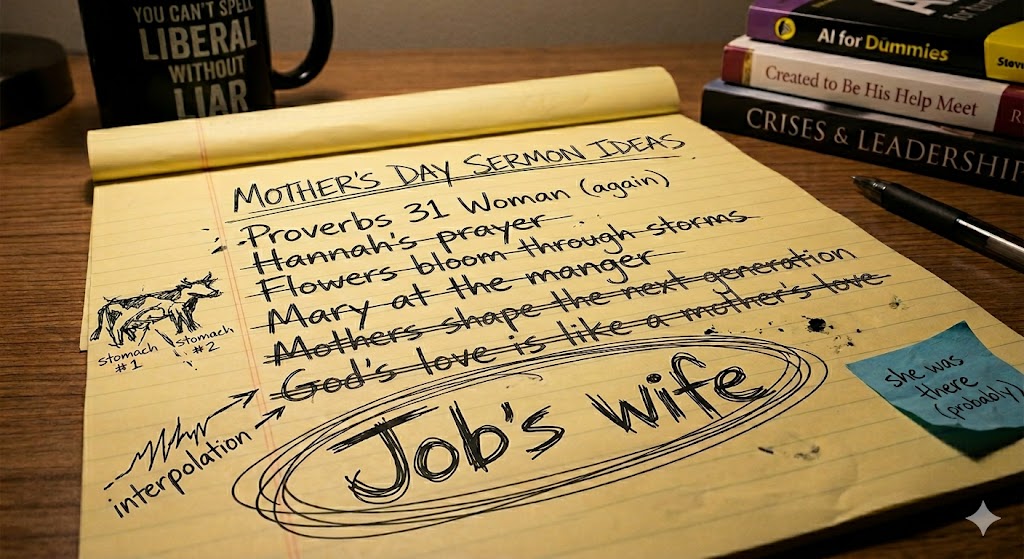
Before he begins in earnest, he names what he’s doing, and the name he gives it is worth pausing on. Reed calls it “interprolation” — a portmanteau, apparently accidental, of interpolation and extrapolation — which he defines as: “you get a point here and you get a point here and then you draw that line out beyond.” He immediately corrects himself to “interpretative,” but “interprolation” is, I would argue, the more honest word. It is going to do a lot of heavy lifting in this sermon.
“We may find out in a minute why that’s true.”—Pastor Jay Reed
I wistfully eye the door. But it’s too late to escape now.
Reed’s self-deprecating expectation management is an all too familiar trope at this point. He tells the congregation his approach will be “a little bit esoteric, a little left fieldish,” and pre-emptively instructs them not to “sigh and fold your arms” when the logic gets difficult, and specifically not to let anyone know if they can’t follow him — “you can do that in your inside the head voice.”
And then, having constructed this entire elaborate disclaimer, Reed does something equally characteristic: he dismantles it himself.
“I really think honestly, that that’s a lot of qualifying. That is a lot of front-end apologizing for what I don’t think you’ll need.”—Pastor Jay Reed
(A brief, entirely unrelated note: covert narcissism, as distinct from its more theatrical cousin, is characterized by a particular sensitivity to criticism, a tendency to pre-empt negative feedback by framing scrutiny as a social faux pas, and a pattern of positioning intellectual self-indulgence as courageous risk-taking. I mention this for no reason at all. Carry on.)
So now we know what to expect, let’s get into it.
The Plane of Possibility (And the Scenery It Invents)
We already met “interprolation” in the disclaimer — that accidental portmanteau Reed coined, corrected, and then quietly put back to work. Now he deploys it formally, and it is worth watching how he does this, because the methodology is going to carry the entire structural weight of everything that follows.
Reed defines “interpolation” as drawing a line between two known points and extending it into unknown territory — in his words:
“You get a point here and you get a point here and then you draw that line out beyond and you’re saying, all right, you’ve created a plane of possibility.”–Pastor Jay Reed
He presents this as a legitimate hermeneutical method. A way of reasoning from what we do know about Job’s wife toward what we can reasonably infer.
In standard mathematics, interpolation estimates unknown values that fall between two known points. You have a measurement at A. You have a measurement at B. You make a reasonable inference about the space between them. What Reed is describing — extending the line beyond the known points into uncharted territory — would be more accurately called extrapolation. This is very important, because interpolation carries an implicit constraint: you stay between the data. Extrapolation carries no such guardrail. The further you extend the line from the last known point, the more any small error in your original angle compounds. Extend it far enough, and you can end up anywhere.
Reed then tells the congregation that what follows is “biblically accurate and supported by biblical principle,” while acknowledging there will be “a fair amount” of this extended projection. He says he wouldn’t do it if he thought it was “a straight-up pretext.”
Here is what the method produces in practice: Job’s wife speaks five words. The text tells us nothing else about her character, her domestic habits, her spiritual life, or her interior experience at any point before, during, or after the catastrophe. So Reed now fills that silence with a complete biographical portrait — her virtues, her household contributions, her spiritual arc, her ultimate restoration — none of which exists in the text. The “plane of possibility” turns out to be quite generously sized.
In the spirit of intellectual honesty, let us try the methodology ourselves.
We know Jay Reed owns a suit. We know he has access to a Bible concordance. We know the concordance has a J section. Drawing our line out beyond these known points, into the plane of possibility they create, we can construct the following scene with full pastoral authority: It is 9:47 p.m. on a Saturday. Jay Reed is in his study. He has a yellow legal pad. He has written “Mother’s Day” at the top and crossed out thirteen things beneath it. He writes “Job’s wife.” He stares at it. He writes a question mark. He crosses out the question mark. This is his plane of possibility. This is his sermon.
I wouldn’t put this forward if I thought it was a pretext. I’m just “interprolating.”
But as usual, the major problem here is not the methodology. The problem is what Reed does with it.
He begins reasonably, by arguing that Job’s wife’s one recorded moment should not define her. That it is unfair to reduce a person to their worst sentence and that she deserves to be remembered as more than five desperate words spoken in grief.
Then he spends the next hour defining her entirely, through a story he has decided to write himself.
Where Did She Go?
Before Reed can build his biographical portrait of Job’s wife, he needs a foundation to build it on. And here, I will give him credit: he finds the most emotionally effective argument available to him.
“She was there.”—Pastor Jay Reed
Reed repeats this four times in quick succession. She was there through the years of blessing. She was there through Satan’s unparalleled attack on one family. She was there through the aftermath of losing everything. She was there through the return to blessing.
“Witness to it all…joined with Job in the incredible highs and the unfathomable lows that was their life.”—Pastor Jay Reed
It is an evocative image. A woman standing at the edge of a crater that used to be her life, present for every moment of both the abundance and the annihilation.
But is it Biblical?
The problem is that “she was there” is not an argument. It is an assertion—and the Bible does not actually make it.
Job’s wife appears in the narrative exactly once, in chapter two, to deliver her five infamous words. She is not named. She is not described. She is not mentioned in the prologue, where Job’s household is introduced and his children are catalogued. She does not appear in the epilogue, where his restoration is recorded.
Reed’s “she was there” assumes that the unnamed woman who says “curse God and die” in chapter two is the same woman who bears ten replacement children in chapter 42. The text does not say this. To a modern reader—or even to someone whose cultural reference points calcified around 1987—the assumption might feel self-evident. Of course it’s the same woman. Who else would it be?
The answer, in the historical and cultural context of the ancient Near East, is: several plausible candidates.
Job was a wealthy patriarch in a world where polygamy was not merely tolerated but unremarkable among men of his social standing. The text does not establish that Job was monogamous. Given the time, the culture, and the scope of his documented wealth, a single wife would have been the exception rather than the rule. But even setting polygamy aside entirely: the Bible does not confirm Job had any continuous marital relationship across the full span of the narrative. He could have been widowed. He could have remarried. The silence is total, and it runs in every direction.
This matters more than it might seem, because “she was there” is the connective tissue of Reed’s entire sermon. Remove this assumption and the arc collapses. You cannot track one person’s journey from prosperity through catastrophe to restoration if you cannot establish it is the same person at each waypoint.
What Reed has done is make his most consequential interpretive move before the sermon formally begins. He has assumed a continuous subject. He has assumed monogamy across an unspecified time span in the ancient Near East. He has assumed that the silence between chapter two and chapter forty-two represents the same person waiting offstage — rather than, more plausibly, the text’s complete loss of interest in her.
“She was there” is the foundation of the house. And it is, like everything Reed will build on top of it, something he brought to the text rather than something he found there.
The Domestic Elevation Hallucination
Reed’s first move is to rehabilitate Job’s wife. This is actually a sympathetic impulse, and the core of it is defensible: the woman has been remembered for 3,000 years for five bad words spoken at the worst moment of her life, and that is genuinely unfair. Job himself, Reed points out, says things he later has to repent of in dust and ashes. The text is harder on Job’s three verbose friends than it is on his briefly terrible wife.
Unfortunately, rehabilitating Job’s wife requires Reed to construct her from nothing.
What the Bible tells us about Job’s wife before chapter two: nothing. She is not mentioned. She has no recorded words, actions, attributes, or opinions prior to her appearance in the disaster narrative. She is, textually speaking, a blank.
A blank, it turns out, is exactly what Reed needs.
“Wives are the driving force behind better marriages. Wives help men to become better fathers… Mothers create the gravity of a family.”—Pastor Jay Reed
Reed tells us Job’s wife was the “driving force” of the marriage. She was the “beating heart” of the home. She was the gravitational center that held the family together. She contributed to Job’s own spiritual character. She was the architect of the family’s closeness. She was possibly a financial contributor. She was, in short, the Proverbs 31 woman, retroactively installed into the book of Job by pastoral executive order.
Every single one of these attributes is invented. Not inferred from the text. Not supported by the text. The Bible does not say any of this. Reed says it, then preaches about it, and calls it biblical because he found her name in the Bible.
Reed also introduces, at this point, what he calls the “joy bank.” The idea is that during good seasons, you should “squeeze a little extra out of it” — emotionally, spiritually — and “file a little bit away,” so that when the bad times come, you can draw on those reserves. He even reaches for a ruminant metaphor:
“It’s kind of like a cow, you know, they don’t get everything out of the grass the first time. They have to put it in stomach number one and then chew a little bit more.”—Pastor Jay Reed
So if joy is a savings account, then Job’s wife’s breakdown in chapter two is, at least implicitly, a budgeting failure. She didn’t ruminate enough in the good years. She was, spiritually speaking, overleveraged. She presented herself at the window of her joy bank at the worst possible moment and found the account insufficient.
The Book of Job, of course, contains not a single verse suggesting that any of this is true. What the text offers is that a woman lost everything in a matter of days, as the result of a celestial wager she had no knowledge of and no say in. The text suggests she was at the epicenter of a catastrophe of divine permission. What Reed’s framework suggests is that she might have made it through with better emotional preparation.
These are different claims. Only one of them is in the book of Job.
The Sanctification of Tribulation Silence
Finally, we arrive at the actual text.
“Then said his wife unto him, Dost thou still retain thine integrity? curse God and die.”
This is, in the original Hebrew, a painful line. The word translated “curse” (bārēk) is, with magnificent irony, the same word typically translated “bless” — a scribal euphemism so uncomfortable with what it was recording that it replaced the profanity with its opposite. Even the people who wrote the text down couldn’t quite bring themselves to write it straight. This woman’s grief was so unacceptable that the manuscript tradition softened it.
Reed does not go here. Reed goes instead to Job’s response — “Thou speakest as one of the foolish women speaketh” — and uses it as character evidence. Job’s rebuke, he argues, implies that this was out of character for her. “That’s not my wife,” Reed ventriloquizes tenderly:
“My wife doesn’t talk like one of the foolish ones.”—Pastor Jay Reed
Let’s recap because I want to make sure Reed’s scriptural line edits haven’t confused you.
Reed argues that Job’s wife’s “curse God and die” was “out of character” for her, and he knows this because of Job’s rebuke. Job says she is speaking “as one of the foolish women.” Reed interprets this to mean she was normally not foolish — that the rebuke is evidence of prior excellence.
So, if I say to someone, “You’re acting like a fool,” what I have established is: I think they are currently acting like a fool. What I have not established is their baseline intellectual or spiritual capacity. The rebuke tells us Job was hurt, or angry, or disappointed. It does not tell us what she was like on any of the days before this one.
Using Job’s pained rebuke of his wife’s statement as a certificate of prior virtue is a stretch. Using it as the foundation for a fifteen-minute meditation on her excellent pre-tragedy character is the stretch drawn out beyond into a plane of possibility that the geometry of the text simply cannot sustain.
But the more significant moment in this section is what Reed does with her subsequent silence — and here, briefly, the sermon becomes something else entirely. Reed mentions that when his own daughter was gravely ill, he watched other parents exhaust their children with experimental treatments because they needed to do something. “Sometimes there’s nothing to do,” he says. “Sometimes there’s nothing to say.”
He is right about this. And the fact that he clearly knows it from a devastating lived experience makes it the most valuable thing he says in seventy-six minutes.
The problem is what he does with it next.
Personal suffering is not a hermeneutical method. Grief is not exegesis. The hardest-won wisdom about what it feels like to sit in the ash pile does not tell us what Job’s wife thought, said, felt, or became. Reed’s loss is real. The silence he learned from it is real. The woman he is projecting that silence onto is not.
After her one recorded statement, Job’s wife disappears from the text. Reed interprets this disappearance as spiritual achievement:
“She learned…sometimes there is nothing to say.” —Pastor Jay Reed
He presents her quiet as a model of dignified endurance — earned through suffering, superior even to Job’s own twenty-plus chapters of anguished argument.
“Here’s what she would tell us. Now, she could come back. She would say this, ‘Be still.’… Be still… be quiet. Sometimes he speaks in a very still in a very small voice. And if we’re not careful, if we’re not quiet, we’ll miss it.”—Pastor Jay Reed
What Reed has done here is mistake the narrator’s erasure for the character’s wisdom.
Job’s wife goes silent in the text because the text stops caring about her and because ancient Near Eastern narrative literature was not, broadly speaking, interested in women’s sustained interiority. She is not quiet because she achieved enlightenment. She is quiet because the camera moved.
There is, in fact, a verse that Reed does not visit: Job 19:17, in which Job says that his breath “is strange to my wife.” In context, this appears to mean she has become physically repulsed by him — that she has withdrawn, estranged, stepped back from the marriage entirely. The text that Reed is reading does not feature a woman who found peace and waited on God. It features a woman who may have, entirely reasonably, checked out.
Reed’s reading is certainly imaginative. It is also, conveniently, the only one that makes the sermon work.
The Arithmetic of Grief
Before we proceed, I want to remind you of something.
This is a Mother’s Day sermon.
There are women sitting in this room who have lost children. Who are estranged from children. Who are sitting in the complicated, unresolvable grief of loving someone they cannot reach or cannot keep. Reed has selected for these women, as his climactic movement, the part of the Job story where God gives the bereaved mother ten replacement children.
Job 42 records that in his restoration, Job fathered ten more children. Reed tells us that Job’s wife “traveled to the delivery room ten more times” and that this proves she “mended her relationship with God” — because, the argument goes, God would not have blessed her with children if she were still bitter. There is just one problem with this.
Job 42 does not mention Job’s wife. At all. She is not in the restoration chapter. Her name does not appear. Her womb is not referenced. Her spiritual state is not assessed. The chapter that is supposed to prove her restoration does not acknowledge her existence.
Reed presents this as settled pastoral fact. He does so with the quiet authority of a man reading from a chapter that says what he is telling you it says. It does not.
Then there is the math.
Reed calls the ten new children a “sweet place to end.” He holds them up as the resolution — proof that God blesses faithfulness and that suffering is not permanent. But he also says, in the same breath, that “there were still ten graves.” That she “never got those kids back.”
“You can get money back. You can get possessions back. You can get your health back. She never got those kids back.”—Pastor Jay Reed
And then, immediately:
“Some people can never fully allow the blessing of God in their life because they can’t get over what has already happened.”—Pastor Jay Reed
The progression is worth diagramming:
- God blessed Job’s wife with ten new children.
- This proves she released her bitterness.
- If the “other side” hasn’t arrived for you yet, you may still be “gripped by bitterness.”
- The burden of your unresolved trauma is, at least in part, a you problem.
The ten original children have become, in Reed’s framework, spiritual ledger items — losses that the sufficiently faithful will eventually balance out. What this framework cannot accommodate is the mother for whom there is no double portion. No ten new children. No “sweet place to end.”
Reed does not ask what his theology says to her. The question would dismantle the architecture of his third point entirely, so it goes unasked. The women in that room for whom grief has not resolved into blessing received, on Mother’s Day, a framework that quietly reframes their unresolved suffering as a posture problem.
This is the cost of Reed’s interprolation fan-fiction. He began by filling a textual silence with a character he needed. He ends preaching that character’s invented restoration as a template for the living — in a room full of people whose losses are not literary, whose children are not going to be replaced by the end of the chapter, and whose grief does not resolve because the narrative requires it to.
This is not merely the “esoteric” or “left-fieldish” interpretation we were told to expect. When invented scripture is used to instruct grieving women that their inability to “allow the blessing of God” is the obstacle standing between them and their healing, that is a harm. This sermon is harmful. I want to be plain about that.
The fact that Reed’s pastoral concern for the suffering women in that room appears entirely sincere, makes it not less troubling, but more. As it is also another example of Reed’s particular brand of theological and scriptural inversion.
The Book of Job is, at its core, a sustained argument against exactly this theology. Job’s three friends spend thirty-five chapters insisting that his suffering must be legible, must be deserved, must resolve into a lesson about what he did wrong or failed to do right. God, at the end, rebukes them for it. He does not rebuke Job.
Reed has spent the last hour preaching the theology of the three friends and calling it the wisdom of the wife.
All Roads Lead to the Same Altar
Reed has one more move, and it is the most predictable.
He picks up Job 19:25 — “I know that my redeemer liveth” — and pivots to an altar call. If you have attended a Sunday service at Peachtree Road Baptist Church, or any IFB church, you have seen this exit ramp. Whatever the sermon’s stated destination, it always ends here.
“The Redeemer” (Hebrew: goel) is a word I’ve discussed before (funnily enough, in a sermon where Reed gave Biblical Ruth a very similar treatment to the one Job’s wife received this morning). Goel has a specific legal meaning in the ancient Near East. A goel was a kinsman-redeemer — a family member with both the right and the obligation to buy back a relative who had fallen into debt-slavery, to avenge a wrongful death, to restore property that had been lost. When Job demands his goel, he is making a legal argument. He is saying: there is someone in my family line with the standing to hear my case before God. I want a hearing. I want vindication. I want someone to testify that I am not guilty of what I am being accused of.
This is not “accept Jesus into your heart.” This is a man filing suit against heaven.
Reed converts it into an invitation: “There’s somebody that can make something out of this mess.” The ancient Near Eastern legal framework, in which Job demands cosmic due process, becomes a generic assurance that Jesus can fix your life, which may be true, but is not what the word goel was doing in Job’s mouth in 19:25.
The esoteric journey, it turns out, had a very ordinary destination. It always does.
So What Was This About?
After an hour of this, what exactly did Jay Reed intend us to leave with? I’ll do my best to interprolate.
For Mother’s Day, Reed shared his vision of ideal womanhood: domestically central, emotionally managed, spiritually quiet. Since this cannot be preached to women directly without sounding like a job description, it is projected onto a biblical character and held up as an example. Job’s wife is useful precisely because the text gives her no personality of her own. She accepts whatever the preacher puts there. She cannot object. She has five words and then nothing, which is, if you think about it, exactly the amount of text you need for this exercise.
Job’s wife is last seen in the text in chapter two, verse nine. She is not in the restoration. She is not in the epilogue. She is not confirmed, vindicated, replenished, or even named.
She said five words at the worst moment of her life and was then written out of the story.
Reed spent an hour telling us to remember her. The only version of her he offered us is one he made up.





Leave a Reply