Notes on a sermon delivered at Peachtree Road Baptist Church on 03/22/2026 The full sermon can be viewed on Youtube
Pastor Jay has a new grandchild named Lucy, which is lovely news, and the congregation is invited to share blessings between the verses of Count Your Blessings — a participatory worship structure that is, I will admit, one of the more charming liturgical innovations I’ve encountered in this project. Brother Tim offers his blessing: the church family.
Then they turn to Exodus 10, and we are off.
A Brief Note on “Third Rail Theology”
Long-time readers will recognize the term “third rail theology” as Jay’s preferred branding for sermons on subjects he frames as too hot for modern preachers to touch. Sex. Authority. Money. The implication is always that preaching on these subjects requires a kind of pastoral courage, a willingness to wade into electrified territory that lesser men avoid.
I want to gently note, once again, that independent fundamental Baptist pastors have been preaching about money, authority, and sexual propriety in essentially these terms since roughly the Eisenhower administration. Jay is not touching a live wire. He’s essentially strapping on rubber gloves to grab a copper pipe and calling it bravery.
But set that aside. Tonight’s subject is money. And I am very glad it is. Because I’ve had questions about the financials at this place for quite a while, and this sermon finally gave me a reason to fully investigate. And tonight — I say this without sarcasm, which will make what follows more uncomfortable — Pastor Jay is more organized, more scripturally grounded, and more rhetorically coherent than I have seen him in months.
So maybe there is some real danger here. Let’s find out.
Don’t Sell Your Soul to Pharaoh
Here’s the framework. Pharaoh, in Exodus 10, offers Moses three compromises: go, but don’t go far. Go, but leave your children. Go, but leave your money. Jay has preached on the first two already. Tonight is the third.
Pharaoh, Jay explains, isn’t just ancient history. Pharaoh is your mortgage company. Pharaoh is your power company. Pharaoh is every credit card issuer in America. And the people who push back when a preacher starts talking about money — the people who find the whole subject a little uncomfortable, a little coercive, a little too convenient — those people aren’t exercising discernment. They’re demonstrating that Pharaoh already owns their hearts.
“If Pharaoh can get your money, he can get you.”—Pastor Jay Reed
A self-sealing argument is one that converts disagreement into confirmation. If you agree with the premise, the premise is true. If you disagree with the premise, your disagreement proves the premise. There is no third position available. The cage is built before the sermon begins, and it is built out of your own resistance.
The Biblical Survey
From Pharaoh, Jay launches into what is genuinely the most scripturally thorough sermon I have covered in this series. Cain and Abel. Noah. Abraham tithing to Melchizedek. The Israelites overfunding the tabernacle so severely that Moses had to announce a giving moratorium; a passage Jay describes as “the chapter independent Baptists read when they need a little pick-me-up.” David’s private gift to the temple treasury, which Jay calculates at roughly $18 billion in contemporary gold prices, the math for which is actually defensible. Solomon’s thousand burnt offerings. The widow of Zarephath. The widow’s mite. The alabaster box. Barnabas. Ananias and Sapphira.
Note this survey does not include Acts 2:44-45, where the early church holds goods in common and distributes to each according to need — a model with rather pointed implications for the relationship between a pastor’s compensation and his congregation’s economic circumstances.
It also does not include 1 Timothy 3, where the qualifications for a bishop include being “not greedy of filthy lucre” and managing his own household in a manner that demonstrates fitness for managing the church.
It does not include the parable of the talents, which is about stewardship in the broadest sense and has some interesting things to say about accountability for assets held in trust.
These are not obscure texts. They are simply texts that don’t point in the direction the sermon is traveling, and so even if they are not on Jay Reed’s itenerary, they are definitely on mine.
Malachi 3, or: The Moment the Velvet Comes Off
Around the one-hour mark, Jay arrives at the passage the entire first hour has been building toward.
“Will a man rob God? Yet ye have robbed me. But you say, ‘Wherein have we robbed thee?’ In tithes and offerings. Ye are cursed with a curse.”—Pastor Jay Reed
And then, to break this tension with a timing that is either unconscious or masterful:
“You shouldn’t mess with a God that wrote the book of Numbers. He’s keeping track.”—Pastor Jay Reed
I chuckled, but let’s be precise about what is happening theologically. The promise of Malachi 3:10 — “prove me now herewith, if I will not open you the windows of heaven” — is being read as a direct, transferable, financially literal covenant between the congregation of Peachtree Road Baptist Church and God Almighty. Give your tithe, receive material blessing. Withhold your tithe, receive a curse.
This is the transactional structure that forms the theological backbone of the prosperity gospel. I want to be precise here, because Jay Reed and Joel Osteen share essentially no aesthetic DNA and would likely have considerable words about each other’s theology if they ever met. The IFB and the prosperity gospel are institutionally distinct traditions.
But a transaction is a transaction regardless of the décor surrounding it. The logical structure: give money, receive blessing; withhold money, receive curse is identical in Osteen’s Houston megachurch and in this Sunday evening service in suburban Atlanta. The difference is that Osteen promises you a Bentley and Jay promises you that God is keeping a ledger. The mechanism is the same. The wardrobe is different.
“You will be glad if you put the faith in faith-promise giving and you’ll regret it if you don’t.”—Pastor Jay Reed
The Eight Self-Evident Propositions
Jay closes his biblical survey with a declaration that deserves a highlight:
“I’m going to make statements. These statements are self-evident in my thinking. If you have the ability to contradict me, I welcome it. I will pause after each one of them and I welcome any criticism.”—Pastor Jay Reed
He then lists eight propositions; givers are happier, givers lay up treasure in heaven, givers receive more blessings from God, and so on, pausing after each one.
In the philosophical tradition, a self-evident proposition is one that is known to be true simply by understanding its terms. “All bachelors are unmarried” is self-evident. “Givers receive more blessings from God” is not self-evident; it is a theological claim of some complexity that depends on contested definitions of “blessing,” “giving,” and “more.” Framing it as self-evident is not an invitation to debate. It is a preemptive foreclosure of debate, reclassifying disagreement as a failure of perception rather than a legitimate counter-argument.
Jay is pausing for contradiction in a church service where no congregant would dream of raising a hand to dispute the pastor’s eight points on tithing. The invitation is structurally present and socially impossible, which is a very efficient way to perform intellectual openness without incurring any of its costs.
And Now We Need to Talk.
I have been observing Pastor Jay Reed’s sermons since early 2024. I have tried, in each published review, to be genuinely fair — to credit what is creditable, to critique what warrants critique, and to treat the congregation with the respect they deserve as people navigating a complex religious environment in good faith.
This installment is going to be different in one respect. Because this sermon is not just a theology lecture. It is a financial ask, by a man whose own relationship with money and institutional accountability deserves to be examined with the same rigor he applies to his congregation’s giving habits.
Everything that follows is drawn from public records, public statements, and what is visible on the church’s own website and on Google Maps.
What the Public Record Shows
Peachtree Road Baptist Church does not hold registered 501(c)(3) status. This is verifiable through the IRS Tax Exempt Organization Search, which returns no filing for the church. This is legal. Under IRC Section 508(c)(1)(A), churches receive an automatic tax exemption without having to apply for formal recognition.
The consequence of this choice — and this lack of tranparency is a choice — is that PRBC has no Form 990 obligation. The Form 990 is the public financial disclosure document that formally recognized tax-exempt organizations file annually. It shows total revenue, executive compensation, property holdings, and related-party transactions; including payments to family members of organizational leadership. Churches that voluntarily file for 501(c)(3) status submit this document to the public record. Anyone can read it. Peachtree Road Baptist Church has no such document. No one outside the board of trustees has ever seen a budget, a compensation figure, or an accounting of how the weekly offering is allocated. And I will note that based on the congregation size, if even half its members are tithing 10%, the weekly offering is likely somewhere in the realm of $5,000-$20,000 per week. In other words, this church is very likely handling a million or more dollars of donations each year, with no public financial disclosures.
According to Gwinnett County property records, PRBC currently owns 17.45 acres of land. On that land sit the church building, several additional structures, and two residential homes.
One of those homes is the parsonage where Pastor Jay Reed lives with his family, rent-free. It is a large, attractive home with a pool, visible on Google Maps satellite view. Conservative estimates based on comparable properties in the area place its market value between $4,000–$5,000 per month at fair market rent. The church pays all utilities.
The second residential home on church property is occupied by Jay’s son and daughter-in-law — also rent-free, with utilities covered. (Note: the church cannot charge rent for these properties without incurring property tax obligations it currently does not pay, which means the housing arrangement is, in a specific legal sense, structurally necessary to maintain the church’s current tax posture.) Comparable rental rates for a residence of that type in Gwinnett County run approximately $3,000 per month.
In 2023, the church sold 14 acres of its property for $6.5 million. There is no public accounting of where that money went. No budget was released. No stewardship report was published. The transaction is documented in county deed records. Its proceeds are not. Where did $6.5 million go? There are no Bentleys in this parking lot. The congregation skews working class.
There is, however, a brand new Honda pickup truck in the parking lot. Gifted by the church to Jay Reed last year. We’ll come back to that.
A BRIEF DETOUR INTO GWINNETT COUNTY DEED RECORDS, 2015
This is a transaction I am going to discuss but, carefully, because it is the kind of thing that is easy to overstate and impossible to ignore.
In January 2015, Peachtree Road Baptist Church transferred 6.44 acres of its property — approximately fifteen percent of its total landholdings at the time — to a man named Jerry C. Johnson, of Winder, Georgia. Jerry C. Johnson is a somewhat an obscure figure in the institutional history of this church. As a matter of fact, I couldn’t verify his identify outside the deed transfer which notes his address, though he may be associated with the Jerry C. Johnson Foundation, Inc., a 501(c)(3) founded in 2016 (that notably did not list the property as an asset in most recent 990 filing). None the less, foundations like this are sometimes described by estate attorneys as “a useful vehicle for managing family assets with minimal public visibility.” His personal residence at 898 Harrison Mill Road in Winder is, as of early 2026, listed for sale at approximately $3,985,000. It is a six-bedroom home on 6.5 acres built in 2002. It is, by any measure, a significant property. And Jerry C. Johnson is clearly a very wealthy man.
The 6.44-acre parcel transferred to Johnson in 2015 — Parcel R7152 002, for those following along with the Gwinnett County GIS viewer — was carved from the church’s original contiguous 30-plus-acre campus. The deed uses the notation “Johnson Jerry C Etal,” meaning Johnson received the land along with one or more additional parties, typically family members or designated co-trustees. That notation is not unusual. What is unusual is the price. The transfer price recorded in Gwinnett County deed records is zero dollars.
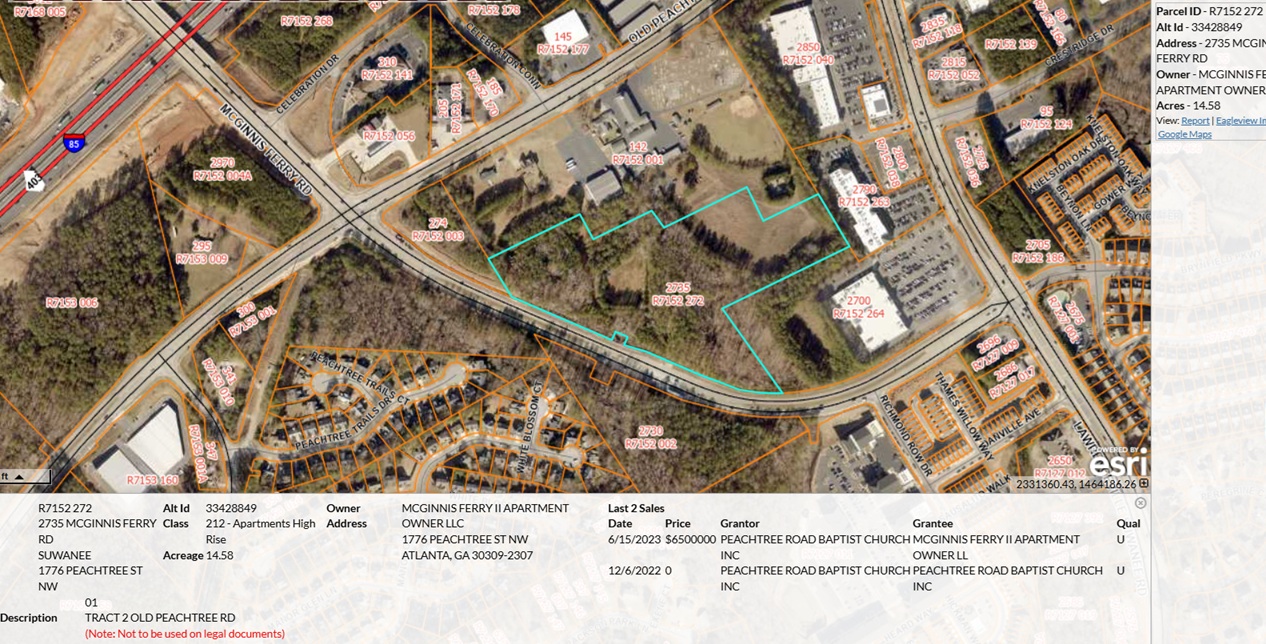
In 2023, Peachtree Road Baptist Church Inc. also sold 14.58 acres of the original campus — Parcel R7152 001 — to the McGinnis Ferry Development Group for what county records indicate was $6.5 million, in connection with a planned 350-unit residential community.
This works out to roughly $445,000 per acre on that parcel. Apply that per-acre figure to Johnson’s 6.44 acres, and you arrive at a back-of-the-envelope valuation of approximately $2.8 to $3.5 million. A church transferred land today worth approximately three million dollars to a private individual and his family trust. For zero dollars. And then, eight years later, sold another parcel for $6.5 million, the proceeds of which have never been disclosed in any public filing. I am not asserting fraud. I am not asserting theft. I am asserting that this is, by any reasonable institutional standard, a very large number of zeroes attached to a transaction that has no visible public disclosure attached.
Again, Peachtree Road Baptist Church does not file a Form 990, which means it has no public obligation to disclose asset transfers, compensation arrangements, or related-party transactions. Here is where I want to slow down, because there is a temptation in investigative writing to take a collection of facts that look bad and assert that they are bad, and I don’t want to do that. It is possible — genuinely possible — that the 2015 transfer was a legitimate, consensual, legally sound transaction that the congregation voted on, prayed over, and understood fully. It is possible that Jerry Johnson provided some consideration that doesn’t appear in the deed record. It is possible that the whole arrangement was disclosed in a members’ meeting I have no access to.
What is not possible is that this transaction is transparent. It is not visible. It is not documented in any public-facing material the church has ever produced. And again, this is a choice.
The Family Business
A review of the church’s staff directory reveals the following: Jay’s son currently directs the church’s global missionary program. Jay’s son-in-law serves as assistant pastor and teacher at Peachtree Road Baptist Academy, the church’s on-site K–12 school. Jay’s daughter teaches at the Academy. Jay’s wife teaches at the Academy.
Four members of the immediate Reed family hold paid positions within the institution Jay leads, in addition to the housing benefit for one family unit on church property, Jay’s own parsonage, the church-paid utilities for both households, and the vehicles.
There is a term for this institutional structure. It is nepotism, defined simply as the practice of favoring relatives in appointments to employment and benefits. The term carries no automatic moral weight, and families have worked together in ministry throughout church history. These arrangements may be entirely above board. The question is not whether the Reeds love each other or whether they are competent at their respective jobs. The question is whether this arrangement is visible, whether it is accountable, and whether the arrangement is fully transparent to the people funding it.
The answer to all three questions, as best as the public record can determine, is no.
The Arithmetic Nobody Asked Me to Do
Let us try, conservatively and carefully, to estimate the annual financial benefit flowing to the Reed family from PRBC, using only what is visible in public records or has been publicly acknowledged.
Jay’s parsonage, at fair market rental value: $4,000–$5,500 per month, or $48,000–$66,000 per year. Church-paid utilities: approximately $6,000–$10,000 per year. His church-gifted Honda truck, amortized over useful life plus insurance: approximately $8,000–$12,000 per year. His wife’s church-gifted Honda Pilot, similarly: approximately $5,000–$7,000 per year. Housing benefit for the son-in-law and daughter: $36,000 per year. Their utilities: $4,000–$6,000 per year.
That is between $107,000 and $137,000 in non-salary benefits annually, before we add a single dollar of salary for any of the five Reed family members on payroll. It is also worth noting that the parsonage allowance is almost certainly untaxed at the federal level: under Section 107 of the tax code, housing benefits provided to ordained ministers are excluded from gross income. The congregation members who fund that benefit do so with post-tax dollars. The pastor who receives it pays no income tax on it.
Add five salaries — even modest ones, at rates consistent with comparable roles in similar institutions — and the total annual financial benefit to the Reed household almost certainly exceeds $500,000 per year. Some estimates would place it considerably higher, particularly if it were compared to pre-tax income.
I am not asserting that this money is stolen. I am not asserting that anyone at PRBC has committed a crime. I am asserting that this compensation structure exists, that it is funded by the congregation’s tithes and offerings, and that the congregation has never been shown a number.
Jay Reed is careful about his image. He is not flashy. He does not seem wealthy. He presents as a career pastor — ostensibly a single-income household, one might reasonably assume, on perhaps $70,000 a year, with six children.
He lives in a 5,000 square foot home with a pool. He drives a $50,000 truck the church gave him. His wife drives a Honda Pilot the church gave her. He owns a boat. He owns a home in another state.
Jay told his congregation on Sunday night that Pharaoh runs the power company, Pharaoh runs the mortgage company, Pharaoh runs every credit card company in America. He said this from a house where the power bill goes to the church. There is no Pharaoh in his utilities closet. He has been liberated from Egypt on his congregation’s dime.
“Someone that enables you to keep your money away from God’s treasury is not your friend.”—Pastor Jay Reed
That’s pretty easy to say when all your bills are already paid.
One More Thing About Barnabas
Tonight, Jay held up Barnabas as the model of Christian generosity: a man who sold his land and laid the full proceeds at the apostles’ feet, holding nothing back.
He also cited, as a cautionary tale, the story that immediately follows in Acts 5. Ananias and Sapphira sold their land just as Barnabas did. They brought money to the apostles just as Barnabas did. But they kept a portion for themselves while claiming to have given it all. The specific nature of their sin was not the withholding itself — Peter says explicitly they were free to keep the money if they chose. The sin was the concealment. The gap between what they claimed and what they disclosed.
In 2015, a portion of extremely valueable church land was transferred for zero dollars to a private individual with institutional ties to this church.
In 2023, another piece of church land sold for $6.5 million.
There has been no public disclosure of what became of either transaction. There is no place for congregants to audit the church’s financials, unless they have access to its closed door budget meetings.
I am not drawing the comparison Jay did not draw. I am simply noting that he drew it first, and that the texts he chose to preach are not always as safely distant from his own circumstances as a careful preacher might prefer. A man confident enough to preach Ananias and Sapphira in a church whose land records look like this is either very brave or very certain that no one will ask these questions.
He may well be right about that. He usually is.
The Line That Lands Differently Now
Late in the sermon, after the Malachi passage and before the altar call, Jay says something that is, taken in isolation, genuinely beautiful:
“You know what your goal ought to be as a Christian? More and more for Jesus and less and less for me.”—Pastor Jay Reed
I believe he means it sincerely. This is a man who has been in ministry for decades expressing something he actually believes about the life of faith.
But the sermon has spent ninety minutes constructing a world in which “more for Jesus” and “more for PRBC’s treasury” are functionally synonymous — in which the financial accountability that God demands of the congregation flows in one direction only, toward an institution that has arranged itself to be accountable to no one.
More and more for Jesus and less and less for me is a beautiful sentence. It would be more beautiful if the man saying it could show us the budget.
A Note to the Congregation
I want to be direct with you, because I think you deserve it.
If you are a member of Peachtree Road Baptist Church who is filling out a faith-promise card this week, you are being asked to make a financial commitment to an institution that has never shown you how it spends your money. The man asking you to give sacrificially lives in a home your tithes pay for, drives a truck your tithes paid for, employs four members of his family on a payroll your tithes fund, and operates within an institutional structure specifically designed to ensure that no one — not you, not any outside authority, not any public body — can see the ledger.
This is legal. It may even be, in Jay’s sincere understanding, righteous.
But you are also the people Jay quoted tonight — the former slaves who finally received wealth and gave it back to God with such abandon that Moses had to beg them to stop. You are the widow with the last meal. You are the woman with the alabaster box.
You deserve to know where the ointment goes.
Note: This analysis represents the author’s subjective interpretation of the sermon delivered on the date mentioned above. For further details, please see my full [Legal Disclaimer]




Leave a Reply