
Notes on a sermon delivered at Peachtree Road Baptist Church on 12/03/2025. The full sermon can be viewed on Youtube.
Wednesday evening services at Peachtree Road Baptist Church have a different energy than Sunday mornings. The ties are loosened. The crowd is smaller. And Pastor Jay Reed’s sermons—already characteristically rambling on Sundays—become even more unstructured, more stream-of-consciousness, more prone to tangential rabbit trails. Which makes it all the more interesting when Reed decides to preach on Proverbs 4—a text he boils down to two words: “Get wisdom.”
You’d think this would be straightforward. Proverbs is practical literature. It deals in observable patterns, cause and effect, the accumulated knowledge of what works and what doesn’t. But Reed’s handling of “get wisdom” reveals something more interesting than exegesis: it exposes the mechanics of how closed systems maintain themselves. By the time the sermon ends, “wisdom” has been redefined so narrowly that the only way to obtain it is to never leave, never question, and never trust your own discernment.
Before Reed gets to the text, though, there’s a guest speaker. And his testimony sets the tone for everything that follows.
The Ox and the Prayer Portal
Warren Storm is a traveling bus mechanic who has spent more than three decades servicing church buses across the country. Jay Reed introduces him warmly, urging the congregation to provide additional financial support for Storm’s itinerant ministry. Storm opens with his credentials: open-heart surgery last year, followed by a return to physically demanding labor—changing tires in the cold, chopping three-quarters of a cord of oak wood. He recounts showing photos of this work to his cardiologist, who allegedly pronounced him “the healthiest patient I’ve got” and concluded, approvingly, “You’re just an ox.”
Storm embraces the label. “We were taught not to quit,” he explains. “I don’t plan to.”
There is perseverance here, certainly—but also a conspicuous absence of any notion of sustainable limits. The medical language for this posture would include phrases like contraindicated exertion and post-surgical risk. Storm prefers a simpler framing: endurance as virtue, quitting as moral failure.
Storm then describes what he calls the “prayer portal”: a twice-weekly conference call among roughly twenty-eight bus mechanics scattered across the country, many of them in their seventies. “They’d been talking about quitting for a long time,” Storm explains. “And since we started the prayer portal, they quit talking about it—because there’s other guys just like them.”
This is framed as encouragement. In practice, it functions as reinforcement against exit. Elderly men with serious health concerns are using spiritualized peer pressure to dissuade one another from making medically reasonable decisions about retirement. This is less iron sharpening iron than crabs in a bucket.
The Independent Fundamental Baptist ecosystem is uniquely suited to produce this dynamic. With no denominational oversight and no institutional mechanisms for intervention, responsibility collapses downward. Each man becomes accountable only to other men already trapped in the same system. It is a decentralized structure that perpetuates itself through shared martyrdom.
Reed returns to the pulpit and underscores the point. He jokes about Storm living in a “box”—the RV he and his wife inhabit full-time—despite owning a house they no longer live in. Reed quotes his mentor Keith Gomez: “I’d rather live in the will of God and visit home than live at home and visit the will of God.” He adds approvingly, “I appreciate people who give action to such thoughts.”
Storm is a proof-of-concept. The ox who won’t quit. The man who trades rest for righteousness, stability for sanctification. With that image firmly installed—a septuagenarian fresh off open-heart surgery, choosing a “box” over a home and physical labor over recovery—Jay Reed opens his Bible.
“Get wisdom,” he says.
Ignorance of the Law Is No Excuse (Unless You’re the Pastor)
Reed begins his actual sermon with what appears to be a straightforward illustration. He’s introducing Proverbs 4:1—”Hear ye children the instruction of a father and attend to know understanding”—and he wants to make a point about accountability. His thesis is simple: “Once the Lord gives [wisdom] and makes it available, you have an accountability to it.”
To illustrate this principle, Reed launches into a story about getting pulled over. Actually, three stories. Like most trilogies, the quality deteriorates with each installment.
The first is generic: “I may or may not have been pulled over by police before in 11 different states.” He’s setting up the premise with a knowing wink. Everyone speeds. Everyone’s been pulled over. It’s relatable. It’s also a tacit admission of habitual disregard for traffic laws, but we’re getting ahead of ourselves.
Then comes the Tennessee story. Reed describes being rerouted through back roads where the speed limit was 65 mph—except for one brief section where it dropped to 45. He didn’t notice. He was tired, listening to an audiobook, maybe daydreaming. He got pulled over going 62 in a 45. When the officer explained the violation, Reed questioned it: “Why did the speed limit drop? There’s nothing here.”
The officer’s response: “License and registration, please.”
Reed hates this. “I hate when I get robots because if I get a real guy, I can talk to him.”
Translation: “I hate when officers enforce laws instead of being charmed by my personality.”
He explains his usual strategy for dealing with law enforcement: “I am shameless when it comes to that. I’ll pull a New Testament. Every Bible I have, I’ll just put it up on the dash…They ask for identification. I hand them a church tract with my picture on it. I’m shameless, man.”
Then the third story: Reed gets pulled over in Georgia “driving by grace and not by law” and when the officer hesitates about letting him go, Reed says: “Look, I’m a pastor. I’ll pray for you. So, you got something I can pray about?” The officer mentions his troubled son. They pray together. Presumably, Reed drives away without a ticket.
I’m hopeful that Reed doesn’t intend to imply he’s offering intercessory prayer as quid pro quo for avoiding legal consequences. Unfortunately, that is precisely what this sounds like.
He returns to the Tennessee story:
“But I remember that that cop in Tennessee…I genuinely didn’t know the speed limit had dropped. I didn’t. He didn’t care because the information was available. And what they will tell you is ignorance of the law is not an excuse. You have an obligation to be aware of the rules of the road.”—Pastor Jay Reed
And here’s the bridge to Proverbs:
“God grants wisdom. He giveth to all men liberally and upbraideth not. Think about that. Wisdom cries in the chief places the concourse. The heavens and creation is a manifestation of the wisdom and order of our God. There is an availability. And so if it’s available, you’re accountable.”–Pastor Jay Reed
On its face, this is standard evangelical preaching. The problem is Reed just spent ten minutes totally undermining this message.
The “robot” cop in Tennessee enforced the law consistently. Reed “hated” him for it. The “real guy” in Georgia could be “talked to”—could be manipulated through charisma, spiritual language, and appeals to shared values. Reed celebrates the latter and mocks the former.
Reed is preaching about accountability while describing his systematic attempts to avoid accountability. He’s using stories of his habitual disregard for traffic laws to illustrate a point about our obligation to obey God’s law. The cognitive dissonance is spectacular.
“I’m shameless, man.”
Yes. Yes he is.
Focused Hearing (But Only When I’m Talking)
Having established that wisdom is available and you’re accountable to it (unless you’re a pastor with a Bible on your dashboard), Reed moves into Proverbs 4:1: “Hear ye children the instruction of a father and attend to know understanding.”
He zeroes in on two words: “hear” and “attend.” He references Revelation 2-3, where the letters to the churches repeat the phrase “He that hath an ear let him hear.”
This is solid homiletics. The text does emphasize active listening. Reed is setting up an important principle about how we receive instruction.
But then he pivots to illustration, and again the wheels come off.
“I’m not a great listener, okay? Unless people start whispering and then I get really good.”–Pastor Jay Reed
Already we’re in trouble. Reed is teaching about the importance of attentive listening while opening with “I’m bad at this thing I’m instructing you about.”
“Brother Keeling has this card that every man should have from his audiologist. He was—he did a hearing test and the audiologist said he said you are you are deaf at this frequency this he said and then this group of frequencies where you are deaf he said that’s where women speak he is literally chick deaf.”—Pastor Jay Reed
Reed leans in: “True story I’m like do you have a card that says that and can I get one—I’m sorry I’m chick deaf.”
Let’s pause here and appreciate what’s happening. Reed is ostensibly teaching about the importance of active, focused listening—specifically in the context of receiving instruction and wisdom. And to illustrate this principle, he tells a story about a man who has a medical excuse for not listening to women, then jokes about wanting the same excuse for himself.
To be fair to Reed, this kind of humor is common in complementarian circles, and many people—including women—find it harmless. But in a sermon specifically about focused, attentive listening, it reveals a blind spot. Reed is teaching about receiving wisdom while joking about his inability to hear half the population. The cognitive dissonance isn’t subtle.
“And I have to tell you, I am not a good listener. But I will say this, sometimes my wife is not a good consolidator.”—Pastor Jay Reed
Ah yes, the classic: “I’m bad at listening, but also, the person speaking to me is bad at talking.” It’s bilateral failure—we’re both part of the problem here.
Except Reed then makes this observation:
“And I will say this, this is something that your wife can do to you, but you can’t do back. My wife will tell me, ‘Get to the point, right?’ And I’m like, ‘Okay.’ But if I tell her, ‘Get to the point,’ it doesn’t go as well…this is not something men are allowed to do.”—Pastor Jay Reed
Reed frames this as a gender-based injustice. What he doesn’t seem to recognize is that he’s currently twenty minutes into a sermon where he’s told three stories about speeding tickets, made jokes about being “chick deaf,” complained about his wife’s storytelling, and repeatedly reminded everyone that he’s not a good listener—all while ostensibly teaching a text about focused attention to wisdom. His wife’s observation—”get to the point”—might not be a gendered attack. It might be good advice.
“Folks, listen. I I realize I’ve been the pastor here for 15 years. You’ve heard all of my jokes, all of my illustrations. Um, you’ve heard all my little cute ways of saying things. I don’t know that I could surprise you anymore.”—Pastor Jay Reed
Reed admits he has nothing new to say after fifteen years. Rather than seeing this as a call to grow, he reframes pastoral stagnation as spiritual discipline: the congregation needs repetition.
“When the Bible repeats things, it’s for emphasis. And when truth is repeated in your life, it’s because you probably need to hear it again.”—Pastor Jay Reed
Scripture does use repetition for emphasis, but this doesn’t justify a pastor’s lack of inspiration or preparedness. It doesn’t mean Reed gets to rebrand “I’m repeating myself” as “God is emphasizing truth through me.”
So when Reed speaks, activate focused attention—even when he’s rambling, repetitive, or telling the same stories for the fifteenth year in a row. When others speak—especially women—well, you might be “chick deaf,” and that’s just biology.
Doctrine Divides (And That’s the Point)
“You have to know doctrine, folks. Listen, doctrine is truth about God. It’s not the throwaway part of Christianity.”—Pastor Jay Reed
This is uncontroversial. Theology matters. Beliefs have consequences.
“And I realize what the modern church the modern church has devalued doctrine. This is what they say. Well, doctrine divides.”—Pastor Jay Reed
Reed says this with the tone of an obviously ridiculous claim. But he seems to feel this is a feature not a bug, when he fervently agrees, “Yes, yes it does.”
Reed has no qualms about doctrinal divides nor calling out the Christians he feels have it wrong.
What follows is a catalog of who’s out and why, as Reed systematically draws the boundaries of acceptable Christianity, and with each exclusion, the circle grows smaller—and his reasoning grows more dishonest.
But before I proceed, I want to acknowledge my own interpretive commitments. When I critique Reed’s handling of Methodist or Catholic theology, I’m not claiming perfect objectivity. I’m arguing that his readings are less defensible than he presents them, not that mine are beyond dispute. The difference—and it matters—is that I’m trying to acknowledge where reasonable people disagree, while Reed presents his positions as the only biblically sound options.
This essay will be critical. At times, sharply so. But I’m not interested in mockery for its own sake. I’m interested in examining how a sermon ostensibly about wisdom ends up systematically undermining the congregation’s capacity for discernment. That’s worth taking seriously, even when—perhaps especially when—the subject matter is absurd.
Target 1: The Methodists
“I have doctrinal differences with Methodists. Okay? They believe you can lose your salvation. They believe that you get sprinkled as a baby. Neither one of those positions are biblically sound.”–Pastor Jay Reed
The “Okay?” here is a rhetorical cudgel designed to foreclose discussion. This is settled. We’re moving on. Except nothing has been settled.
Let’s do some fact checking: The United Methodist Church’s official position on baptism (as stated in their Book of Discipline) is that it’s “an outward sign of an inward grace”—not salvific in itself. Methodist theologians argue infant baptism functions as a covenant sign, analogous to circumcision in the Old Testament. This is a defensible reading of Scripture based on household baptisms in Acts and Paul’s covenant theology in Romans.
Reed is entitled to disagree. But either position is “biblically sound.”
The same goes for the Methodist position on “losing salvation”: where they point to passages like Hebrews 6:4-6 (“For it is impossible for those who were once enlightened…if they fall away, to renew them again”), Hebrews 10:26-27, and 2 Peter 2:20-21.
Reed’s eternal security position requires explaining these verses in ways that mitigate their plain reading. This is interpretation, not revelation. Methodists interpret these verses one way; Baptists another. Both claim scriptural warrant. Neither can claim their position is “what the Bible says” while the other is “not biblically sound.”
But Reed isn’t interested in acknowledging interpretive complexity. He’s interested in establishing that Methodists are wrong, he’s right, and anyone who disagrees is not just incorrect but biblically unsound.
Target 2: The Charismatics
Reed’s tone shifts from condescension to outright mockery when he discusses Charismatic Christians:
“I have a doctrinal difference with charismatics. Okay? What goes on in the charismatic church is just chaos. Don’t pretend like it’s normal…they’re not…Okay, it’s poppycock. It gives Christianity a terrible name… speaking in tongues…you’re a bunch of idiots.”—Pastor Jay Reed
He describes watching Hillsong videos: “People were running the spiritual gauntlet and then laying on the floor while they were pushing out demons and welcoming in the Holy Spirit. Where’s that in the Bible?”
First, this rhetorical question deserves a rhetorical answer: Where’s the altar call in the Bible? Where’s the sinner’s prayer? Where are Sunday and Wednesday evening services? Where’s the four-part gospel presentation using Romans Road? Where’s the church bus ministry?
If “show me chapter and verse” is Reed’s standard, he needs to apply it consistently. But he doesn’t, because it’s not actually his standard—it’s a weapon he deploys selectively against Christians he doesn’t like.
Second, Reed’s caricature is intellectually dishonest. Presenting Hillsong’s most sensational moments as representative of all charismatic Christianity is like using Westboro Baptist Church to represent all Baptists.
Third—and this is where Reed’s biblical argument completely collapses—the Bible contains numerous examples of physical manifestations during spiritual encounters (Matthew 17:6, Revelation 1:17, 2 Chronicles 5:14, Ezekiel 1:28, Daniel 10:8-9, Acts 9:4, Matthew 28:4)
The question isn’t whether physical responses to divine presence appear in Scripture—they manifestly do. The question is whether modern manifestations are analogous to biblical ones. But Reed skips the debate entirely and goes straight to mockery, because engaging the actual argument would require acknowledging that his opponents have biblical warrant for their position.
“Faith healers can’t heal people. There’s not one documented case where it happened.”—Pastor Jay Reed
This is a genuinely stunning claim to hear from a pastor. Full stop. A Christian pastor just said prayer can’t heal people. Not once. Not ever.
The alternative is that Reed misspoke in his zeal to mock charismatics, and what he meant was “charismatic faith healers can’t perform miracles on command.” But that’s not what he said. And given the amount of time he’s spent demanding precise theological language from everyone else, it seems fair to hold him to the same standard.
Reed then cites 1 Corinthians 13:
“You know what Paul said? The apostolic gifts are going to go away with the apostles.”—Pastor Jay Reed
Except Paul didn’t say that. The text says tongues will cease “when that which is perfect is come.” Cessationists argue this means “when the canon is complete.” Charismatics argue it means “when Christ returns.” Both are interpretations; neither is explicitly stated. Reed is entitled to his cessationist reading—but he’s not entitled to present it as “what Paul said” when it’s actually “what Jay Reed believes Paul meant.”
Target 3: The Catholics
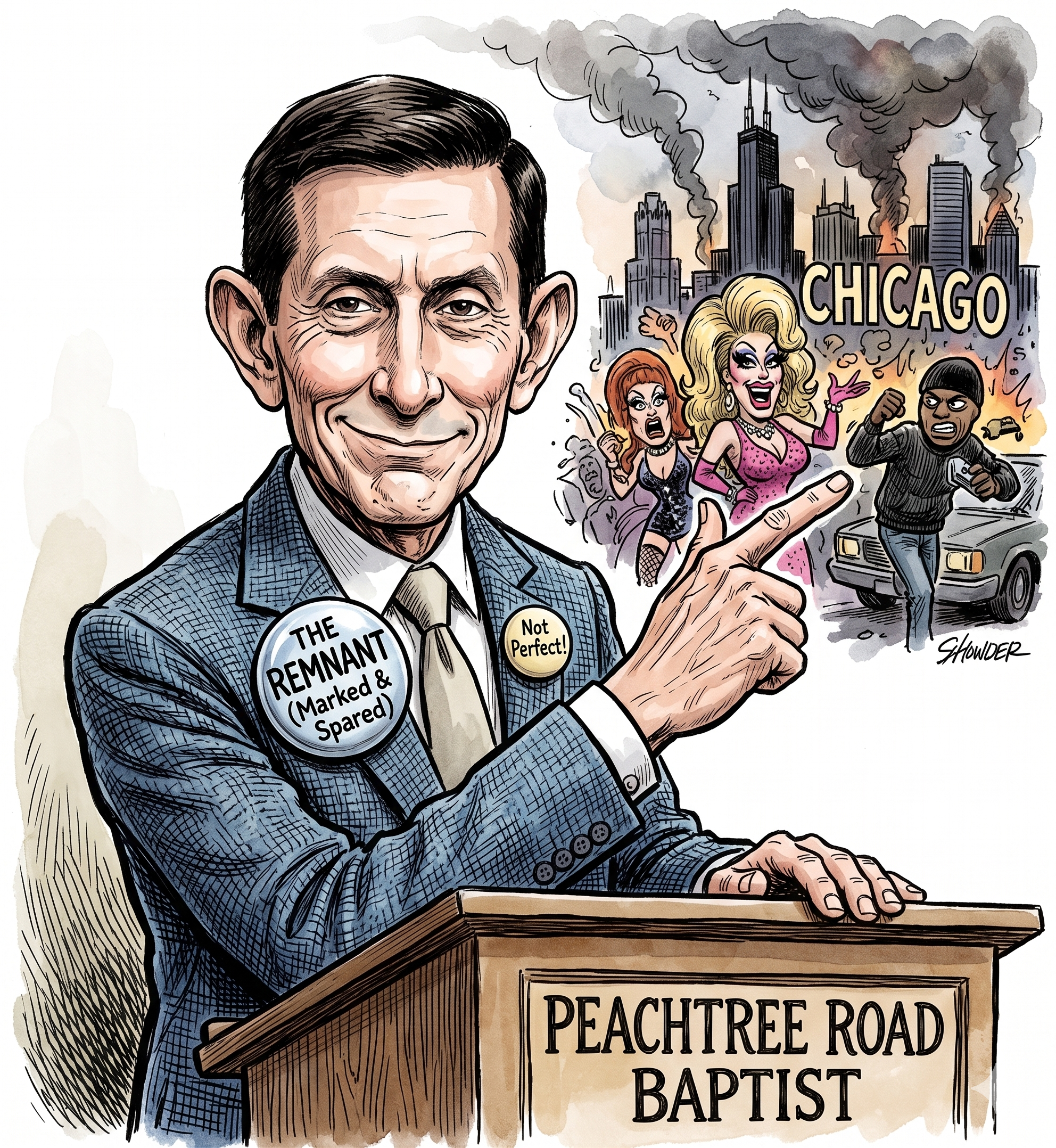
Reed’s contempt next shifts to Rome. He attempts a joke about Pope Leo XIV being from Chicago and makes a pun about the Chicago Cardinals football team. The congregation apparently doesn’t catch it: “You don’t see that irony. I thought you might see irony.”
The joke fails because it’s lazy, juvenile wordplay that trivializes the office he’s critiquing. It’s less theological critique and more “Catholics have a guy called a Cardinal and there’s a football team called the Cardinals, get it?”
Reed then describes papal vestments: “the fish with the open mouth up here and all that, he’s got two keys that he believes are passed down from St. Peter. He thinks that he has the keys to death and hell.”
Time for another fact check: The papal regalia includes a mitre (a tall, pointed liturgical headdress), not a “fish with an open mouth.” The crossed keys on the papal coat of arms symbolize “the keys to the kingdom of heaven” from Matthew 16:19 , not “the keys to death and hell.” Given that Reed has internet access and could spend thirty seconds verifying this, the most charitable interpretation is that accuracy isn’t his priority. The least charitable is that he’s deliberately misrepresenting Catholic religious imagery in order to ridicule it.
Reed also offers a counterargument to priestly celibacy: Peter had a mother-in-law, therefore he was married, therefore celibacy is unbiblical.
This argument would be devastating if Catholics claimed celibacy was biblically mandated. They don’t. The Catholic Church openly acknowledges Peter was married (Matthew 8:14). Their position on priestly celibacy is that it’s a discipline, not a doctrine—not claimed to be biblically required but adopted for practical reasons (full devotion to ministry, avoiding nepotism and hereditary church positions, following Paul’s teaching in 1 Corinthians 7:32-35).
Reed is attacking a position Catholics don’t hold, which is an efficient way to win an argument—less straw man and more tilting at windmills.
“Catholics teach works salvation…It’s not in the Bible.”—Jay Reed
Reed describes Catholic practices (baptism, confession, sacraments) and concluding they teach “works salvation.” But the Catholic Church’s official position (Council of Trent, Catechism of the Catholic Church) is that salvation is by grace through faith in Christ, but that faith is perfected and demonstrated through works—based on James 2:24: “You see that a person is justified by works and not by faith alone.”
Notably, this is the only place in Scripture where the phrase “faith alone” appears, and it’s preceded by “not by.”
Reed claims Catholic doctrine is “not in the Bible,” but here’s what is in the Bible:
- “Not everyone who says to me, ‘Lord, Lord,’ will enter the kingdom of heaven, but the one who does the will of my Father” (Matthew 7:21)
- “Work out your own salvation with fear and trembling” (Philippians 2:12)
- “What good is it, my brothers, if someone says he has faith but does not have works? Can that faith save him?” (James 2:14)
- The entire parable of the sheep and goats (Matthew 25:31-46) judges people based on whether they fed the hungry, clothed the naked, and visited prisoners
Catholics read these verses and conclude works are essential to salvation. Protestants read these verses and conclude works are evidence of salvation. This is a real theological disagreement with substantive arguments on both sides, but Reed’s claim that Catholic doctrine is “not in the Bible” is demonstrably false. Their beliefs are in tension with his interpretation of Paul, but Catholics can cite just as many verses to support their beliefs as he can.
The question isn’t who has Scripture on their side—both traditions do. The question is a complex hermeneutical question about how Biblical data is interpreted. Reed prefers “Catholics don’t do Bible.”
“Prayers for the dead is found in the Apocrypha which the early church rejected…That’s paganism. It’s heathenism. It’s animism.”—Pastor Jay Reed
Reed can argue this practice is theologically incorrect. He can claim it’s not biblically warranted. But calling it “paganism” and “heathenism” is historically ignorant and inflammatory. It’s a practice that emerged as early as 200 AD from Christians trying to live out Jesus’s command to “love one another”—believing that love doesn’t stop at the grave and that prayer for the departed is an act of Christian charity.
Calling this “animism” is particularly absurd. Animism is the belief that non-human entities (animals, plants, objects) possess spiritual essence. Praying that God would have mercy on deceased believers is not animism. It’s not even in the same conceptual category. Reed is just throwing out words that he clearly doesn’t understand.
“Jesus said there is one God and one mediator between God and man, the man Christ Jesus…I don’t need to confess my sins to a man.”—Pastor Jay Reed
Reed doesn’t have to agree with Catholic sacramental theology. But he needs to stop pretending Catholics invented it without biblical basis (James 5:16, John 20:23). Different traditions emphasize different parts of Scripture. It is a profound arrogance for any person to claim absolute certainty about any of these interpretive differences. But that’s exactly what Reed does throughout this “doctrine divides” message and the pattern is consistent, not only in this sermon but in every other message he preaches: caricature the opposing position, ignore the strongest arguments for it, cite selectively from Scripture, present his interpretation as “what the Bible says,” and mock anyone who disagrees.
(Soft) Target 4: The Landmarkists
Having systematically maligned the beliefs of Catholics, Methodists, and Charismatics, Reed arrives at a more delicate target: his own. In the span of roughly thirty seconds—a brevity that itself tells a story—Reed pivots from attacking Catholic apostolic succession to critiquing its Baptist equivalent:
“There’s no such thing as apostolic succession. Okay? And they’re not the only people that believe that. It has crept into the Baptist movement with what’s called landmarkism or Baptist briderism that only churches that have a little bit of, you know, river Jordan water in their baptistry and there’s this unbroken line of success and down BH Caroll’s trail.”—Pastor Jay Reed
The tone shift is remarkable. When discussing Catholics, Reed’s voice dripped with contempt: “keys of hell and death,” “heathenism,” “animism,” “poppycock.” When discussing Landmarkists—a movement that has been supported by his own alma mater—the mockery softens into mild corrective concern.
Landmarkism (also called Baptist Briderism) teaches that only Baptist churches with an unbroken historical succession back to the New Testament constitute the true “bride of Christ.” All other denominations—even genuine believers—are outside this succession and therefore cannot be part of the bride.
This doctrine requires several elaborate (and demonstrably false) historical claims: that Baptist churches (or at least “Baptist-like” churches) have existed in unbroken succession since apostolic times; that this succession can be traced through various dissenting groups (Montanists, Donatists, Waldensians, Anabaptists); and that this historical pedigree is essential for being part of Christ’s bride.
The key text promoting this view is The Trail of Blood by J.M. Carroll (not “BH Caroll”), Published in 1931. Historians—including many Baptist historians—have thoroughly debunked Carroll’s alternative history. But historical accuracy isn’t the problem Reed identifies.
“But listen folks, um there are going to be Methodists in the bride of Christ. Okay? George Whitfield was a congregationalist. He’s going to be in the bride of Christ. He’s not going to be serving us at the marriage supper. That’s not going to happen.”—Pastor Jay Reed
This is a more generous—dare I say—homogenous position than many in Reed’s theological ecosystem hold. He’s explicitly rejecting the claim that only Baptists qualify as the bride of Christ. He’s affirming that genuine believers from other denominations will have equal standing at the marriage supper of the Lamb—not as second-class guests or servants, but as members of the bride.
It’s also completely inconsistent with everything else he’s said in this sermon.
Reed just spent significant time explaining why Methodists are doctrinally unsound. He says these are fundamental errors about how salvation works. Yet somehow, despite getting these core doctrines wrong, Methodists still qualify for the bride of Christ?
The answer is strategic. Reed needs to distance himself from Landmarkism’s most damning (pun intended) claims. While using his authority to scare his congregants away from other churches or ideas, he can’t go so far as to exclude obvious saints like George Whitfield from Heaven. So he splits the difference: Catholic doctrine is “heathenism,” but some Catholics might be saved (he never quite says this explicitly). Methodist doctrine is “not biblically sound,” but at least some Methodists will be in the bride. And Landmarkism is wrong, but The Trail of Blood has “some good information.”
Notice also what Reed doesn’t address: if Landmarkism is wrong—if Baptist succession doesn’t matter—then what actually does make someone part of the bride of Christ? Is it belief in the right doctrines? If so, which doctrines? How much error disqualifies you?
Sanitized Fundamentalist™ Pastor Jay Reed doesn’t answer need to these questions. It’s the theological equivalent of “I’m not racist, but—” where the second half of the sentence inevitably undermines the first. “I believe doctrine divides, but also Methodists are in the bride of Christ” functions the same way: the disclaimer exists to provide cover, not consistency.
Keep Thy Heart with All Diligence
Having established that Catholics, Methodists, and Charismatics are all wrong (and possibly demonic, but still maybe within the bride of Christ), Reed shifts to application mode. He introduces military language to describe how his congregation should handle external ideas.
He references a Dominican Republic fort his family visited, describing how the most secure structure—the “keep”—was built within the castle as the last line of defense. In medieval warfare, the keep was where defenders retreated when outer walls were breached. It was the final stronghold.
“Keep thy heart with all diligence, for out of it are the issues of life…put it in a secure place…Keep your heart. And when it comes to this wisdom that God’s going to give you…keep it. Guard it.”—Pastor Jay Reed
Reed is telling his congregation to view all external ideas as hostile forces requiring military-grade defense. The imagery is telling: outer walls, inner citadel, siege mentality, constant vigilance against infiltration.
He introduces what he calls “zero-sum gain”: “When something comes in, something leaves.” New ideas don’t expand understanding—they displace “biblical wisdom.” The mind isn’t capacious; it’s a fortress with limited space. Every new thought is an invader that must evict a defender.
This is a remarkably impoverished view of human cognition and spiritual growth. It assumes wisdom is static, finite, and threatened by engagement with different perspectives. The alternative—that encountering different viewpoints might refine, sharpen, or deepen understanding—doesn’t exist in Reed’s framework.
“There is a wisdom from beneath. There’s a wisdom this world offers, but it’s not helpful. It’s sensual and devilish. It appeals to the flesh.”—Pastor Jay Reed
Here’s the move: Reed defines “biblical wisdom” as whatever he teaches, and “wisdom from beneath” as everything else. But notice the criterion:
“It can appeal to your intellect. It can make perfect sense, but it’s not wisdom.”—Pastor Jay Reed
Translation: If something makes sense but contradicts Reed, it’s demonic deception. Your own reason is the enemy. Intellectual coherence is a mark of satanic origin. The more logical something sounds, the more suspicious you should be.
Reed is systematically closing every avenue for independent verification of his claims. You can’t trust your reason (it might be “sensual”). You can’t trust other Christians (they have “wisdom from beneath”). You can’t trust your experience (it appeals to “the flesh”). The only safe source of wisdom is Reed’s interpretation of Scripture.
“There are people that are living lives that make perfect sense to them right now, but they’re nowhere near the will of God. They’re in your family.’”—Pastor Jay Reed
Read that again. Reed is explicitly telling his congregation that family members who disagree with his theology are deceived by Satan and “nowhere near the will of God.”
This is not biblical teaching about dealing with unbelievers or apostates. This is a direct assault on family unity over theological distinctives. Jesus said, “If it be possible, as much as lieth in you, live peaceably with all men” (Romans 12:18). Paul wrote, “If any brother hath a wife that believeth not, and she be pleased to dwell with him, let him not put her away” (1 Corinthians 7:12-13). The Proverbs Reed claims to be teaching from say, “A soft answer turneth away wrath: but grievous words stir up strife” (Proverbs 15:1).
Reed is teaching his congregation to view family members—people they love, who love them back—as spiritual threats requiring the same defensive posture as enemy soldiers assaulting a fortress. This isn’t discipleship. This is cult behavior.
Consider the practical implication: A congregant’s adult child leaves Peachtree Road Baptist for a Methodist church. That child is happy, serving, growing in faith. But according to Reed, the parent should view this as spiritual danger—the child has been infiltrated by “wisdom from beneath.”
This common IFB teaching (oft repeated from Reed’s pulpit) doesn’t just divide over doctrine; it weaponizes doctrine to destroy relationships. And it’s utterly antithetical to the fruit of the Spirit: “love, joy, peace, longsuffering, gentleness, goodness, faith, meekness, temperance” (Galatians 5:22-23). There is nothing gentle or peaceable about telling parents to view their Methodist children as agents of demonic “new” wisdom.
Target 5: McKendree United Methodist Church
Having primed his congregation to view even family members as potential threats, Reed pivots to his local example. And here’s where the sermon crosses from theological error into genuine malice.
“If you go down here to McKendree United Methodist Church, you’re going to find a bunch of people who’ve been there for 30 and 40 years and they’re okay with a woman pastor. Now, if you’d asked them 20 years ago, was that okay, they’d said no.”–Pastor Jay Reed
Reed is now publicly naming and shaming a specific local church and pastor from his pulpit—a church whose members live in his community. This isn’t abstract theological discourse; it’s localized aggression designed to poison relationships.
This is precisely the behavior Scripture condemns. Jesus said, “Blessed are the peacemakers” (Matthew 5:9). Paul wrote, “If it be possible, as much as lieth in you, live peaceably with all men” (Romans 12:18). James warns, “The tongue is a fire, a world of iniquity…it defileth the whole body, and setteth on fire the course of nature” (James 3:6).
Instead, Reed is actively sowing discord, holding up neighbors as cautionary tales, teaching his congregation to view other Christians with contempt.
“Now they used to know that a bishop must be the husband of one wife. The husband. The husband of one wife. Okay. I realize there’s some gender questions that are out there, but you’re smarter than that, right?”—Pastor Jay Reed
The question of women in ministry is complex, involving hermeneutics, cultural context, the relationship between descriptive and prescriptive passages, and the interpretation of contested Greek terms. Intelligent, Bible-believing Christians disagree. But Reed can’t acknowledge this, so he presents his position as obvious and anyone who disagrees as either ignorant or rebellious.
“They’re nowhere near the will of God.”—Pastor Jay Reed
Here’s a question Reed can’t answer coherently: In what sense can anything happen outside God’s will?
If Reed holds to typical Baptist theology about God’s sovereignty—particularly the Calvinistic leanings common in IFB circles regarding eternal security—then by what logic can Methodist practices exist outside God’s sovereign control? Either God ordains whatsoever comes to pass (in which case female Methodist pastors exist because God wills them to), or human free will can genuinely thwart God’s plans (in which case Reed’s eternal security doctrine collapses).
Reed wants absolute sovereignty when it supports his soteriology but conditional sovereignty when it supports his critique of others. He can’t have both.
Then Reed plays what he clearly considers a trump card: a story about McKendree’s pastor performing poorly at a funeral—showing up late, dressed inappropriately in “tight pants with a leather vest,” failing to provide meaningful pastoral care to a grieving family.
I don’t know the full context of this situation. Maybe the pastor had a legitimate emergency. Maybe the family’s expectations were communicated poorly. Maybe she genuinely failed in her pastoral duties—which would be a serious problem regardless of gender. Bad pastoral care is bad pastoral care.
But here’s what troubles me: Reed is using the worst moment of these parents’ lives—the funeral of their young son—as ammunition in an argument against women’s ordination. He’s not sharing this story to demonstrate compassion for the family or to highlight the importance of pastoral excellence. He’s sharing it to prove that McKendree UMC is compromised, that female pastors are inadequate, and that his congregation should view their neighbors with suspicion.
One pastor’s failure at one funeral doesn’t prove anything about women in ministry—any more than the countless failures of male pastors (including documented abuse, financial misconduct, and spiritual manipulation) prove anything about men in ministry. If Reed wants to argue against women’s ordination on biblical grounds, he should make that argument. But weaponizing a family’s grief to score rhetorical points isn’t exegesis—it’s exploitation.
And notice what Reed does with the family’s decision to stay at McKendree: he psychologizes it as evidence of compromise. They’re “fired up mad” but stayed because they’ve “got new wisdom”—meaning they’ve been deceived. But isn’t institutional loyalty precisely what Reed demands of his own congregation? When someone at Peachtree Road has a bad experience but stays, that’s faithfulness. When someone at McKendree does the same, it’s compromise. The principle shifts based on whether it serves Reed’s argument.
“If you won’t hold on to the wisdom that God gives you, the devil’s got some wisdom for you.”–Pastor Jay Reed
And there it is. If you’re not getting your wisdom from Jay Reed, you’re getting it from Satan himself. There is no third option. No possibility that other Christians might have legitimate insights. No acknowledgment that the Holy Spirit might work in traditions different from Reed’s.
You’re either in Reed’s fortress or you’re outside the will of God. Those are the only options.
The Wisdom That Judges Itself
Reed warns repeatedly about “wisdom from beneath”—earthly, sensual, devilish wisdom that masquerades as truth. He is right that such wisdom exists. What he never considers is whether he might be demonstrating it.
Return to James 3, the passage from which Reed draws his warning about devilish wisdom. But read the full context:
“Who is a wise man and endued with knowledge among you? let him shew out of a good conversation his works with meekness of wisdom. But if ye have bitter envying and strife in your hearts, glory not, and lie not against the truth. This wisdom descendeth not from above, but is earthly, sensual, devilish. For where envying and strife is, there is confusion and every evil work. But the wisdom that is from above is first pure, then peaceable, gentle, and easy to be intreated, full of mercy and good fruits, without partiality, and without hypocrisy.” James 3:13-17 (KJV)
By this standard—Reed’s own scriptural standard—what kind of wisdom has this sermon demonstrated?
Is it peaceable? Reed has publicly attacked multiple denominations, named a local church and its pastor, characterized family members who disagree as deceived by Satan, and sown discord in his community.
Is it gentle? Reed mocked charismatics as “idiots,” dismissed Catholic practices as “heathenism,” and treated theological disagreements as evidence of spiritual compromise.
Is it easy to be intreated? Reed’s entire sermon is structured to eliminate the possibility of correction—he’s built a fortress against external input and taught his congregation to man the walls.
Is it full of mercy? Reed showed no mercy to the Methodist pastor whose worst moment he exploited, no mercy to the grieving family whose story he weaponized, no mercy to any believer whose interpretation differs from his own.
Is it without partiality? Reed celebrates his own evasion of traffic laws while demanding his congregation’s unwavering obedience to his interpretation of God’s law.
Is it without hypocrisy? Reed preaches focused listening while admitting he’s a terrible listener. He demands doctrinal precision while misrepresenting opponents. He calls for accountability while bragging about avoiding it.
James tells us how to identify wisdom from beneath: “where envying and strife is, there is confusion and every evil work.” Reed’s sermon is designed to create strife—between his congregation and other Christians, between parents and children, between neighbors and the church down the street. This isn’t incidental collateral damage. It’s the intended effect.
The Fortress Complete
“Get wisdom,” Reed commanded. And he meant it sincerely. He believes he is protecting his congregation from error, guarding them against deception, keeping them on the narrow path.
But what does it mean to “get wisdom” in a system that has systematically disabled every tool you might use to evaluate whether the wisdom you’re receiving is true?
What does it mean to “get wisdom” when you’ve been taught to distrust your own reason, dismiss contrary evidence, avoid external perspectives, and equate questioning with rebellion?
What does it mean to “get wisdom” from a teacher who admits he has nothing new to say but forbids you from seeking insight elsewhere?
What does it mean to “get wisdom” in a fortress designed to keep wisdom out?
Reed believes he is the faithful shepherd protecting the flock. But Proverbs—the book he claims to be teaching—offers a different vision of wisdom:
“Where no counsel is, the people fall: but in the multitude of counsellors there is safety.” (Proverbs 11:14)
“The way of a fool is right in his own eyes: but he that hearkeneth unto counsel is wise.” (Proverbs 12:15)
“Without counsel purposes are disappointed: but in the multitude of counsellors they are established.” (Proverbs 15:22)
Biblical wisdom, according to the very book Reed preaches from, is found in the multitude of counselors—in engaging diverse perspectives, listening to correction, seeking input from various sources. Reed has built a system where there is only one counselor, and that counselor is accountable to no one.
This is not wisdom. This is control.
And calling it wisdom doesn’t make it so—no matter how many proof texts you marshal, no matter how loudly you warn about deception, no matter how tightly you build the walls.
The closed system is complete. The fortress stands. The congregation has been warned against every possible source of contrary information.
And Pastor Jay Reed, standing in his pulpit, surveying his defensive works, sincerely believes he has given them wisdom.
Perhaps that’s the most troubling thing of all.
Note: This analysis represents the author’s subjective interpretation of the sermon delivered on the date mentioned above. For further details, please see my full [Legal Disclaimer]




Leave a Reply