
Notes on a sermon delivered at Peachtree Road Baptist Church on 05/31/2026 The full sermon can be viewed on Youtube
I didn’t attend Peachtree Road Baptist services this week because I had other plans. However, I received a tip that I should check out Sunday night’s sermon online because in their words, “You are hitting a nerve.”
Let’s dispense with the throat-clearing: Reed is plainly rattled. While I hesitate to declare this blog the inciting incident, a glance at my site traffic makes it difficult to completely discount.
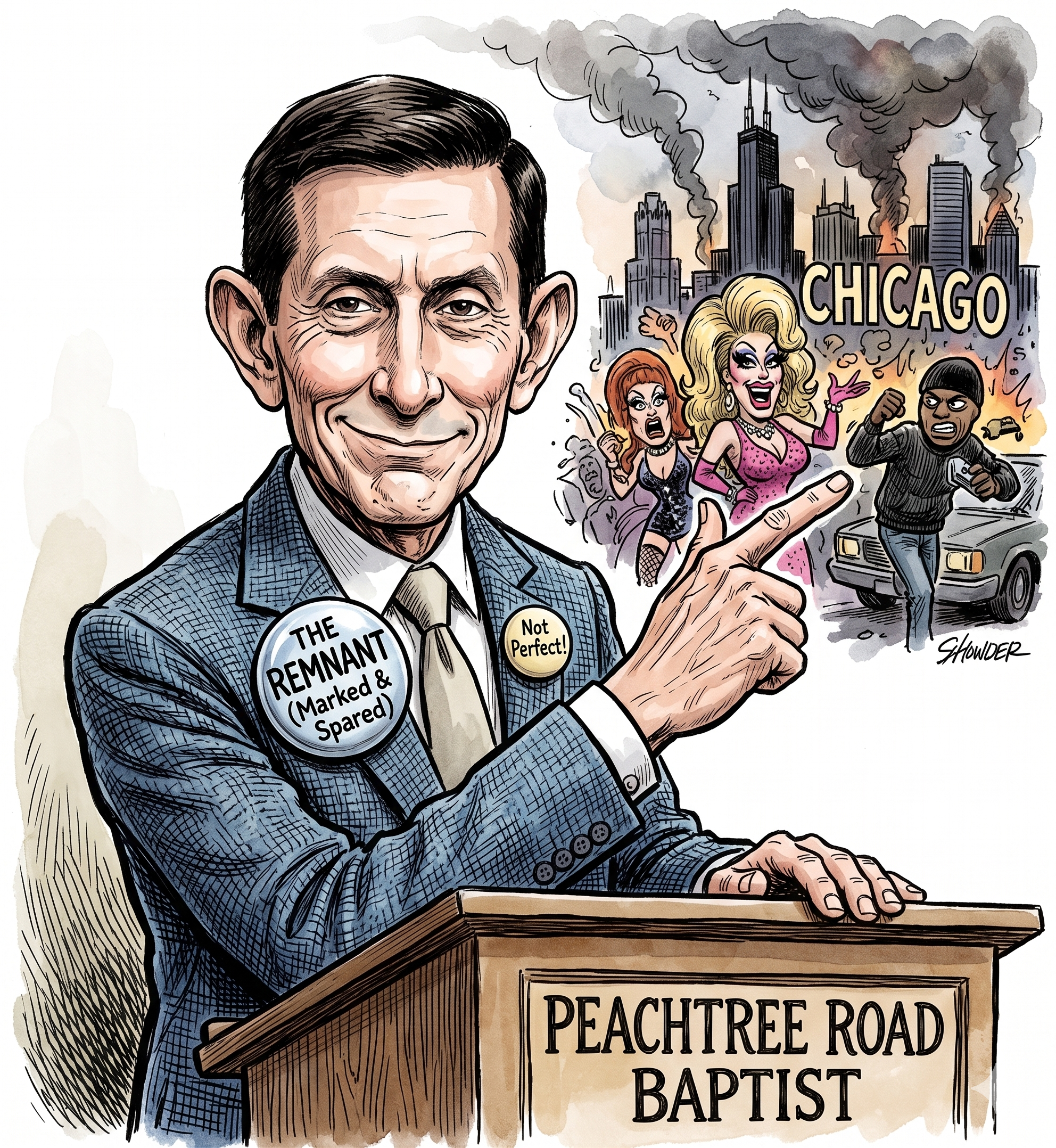
On May 31st, Pastor Jay Reed delivered a sermon titled “Third Rail Theology and Dealing with Dirty Laundry.” It wasn’t actually about laundry; it was about people who talk. People who post. People who run, in his words, “little gossip columns on Facebook and Instagram and X.” People he calls “self-styled Baptist Gestapo” and “little Baptist clickbaitites,” who—he is certain—”don’t smile. And if they do, it never quite reaches the eyes.”
Now, I want to be careful here, because being careful is the entire difference between what I do and what Reed maybe spent Sunday night accusing me of doing. I don’t actually know who Jay Reed spent ninety minutes shadowboxing Sunday night. Maybe this blog did touch a nerve third-rail (sorry, couldn’t help myself). Maybe the broader phenomenon of former members of IFB churches finding a comment section reached some critical mass and he felt the floor shift. Maybe he simply woke up on the thirty-first of May with a burning, unprovoked desire to defend the posthumous reputation of Jack Hyles. I genuinely cannot know, and I’m not going to pretend otherwise. What I can tell you is that early on, Reed told the visitors they’d leave wondering “who he was talking to.”
He nailed that prediction, at least.
But out of an abundance of caution, in case any portion of those ninety minutes was aimed at me or my audience, let me restate for the record a simple fact which complicates Reed’s narrative, and what he therefore may find difficult to accept:
I am not a former member of Peachtree Road Baptist Church. Nor have I ever been on any IFB church roll.
I do not know Jay Reed personally. I was never kicked out of a service, never passed over for a ministry position, never denied a parking spot. I am not nursing a grievance from a church split in 1987. I do not—whatever this is supposed to mean—have “skeletons in my closet” that I am projecting onto the IFB movement to avoid confronting my own sin. Though I’ll once again marvel at the efficiency of an accusation that requires no evidence and conveniently disqualifies any rebuttal as further proof. I have said all of this before, repeatedly.
Who are you talking to, Pastor Reed? I’ll tell you.
I am a curious, unaffiliated outsider who developed the peculiar hobby of attending a local church’s services and writing down what was actually said in them. That is the whole enterprise. If it has a mission, the mission is modest: to hold a man with a great deal of spiritual authority accountable for the specific words he chooses to put in God’s mouth, and to let anyone in the building who quietly felt the same way know they are not imagining things.
Now that we have that out of the way, let’s recap the sermon. Jay Reed called it “Dealing with Dirty Laundry.” I have an alternative suggestion:
Who Gets to Know the Laundry Is Dirty?
Matthew 18 for Beginners, and Other Ways to Never Be Questioned
Reed opens in 1 Corinthians 6, and his choice of text is, at the start, entirely fair. Paul is scolding the Corinthians for hauling their disputes “before the unjust, and not before the saints,” dragging believer-against-believer quarrels into pagan civil courts when they should have settled them inside the church. From there, Reed moves to Matthew 18, where Jesus lays out a graduated process for a personal offense: go to the person alone, then with witnesses, then to the church.
The thesis, which Reed states plainly and repeats often enough that you could set a metronome by it, is this: keep the circle small.
“Keep the circle small…the whole idea is keep the circle small…God doesn’t intend for the circle to be any larger than it needs to be.” —Pastor Jay Reed
Christians resolve their conflicts in the smallest possible group. Per Reed’s interpretation, going outside that group, to secular courts or to public opinion, violates the principle.
Here is what I will grant him loudly: The principle that believers should resolve personal disputes internally is legitimate and ancient. If a brother breaks your lawnmower or gossips about you at a potluck, you go to him privately. That is good pastoral sense and good manners.
As usual, the problem is not the Bible. The problem is what Reed does with it.
“I’m going to pivot here. Within the whole of Christendom, there is a tribe called independent fundamental Bible believing Baptists. I would argue that this is the closest group in structure and mission to the early church. You’d have a hard time refuting that argument.” —Pastor Jay Reed
I just have to pause a moment here to insert, I would have no difficulty refuting this so-called “argument,” in fact, I’d love nothing more than to dissect this bold claim like a frog in an 8th grade science class. Unfortunately, I must stay focused on the matter at hand. So I’ll let Reed continue—
“…We’re independent because we don’t have a hierarchy that can control us and lead us in a bad direction. We’re fundamental because we believe what the Bible says. Okay? The fundamentals of the faith….So this is our tribe. These are our people. But it is a family made up of people. So there are going to be problems. Some problems are minor disagreements. Some are major doctrinal errors. Some are major moral failings. Problems will exist between some or all of the local assembly and sister churches of similar beliefs. Sometimes the problems ripple out. Okay? And boy, there have been some seismic ones that have rippled out.” —Pastor Jay Reed
Let’s diagram this theological malpractice. 1 Corinthians 6 is specifically about active lawsuits in secular courts. Paul is not discussing journalism, memoir, or public discourse; he is discussing litigation. Matthew 18 is a conflict resolution protocol for personal offenses within a shared covenant. Verse 15 begins: “If thy brother shall trespass against thee.” The operative words are brother and against thee.
What he does is take a mechanism built for restoring fellowship between two people who know each other and quietly expand it into a universal gag order. Watch the scope creep. Reed reads Mathew 18 correctly at first; in fact he leans on it, telling the room the grievance “has to be something that affects you. Somebody did something that affects you.” Good. That is what the text says. The offense has to be yours.
And then, having established that the verse is about your own personal injuries, he applies it to things that are nobody’s personal injury at all: a teacher’s public doctrine, an institution’s handling of a scandal, the conduct of men he names from the pulpit who have been dead for years. He gives the example himself:
“All this ancillary stuff. Well, over in this church, they hired a staff member who had been defrocked by another church and left, but without the full story being known. and now he’s at this church over here and he’s continuing his dirty deeds and so we have to expose him. Not your problem. Not your problem. There’s no biblical mechanism for you to do anything because it’s not your problem. Whose problem is it? The local church.”—Pastor Jay Reed
The standard that originally said “it has to affect you personally” is now being used to forbid you from saying anything about harm done to other people. If it affected you, take it to offending party privately and stay quiet. If it affected someone else, it isn’t yours, so stay quiet. He is no longer describing a process for resolving grievances; he is describing a blueprint for institutional cover-up.
Anticipating the obvious objection, that some of this is doctrine taught in public and some of the men involved are public figures, he reaches for a counter-example: Paul and Peter. “What about Peter? What about Paul?” he asks, and turns to Galatians 2:11. Paul, he says, “withstood him to his face. He went and saw him directly.” Reed offers this as proof that even apostolic conflict was handled in a small, direct, private circle.
If only Reed had read one verse further. Paul confronts Peter “before them all” (Galatians 2:14) precisely because Peter’s error was public and leading others astray. Reed cited the New Testament’s clearest example of a public correction for the public good, and apparently trusted that no one in the pews would turn the page.
Matthew 18 is a tool for mending a torn relationship between two people. It was never built to shield a man with a microphone from being quoted, or an institution from being asked what it knew and when. Stretch it to cover those things and you have not protected the church. You have built a rule under which the more public the conduct and the more powerful the person, the less anyone is permitted to say about it. Reed calls this keeping the circle small. But it strikes me as a very cozy space for predators.
The Deadman’s Clause
Having stretched Matthew 18 to cover public criticism of public figures, Reed runs into the obvious problem with his own framework: a number of the people being discussed online are dead. Surely he doesn’t mean that you must go privately to a dead man and resolve it face to face before you’re permitted to say anything about him.
He means exactly that.
“I know they haven’t followed Matthew 18, because in some cases the parties are dead. And the first thing you’re supposed to do before you go anywhere else is go to that person directly. These people with their little gossip columns on Facebook and Instagram and X and all these other places that are posting about people that are dead. They’ve never talked to them.” —Pastor Jay Reed
Follow this logic where it inevitably leads: If step one is mandatory, and death blocks step one, then death is the permanent end of accountability. A man’s record becomes untouchable the moment he dies. It is a statute of limitations that runs backward: the longer the silence held while he was alive, the more total it becomes once he’s gone.
For readers wondering which dead men Reed has in mind, he names them:
“Was Jack Hyles perfect? No. Was John Rice perfect? No. Was Peter Ruckman perfect? No… These men had profound impacts on my life.” —Pastor Jay Reed
A word on the man at the top of that list, because “perfect? No” is carrying an extraordinary amount of weight.
Jack Hyles pastored First Baptist Church of Hammond, Indiana, and founded Hyles-Anderson College, the unaccredited institution this blog has discussed before. He died in 2001. The “imperfections” Reed waves past are documented, and pointedly not in gossip columns: a 1989 exposé by fellow fundamentalist editor Robert Sumner (“The Saddest Story We Ever Published”) laying out allegations of adultery, financial misconduct, and doctrinal error; a book-length account by Voyle Glover, a lawyer and nineteen-year member of the church; a 1993 Detroit television investigation documenting a pattern of sex-abuse cases across Hyles-affiliated churches; a 2020 Chicago Tribune report on a woman alleging she was raped by a First Baptist youth pastor in the 1970s; and a 2020 class-action lawsuit filed against the church alleging pervasive child sexual abuse. Hyles’s hand-picked successor and son-in-law, Jack Schaap, was sentenced in 2013 to twelve years in federal prison for transporting a sixteen-year-old congregant across state lines for sex, a girl he had been counseling. That last one is not an allegation. It is a federal conviction.
Reed’s response to this record:
“And I’m not going to dig up cold dead carcasses from 30 years ago and kick it around.” —Pastor Jay Reed
Reed’s defense is that David arranged a murder and Moses killed a man—flawed men do good things. I grant the point, but watch the substitution. He is answering a charge nobody made. The objection is not “Hyles was imperfect.” The objection is that pastoral authority was used to keep victims quiet, and that the very “keep the circle small” principle Reed is preaching is the mechanism by which that protection operated.
Personal moral failure and institutional cover-up are not the same category of thing, and they do not call for the same response. “David sinned too” is an answer to the first. It is not an answer to the second. It is a way of changing the subject from the second to the first and hoping no one notices the swap.
And “God will handle it,” his proposed alternative, is not a neutral act of faith in this context. It is the precise response that allowed these situations to compound, quietly, for decades, while everyone inside the circle kept the circle small. The silence was not the solution to the problem. The silence was the problem.
Reed knows this is the actual argument. He has clearly encountered it; he spends the back half of the sermon characterizing the people who make it. He simply declines to engage it on the merits. Instead, he gives them a name:
“Now, we have this self-styled Baptist Gestapo using public opinion to attack and defame other Baptists with whom they disagree.” —Pastor Jay Reed
We’ll deal with the Gestapo in a moment. It’s worth sitting with the fact that the alternative he’s offering them, the thing the “Baptist Gestapo” is supposedly violating, is a rule under which Jack Schaap’s victim would have been biblically obligated to take it to him privately, alone, and keep it there.
The Portrait of a Critic, and Its Purpose
The most revealing moment of the night is one Reed almost certainly intended as a rhetorical question. Complaining that the former members now writing about the movement never brought their concerns to him, he says:
“They hadn’t called me about it. It’s funny. I’m their pastor for a long time till it comes to these things and they’re not calling me about it. I wonder who they’re accountable to.” —Pastor Jay Reed
It is a fair question, and it has an answer, and the answer is sitting in the same sermon.
Reed wants to know why a concerned person wouldn’t come to him first. So let’s ask the sermon how he handles disagreement when it arrives. Over the course of the same ninety minutes, he sweeps “the whole me too movement” into his list of antagonists, which is to say the people who went public about abuse. He calls the “Recovering Independent Baptist” a “poor little thing” whose “mommy didn’t let you go to the movies.” He tells the room he won’t accept a Facebook friend request if he can’t pronounce the person’s name, and then says, on the record, “You say that’s racist. It is.” He describes people protesting police violence as “the rabble,” and recounts a flight full of George Floyd protesters on which, he says, “I didn’t see anybody that looked like me on that whole flight.”
I don’t know how Reed receives criticism in private. But I know how he receives it from a pulpit, with a room that agrees with him and a critic who cannot answer back. And if that is the posture when every condition is maximally in his favor, it is not hard to infer why the conversation didn’t begin with a phone call. He asked who his critics are accountable to. The more honest rhetorical: is why anyone would bring a grievance to a man who responds to grievance like this?
Look at how carefully the critic is constructed before any actual critic has been named.
Across the message, the person posting about IFB scandals is assembled, part by part, into a single figure: a former insider with an axe to grind (“former members of this church that have started in this nonsense”), a coward who won’t speak face to face, a person who “hates authority” and “hates that they weren’t in the cool kids club,” a clickbait merchant chasing subscribers, a member of “the me too movement,” and the “Recovering Independent Baptist” sulking about the movie ban. Then he tightens the screws and tells the congregation what is inside this person’s heart:
“They hate themselves. They hate authority. They hate that they weren’t in the cool kids club. They stir up strife because they have hatred in their heart. Every one of them. They don’t smile. And if they do, it never quite reaches the eyes, does it?” —Pastor Jay Reed
This is not a theological argument. It is a character sketch drawn in advance of any specific person stepping forward. He’s poisoning the well, before the debate begins. If the critic is by definition bitter, self-loathing, and click-hungry, then the content of the critique never has to be examined.
And this is the structural flaw in the whole device. The portrait has exactly one slot, the wounded ex-member, and a critic who doesn’t fit it simply walks past. An unaffiliated person with no membership, no grievance, and a habit of citing sources is a figure the sermon has no category for, which is inconvenient for Reed, because that critic can’t be waved off as bitter. Their observations have to be answered on the merits.
So I went looking for the place in the sermon where that happens. Where a specific claim about IFB institutional history is named and rebutted. Where a documented allegation is met with a documented counter. Where the substance of any critique is engaged rather than the imagined psychology of the person making it.
There isn’t one. Not a single critical observation in this sermon is answered on its merits.
Not one.
Every Exit Has a Verse Nailed Over It
Late in the night Reed finally names the objection he has been circling for an hour, and then disposes of it in about three seconds:
“You say, ‘What about the victims?’ Vengeance doesn’t belong to the victims. Never did. It doesn’t belong to you. It doesn’t belong on social media. It belongs to God.” —Pastor Jay Reed
Translate that out of the register of divine sovereignty and into the plain English of what is actually being requested, and it comes to this: people harmed inside IFB institutions should not pursue public accountability, because accountability is God’s jurisdiction, not theirs. Reed even hands us the load-bearing premise a moment later —
“Whether or not you trust God to handle it is the real issue.” —Pastor Jay Reed
So let’s take him at his word and ask the one question he never asks himself. If God is going to handle it, then where, mechanically, does the handling occur? Walk the building with me and try the doors.
Not the courts — 1 Corinthians 6 forbids dragging a brother before the unjust. Not social media — that is the talebearing of Leviticus 19 and the untamed tongue of James 3. Not Matthew 18’s private-confrontation protocol — because, as the Deadman’s Clause established, the people in question are frequently dead, or powerful, or otherwise unreachable, which terminates the process at step one. Not a neighboring congregation taking an interest — because, in Reed’s own words, “for other churches to involve themselves violates Christ’s principles of keeping the circle small.” And certainly not public discourse of any kind, because that is placing the dirty laundry of God’s people before the lost world.
What is left, after every other door has been tried?
Prayer. Private prayer, in a small circle, addressed to a God who sees all things, and administered on the ground by the local church — the same local church that, by hypothesis, either decided nothing happened or quietly handled it thirty years ago. The accountability mechanism Reed leaves standing is the institution investigating itself, in silence, and reporting the results to no one.
This is the architecture I keep returning to in these recaps, and here it reaches its purest form. It is a closed system, and every exit out of it has a Bible verse nailed over the doorway. (There is a grim historical symmetry worth pausing on: Luther’s generation nailed its theses to the church door in order to start an argument. Reed nails his verses over the doors, on the inside, to make sure no one finishes one.) Pull on any handle and a chapter-and-verse drops to block it. The circle stays small. The bones stay buried. God will handle it.
I want to be precise about what that is, because the language keeps insisting it is something nobler. It is not a theology of accountability. It is a theology of institutional self-preservation wearing the vestments of submission to divine sovereignty — and it is being preached to a congregation already taught, sermon after sermon, that questioning the man at the front is itself a spiritual failing.
Quis Custodiet — Who Polices the Watchmen?
To his credit, Reed raises the obvious objection before I can:
“I wonder who the tail bearer squad is accountable to. Who polices God’s enforcing gang?” —Pastor Jay Reed
It is a genuinely good question, and he clearly intends it to have no answer. (The phrase has a distinguished pedigree he probably did not intend to invoke: quis custodiet ipsos custodes — “who will guard the guards themselves” — comes from Juvenal, where it is a joke about the futility of hiring men to watch over a man’s wife, since the watchmen will simply sleep with her too. A line born as satire about the impossibility of controlling people through surveillance is an unusually fitting thing to find smuggled into this particular pulpit.)
But the question does have an answer, and it is not the smug nobody Reed is fishing for. It is almost embarrassingly straightforward.
A critic who writes in public is accountable to the public. Everything such a person says can be read, dated, fact-checked, traced back to a primary source, and rebutted by anyone with an internet connection and an afternoon. Their reasoning can be audited for the exact kind of logical seams I’ve been pointing at all post. Their claims can be falsified. Their conclusions can be disputed in the open, by name, by anyone — including by Reed. A public critic is accountable, in short, to precisely the transparent and adversarial scrutiny that this sermon treats as a spiritual offense.
Reed, by contrast, runs an independent church. That is the first word in the movement’s name and the one he is proudest of — “we don’t have a hierarchy that can control us.” It is also, read a degree to the left, a description of a man with no denominational oversight, no external review, no board that can examine him, and no mechanism by which anyone outside his own pews can ask whether his theology is sound, his conduct appropriate, or his handling of a sensitive situation just. And those pews have been carefully taught that questioning him approaches questioning God.
So when Reed asks who polices his critics, the honest answer is: everyone who reads them. And when we turn the same question on Reed and ask who polices him, the honest answer is: Reed.
That is not a small difference. It is the entire difference.
The Conversation That Will Not Be Shut Down
There is one verse Reed quotes that I want to hand back to him, because he aimed it at the wrong end of the room. Defending against his critics, he reads from James:
“Brethren, be not many masters, knowing that you shall receive the greater condemnation.” —Pastor Jay Reed
— and tells the congregation, of those critics, “You want to put yourself in that position.” But open the verse. James is not warning the audience; he is warning the teachers. “Masters” there is didaskaloi — instructors, the men who stand up and presume to explain God to other people. The greater condemnation is promised not to the person in the pew with a Facebook account, but to the man with the microphone and the spiritual authority over a room. Reed quoted the one verse in the New Testament that raises the standard for people in exactly his job, and applied it to everyone except himself.
That inversion is the whole post in miniature. Authority does not lighten the burden of accountability; it is the thing that makes the burden heavier. A man whose word shapes the theology, the marriages, the parenting, and in many cases the entire worldview of the people in front of him answers for more, not less — because when he is wrong, the cost is not absorbed by him. It is absorbed by the people who trusted him. Scripture does not exempt such a man from scrutiny. If anything it singles him out for it.
A public pulpit invites public critique. This is not a gotcha; it is just what the word public means. If you stand in a broadcast space, claim authority over a congregation, name dead men from the front and defend their legacies, and preach your own interpretation of the divine to anyone with the link — you have forfeited the right to demand that every response be slid quietly under your office door and handled in a circle of your choosing. Humility is the entry-level requirement for that kind of authority, not a bonus feature. Reed loves to remind the room that everyone is a sinner, himself included. But a leader who uses his platform not to repent and not to reflect, but to build a biblical forcefield around himself and around his crumbling institutional heroes, has demonstrated, in real time, exactly why outside accountability exists.
Let me restate, one last time, what this blog actually is, since Reed spent ninety minutes describing something else. It has never existed to destroy Jay Reed, settle a score, chase clicks, or perform righteousness for an audience. It exists because the rhetoric that comes out of this pulpit—the proof-texting, the broken syllogisms, the careful conversion of sincere people’s theological commitments into silence and compliance—is worth examining slowly and out loud. A sermon preached in public, posted in public, and addressed in public to critics it accuses of self-loathing and clout-chasing is a public act. It can be discussed by anyone.
Reed is welcome to dispute every word of this. What he is not entitled to do is declare, by theological fiat, that the conversation is over, and wrap that gag order in the language of protecting the bride. He told the room that anyone airing this laundry is, in his words, “not a hero in this story.” Perhaps. But notice that the storyteller reserved for himself the sole authority to assign the roles.
Vengeance, as Reed says, belongs to God. I won’t argue that point. But accountability belongs to everyone, and thankfully the internet keeps receipts.




Leave a Reply