Notes on a sermon delivered at Peachtree Road (Independent) Baptist Church on 11/30/2025
“We’ll start this circus. We’re gonna call a service.” — Pastor Jay Reed
It’s the Sunday following Thanksgiving at Peachtree Road Baptist Church, and the “hard preaching” Jay Reed usually favors is conspicuously absent. Instead, the congregation is treated to what I’m calling “The Holiday Homogenization Special.” The sermon arrives pre-softened, padded with anecdotes, warm phrases, and laughter cues carefully positioned like land mines of false intimacy. It’s a performance strategically engineered for the “visitors” and extended family members unacclimated to the usual intensity of Reed’s fiefdom.
What initially presents as pastoral accommodation, however, reveals itself to be something considerably more calculated. The service functions as a demonstration—not of doctrine, but of management. Authority is rehearsed. Language is inflated. Emotion is solicited, measured, and ultimately pressed into service as proof of spiritual legitimacy.
This matters because the theology on display here doesn’t announce itself with a bullhorn. It arrives sideways, wearing sensible shoes and carrying a casserole. Scripture is not denied; it is repurposed as a kind of spiritual Rorschach test. Grace is not rejected; it is operationalized into a performance metric. The result is a system in which God is no longer the self-sufficient object of devotion but an audience awaiting stimulation—less Almighty, more American Idol judge—and the believer is no longer a recipient of grace but a performer responsible for producing sufficient emotional yield. This is not a failure of education or a moment of rhetorical sloppiness. It is a coherent logic with a clear trajectory.
What follows is not a transcript review or a catalog of preaching quirks. It is an examination of how affective performance is substituted for theology, how immobility is mistaken for faithfulness, and how gratitude is transformed into unpaid labor. By the end of the service, the most revealing question is no longer what Jay Reed believes—but who, exactly, his “god” depends on for sustenance.
Patriarchy, Interrupted
The service opened with some confusion about a guest speaker. Rather than a standard introduction of a trusted peer, Jay Reed spent several minutes over-explaining the logistical “mix-up” regarding who would actually be preaching. But first, this absolute banger:
“I told him, ‘Next time, just have our wives talk and then they can get things straight.’” — Pastor Jay Reed
(Chef’s kiss. The patriarchy, but make it self-aware? Make it bumbling? Make it somehow both authoritative and helpless?)
A chuckle from the audience, because what else are you going to do? This joke is a recurring feature of Reed’s Sanitized Patriarchy™: absolute authority paired with performative incompetence. “I’m in charge, but also I can’t work a calendar without feminine intervention.” It’s the theological equivalent of a man who insists he’s the head of the household but can’t locate the Tupperware lids.
But I’m not going to harp on this too much, because as his introduction continues, it becomes clear Jay Reed is wrestling with some serious angst.
“I was looking forward to Brother Foelke coming and saying a word about the college this morning and he was looking forward to coming and preaching this morning. I’m not going to say who was right in that. I typically do not give up my pullpit if I’m here…So, here’s what we’re going to do. We’re going to split the baby. If it works swimmingly well, you’re like, ‘Pastor, why don’t we do this every Sunday?’ If it crashes and burn, know that it was not anybody’s intent to do it this way.”—Pastor Jay Reed
What followed was not a handoff, but a hostage negotiation. Reed’s profound territorial anxiety goes on for several minutes. The cause is not immediately clear, as he never actually gets around to properly introducing his guest or the “college” his guest is supposedly representing. We get scheduling trauma, pulpit proprietorship discourse, and a Solomon reference that I’m reasonably certain he didn’t think through.
“I’ve given him about 15 minutes. Okay? He’s going to preach everything he was going to preach over 45 minutes in 15 minutes. So, he’s either going to talk very fast or leave a bunch of stuff out or both. I don’t know. Okay?”—Pastor Jay Reed
He explicitly sandboxes “Brother Froelke,” limiting him to a mere fifteen minutes—something he repeated at least three different times, like a man setting an egg timer for a bomb he’s not entirely sure how to defuse.
“He’s going to preach 15 minutes. I’m going to come up afterwards because you pay me to do this every week.” — Pastor Jay Reed
Ah yes, the prosperity gospel’s awkward cousin: contractual obligation as spiritual justification.
Guest speakers seem to be a fairly regular occurrence at Peachtree Road Baptist, but I’m no expert, so maybe this is normal behavior for Reed. He typically runs three services a week, so as an outsider, I’m perplexed by his refusal to fully step aside for this single scheduling mishap. Maybe Reed had a truly groundbreaking sermon prepared—something so inspired, so revelatory, it couldn’t possibly be delayed another week.
“I have a message for you this morning. Now, you may not think so, but I know I have one.”— Pastor Jay Reed
(Spoiler: he didn’t.)
Finally, it was “Brother Froelke’s” turn to speak. Since he was never properly introduced by Reed, I had to do my own research.
Hyles-Anderson College and Independent Baptist Brand Manager’s Dilemma
To understand Steven Froelke is to understand the “mother ship” of Jay Reed’s brand of Independent Baptist fundamentalism. Hyles-Anderson College (HAC) was founded in 1972 by Jack Hyles, a man who pioneered the “bus ministry” (aggressive child recruitment via transportation) and built a small fundamentalist empire based on the absolute, unquestioned authority of the “Man of God” at First Baptist Church in Hammond, Indiana.
HAC has never been accredited by any regional or national accrediting body. HAC offers degree programs with titles like Bible, Missions, Music & General Studies, with subtracks that include “administrative assistant” and—I am not making this up—”marriage and motherhood,” specifically for female students. Women are not eligible to pursue pastoral degrees at HAC, presumably because the Apostle Paul’s letters are to be taken literally except when they’re metaphorical, and we definitely know which is which.
Cursory social media research reveals the school is most known for its rigid dress codes (no pants for women, suits for men), its surveillance culture (think 1984 but with more potlucks), and its demand for “loyalty” to the institution above all else.
Because of this unaccredited status, HAC degrees are generally not recognized by government, educational institutions, or private sector employers outside of IFB ministry contexts. It is an institution that survives on isolation, explicitly rejecting accreditation to ensure its “moral positions” remain untouched by outside scrutiny or, heaven forbid, evidence-based pedagogy. This creates a closed loop where degrees are valid only within the IFB ecosystem—a professional cul-de-sac that ensures total loyalty to the brand. It’s less “higher education” and more “theological timeshare.”
Froelke, as Alumni Director, is primarily tasked with recruiting new students to the school through its network of alumni pastors—a kind of ministry MLM, if you will. Which is what brings him to Peachtree Road Baptist Church. In his opening, he boasts the school has been “turning out a great product” for 53 years.
A great product.
Not educating students. Not forming disciples. Not cultivating theological reflection. Turning out product. Apparently, students at Hyles-Anderson College are not educated; they are manufactured. Quality-controlled. Shrink-wrapped. Shipped with a warranty that’s void if you ask too many questions.
Whether Reed’s performative anxiety was a result of the college’s reputation or merely the territorial grumpiness of a man who hates sharing his stage is impossible to know. I cannot peer into Jay Reed’s conscience. But Froelke’s presence creates an unavoidable proximity between Reed’s pulpit and the documented history of the institution that minted his credentials. This history is not a secret whispered in dark corners; it is a matter of public record and judicial acknowledgment. It is the context that exists whether or not it is acknowledged from the stage:
- 1993 — A.V. Ballenger Conviction: A.V. Ballenger, a deacon at First Baptist Church of Hammond (FBCH), was convicted of child molestation. The case, involving a seven-year-old girl, resulted in a five-year prison sentence and a subsequent out-of-court settlement by the church.
- 1993 — “Preying from the Pulpit”: An investigative report by WJBK-TV (Detroit) alleged a pattern of sexual abuse and institutional silence within IFB-affiliated churches, specifically tracing multiple offenders back to the Hyles-Anderson College ecosystem.
- 2012–2013 — Jack Schaap Federal Conviction: Jack Schaap, then-President of Hyles-Anderson College and Senior Pastor of FBCH, was fired and subsequently pleaded guilty in federal court to transporting a 16-year-old girl across state lines for criminal sexual activity. He was sentenced to 12 years in federal prison.
- 2014/2022 — David Hyles Litigation: In the case of Ryder v. Hyles, the Seventh Circuit Court of Appeals issued rulings regarding a federal lawsuit alleging decades of sexual abuse and institutional concealment. While civil RICO claims were eventually dismissed on technical standing (lack of “business or property” injury), the court’s opinion officially summarized the “horrific allegations” of abuse and conspiracy as part of the permanent judicial record.
This timeline is by no means an exhaustive list of sexual abuse allegations directed at pastors and other “men of God” associated with the IFB church. This is more of a “greatest hits.” Whether this list pricks Reed’s conscience is impossible to know. He needs men like Froelke and institutions like Hyles-Anderson to validate his “Independent Baptist” credentials to the old guard. Reed is a man attempting to sell “tradition.” No matter how he feels about the seriousness of the allegations and crimes listed above, he has to be praying nobody Googles the men who taught him this tradition.
Anyway…back to our sermon.
Botany for Baptists
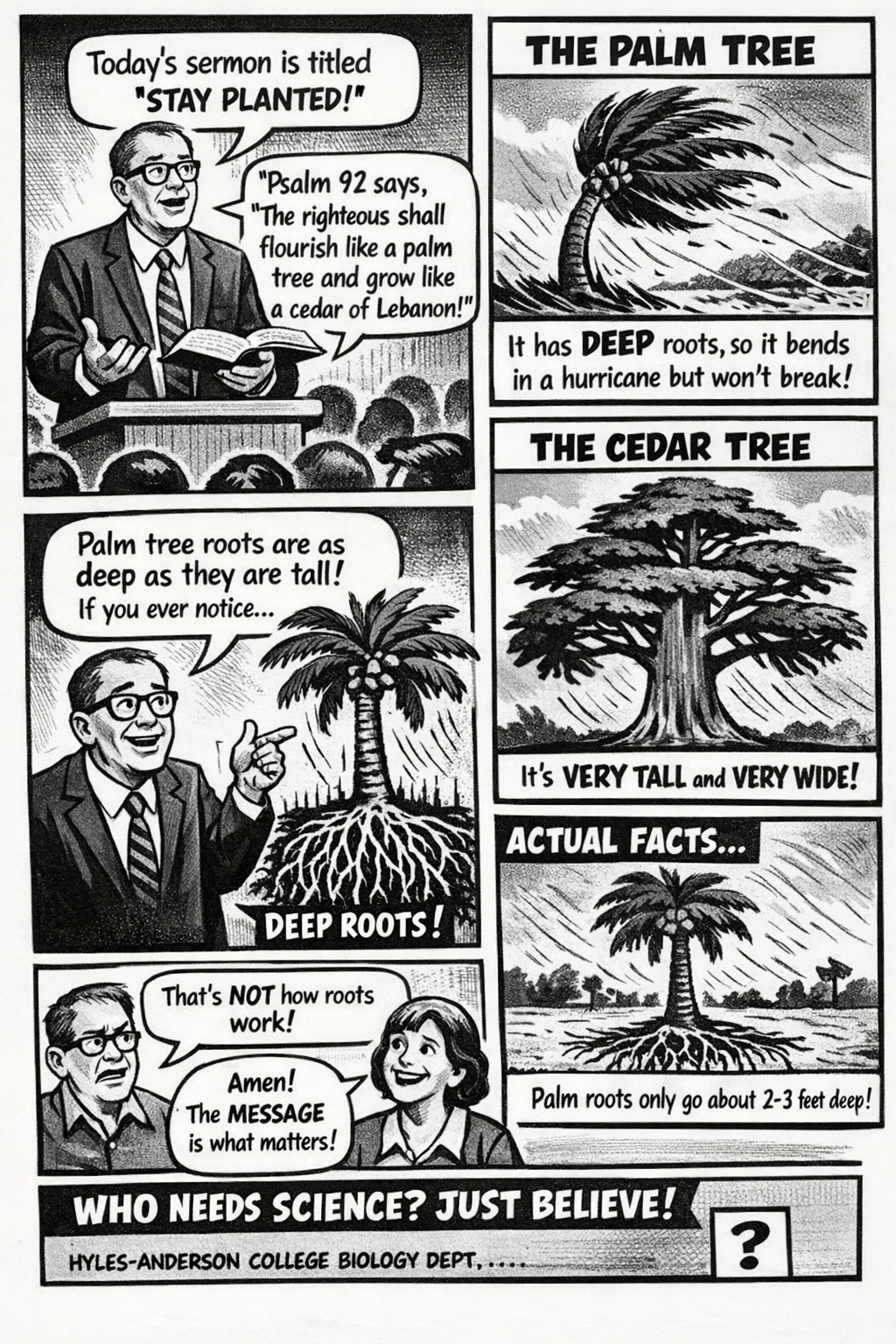
Froelke’s sermon, titled “Stay Planted,” relied on a series of botanical metaphors that would have felt reductive in a third-grade science fair, let alone a pulpit. Froelke turned to Psalm 92, citing the palm tree and the cedar of Lebanon. His “insight” into these complex biblical symbols—images that have sustained millennia of theological reflection—was as follows:
The Palm Tree: It has deep roots, so it bends in a hurricane but doesn’t break.
The Cedar: It is very tall and very wide.
(That’s it. That’s the exegesis. We’ve reached the theological equivalent of “big if true.”)
“Verse 12 says, ‘Shall flourish like a palm tree.’ Uh palm trees roots are as deep as they are tall. Uh and that’s true. If you ever notice in a hurricane or a storm or whatever, a palm tree will bend way way over and then it’ll come back uh up to normal size. And the reason for that is because the palm tree’s roots are as deep as it is tall.” –Steven Froelke
I suppose it’s silly to ask if there’s a biology department over at Hyles-Anderson College? Or even a library with a gardening section? Because here’s the thing: palm trees do not have tap roots. They have fibrous root systems that grow wide, not deep—rarely extending deeper than 3 feet. Palm tree roots are definitively, empirically, laughably not as deep as they are tall. A thirty-foot palm tree does not have thirty feet of roots. This is not a theological dispute. This is not a matter of hermeneutical framework. This is sixth-grade earth science.
But I’m sure that’s not important. Facts are so epistemically slippery these days. What’s important is the message:
“Stayed steadfast, unmovable, staying planted is so important… None of these things move me.”—Steven Foelke
And there it is. This is the “academic rigor” Reed so frequently celebrates—a pedagogical vacuum where complex ancient poetry is flattened into a motivational poster. Froelke’s exegesis didn’t invite the congregation into the text; it used the text as rhetorical lubricant for his true message: immobility is godliness.
Let’s be clear about what “staying planted” means in practice: when a congregant leaves Peachtree Road Baptist Church—perhaps because the “hard preaching” starts sounding too much like a smooth-brained ego trip, or because they’d prefer a pastor who understands the importance of basic fact-checking—they are labeled “church jumpers” who are “undermining authority.” They are unstable. Shallow-rooted. Tossed about by every wind of doctrine (or, you know, reasonable questions).
But when the “Man of God” moves to a larger pond, a more prestigious pulpit, or a better salary? Well, that’s a “divine planting.” That’s God opening doors. That’s the Lord’s leading.
Froelke comes off a bit like a fiduciary of the Hyles brand telling the investors to stay put and keep contributing while he manages the portfolio from a safer distance—one with fewer questions and better liability insurance.
As the sermon reached its climax, Froelke distilled the entire complexity of the New Testament church—with its deacons, elders, teachers, prophets, apostles, and rich ecclesiological diversity—into a binary so crude it would make a medieval feudal lord blush:
“There’s only two positions in the local church. Only two, the pastor and those that help the pastor.”—Steven Froelke
Here Froelke effortlessly strips away the biblical concepts of the “priesthood of all believers,” the “body of many parts,” or any form of collective accountability. Apparently in the Independent Baptist system, the church is not a community; it is a monarchy with a support staff. It’s not the Body of Christ; it’s a sole proprietorship with volunteer labor.
As Froelke’s sermon wraps, I’m mildly disappointed. I’d been hoping Jay Reed’s “crash and burn” comment meant I was finally going to hear the quiet parts said out loud. Instead, I had to settle for reading between the lines. The Hyles-Anderson “product” is a specific kind of soul: one that is too “planted” to notice the shallow roots of the teaching, too “loyal” to question the monarch at the center, and too “sanitized” to realize that a “Man of God” who fears a woman in trousers is usually a man who is terrified of being looked at too closely.
It makes me wonder what the “product” thinks this means: Does “staying planted” mean being rooted in the Truth, or does it just mean staying exactly where the Man of God needs you to be—preferably with your checkbook open and your questions closed?
Approximately fifteen minutes—or by some clocks an eternity—after Froelke began speaking, he passed the baton back to Jay Reed.
Let the circus begin.
Note: This analysis represents the author’s subjective interpretation of the sermon delivered on the date mentioned above. For further details, please see my full [Legal Disclaimer]