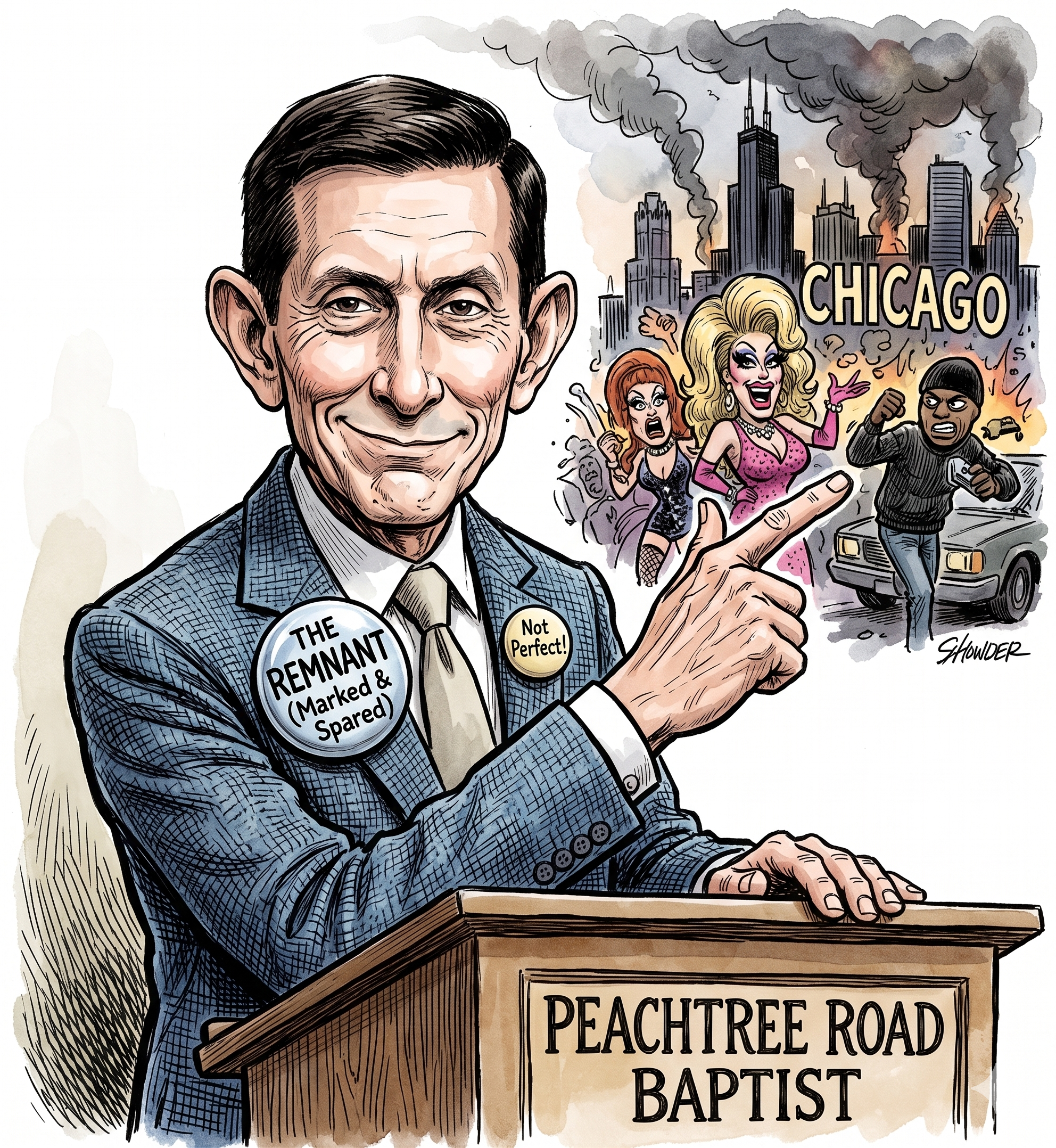
Notes on a sermon delivered at Peachtree Road (Independent) Baptist church on 11/23/2025
This Sunday evening’s message—framed as part of something called “third rail theology”—opened with a familiar assertion: no one is willing to talk about “these things anymore.”
This claim deserves attention not because it is novel, but because it is functional: it operates less as a description of reality than as a preemptive framing device. It allows “Independent” Baptist pastor Jay Reed to posture as embattled and courageous before saying things that have circulated freely through Independent Fundamentalist Baptist pulpits, cassette tapes, pamphlets, and conference circuits for decades—well before the Reagan administration, and certainly without meaningful risk to the speaker.
The maneuver is reliable: by declaring the topic “forbidden,” Reed converts repetition into bravery and inheritance into rebellion.
The sermon nominally takes its text from Psalm 144, though it quickly abandons any sustained engagement with the scripture itself in favor of a more familiar dramatic binary: culture versus Bible. We are told there are only two options—either embrace what Reed calls the “homogeneous nonsense” of modern society, or be “biblical.”
(One wonders what Reed thinks “homogeneous” means. Based on the sermon’s content, I’m guessing he believes it’s a synonym for “gay agenda,” which is itself a synonym for “things that make me uncomfortable.” Linguistic precision is not the point; vibes are.)
This is not an argument so much as a sorting mechanism. Its purpose is not persuasion but classification. By definition, disagreement is recast as spiritual failure rather than interpretive difference. Positions Jay does not articulate—let alone accurately represent—are dismissed in advance as unfaithful. The congregation is not invited to weigh competing readings, only to locate themselves correctly within the approved one.
It’s less exegesis, more theological CAPTCHA: “Select all the squares that contain biblical manhood.”
Before following him there, it’s worth pausing on the source text itself. (King James Version only, of course.)
Psalm 144:1–11
1 Blessed be the LORD my strength, which teacheth my hands to war, and my fingers to fight:
2 My goodness, and my fortress; my high tower, and my deliverer; my shield, and he in whom I trust; who subdueth my people under me.
3 LORD, what is man, that thou takest knowledge of him! or the son of man, that thou makest account of him!
4 Man is like to vanity: his days are as a shadow that passeth away.
5 Bow thy heavens, O LORD, and come down: touch the mountains, and they shall smoke.
6 Cast forth lightning, and scatter them: shoot out thine arrows, and destroy them.
7 Send thine hand from above; rid me, and deliver me out of great waters, from the hand of strange children;
8 Whose mouth speaketh vanity, and their right hand is a right hand of falsehood.
9 I will sing a new song unto thee, O God: upon a psaltery and an instrument of ten strings will I sing praises unto thee.
10 It is he that giveth salvation unto kings: who delivereth David his servant from the hurtful sword.
11 Rid me, and deliver me from the hand of strange children, whose mouth speaketh vanity, and their right hand is a right hand of falsehood.
Strange Children and Other Specters
Early in the sermon, Jay Reed introduces the first of several recurring specters with particular emphasis on “strange children.”
“Rid me and deliver me from the hand of strange children. Now, this is what we’re trying to stay away from. Strange children. We don’t need to raise any strange children. There are enough of those out there.” –Pastor Jay Reed
To deploy this phrase as he does, Jay must either misunderstand—or deliberately repurpose—the original context of Psalm 144. The Hebrew phrase used in Psalm 144:7 and 144:11 is ben nekar (בני נכר), which literally translates to “sons of a foreign land” or “foreigners.”
David is not lamenting failed parenting; he is invoking treaty-breaking enemies. It is a royal prayer for deliverance from foreign aggressors, framed in the language of ancient warfare and national threat, not a sociological meditation on youth culture. The “strange children” of the text are external invaders, not domestic deviations—the kind of people who show up with chariots and questionable intentions regarding your livestock, not the kind who get a nose ring and start listening to Billie Eilish.
Yet Reed smoothly transposes this plea for protection from invading forces into a lament about “kids these days.” With no argument and little explanation, the category of enemy is quietly relocated. Threat is no longer something that happens to the faithful from outside, but something that emerges from within when children fail to conform.
It’s a neat trick: David prays for victory over Philistines; Reed gets sermon material about teenagers who won’t make eye contact.
Notably, Reed never defines the term “strange children” with precision—which is precisely what makes it useful. According to Reed, these children are dishonest. Empty. Unmanly. Unfeminine. Undisciplined. Effeminate. Aimless. The list is suggestive rather than specific, allowing the listener to supply their own anxieties without Reed ever naming them. The phrase functions less as a description than as a container into which cultural unease may be poured, with the added benefit of Jay taking zero risk or accountability with specifics.
Reed does offer at least two illustrations—”We have young men that are grown up. Not manchilds. Not 30 and living in the basement.” / “Our children have five-inch biceps and sixteen-inch thumbs…”—but this clarifies little. These are caricatures, not categories. They establish mood and elicit emotion, not explicit meaning or evidence.
Instead, we must rely on the subtext: a sense that deviation itself is dangerous, and that ambiguity is evidence of moral failure. The sermon operates on the principle that if you can’t immediately gender-sort a behavior into “masculine” or “feminine,” then someone has failed, and that someone is probably the parents—or the culture, or the liberals, or the school system, or whoever is convenient.
Fortunately, we are assured that the solution lies in properly gendered parenting. And here, we can finally parse what Reed was actually trying to say. Sons must be raised like “plants.” Daughters like “polished cornerstones.” This metaphor, also borrowed from Psalm 144, is repeated with increasing confidence:
“That our sons may be as plants grown up in their youth; that our daughters may be as cornerstones, polished after the similitude of a palace.” —Psalm 144:12 (KJV)
From this, Reed constructs a rigid, gender-essentialist pedagogy. Boys must perform physical labor lest they become “cream puffs.” Girls must be “polished” for poised domestic submission. The metaphors are no longer illustrative; they are prescriptive. And also, somehow, both botanical and architectural, which raises questions about what exactly happens during adolescence in Reed’s worldview. Do boys photosynthesize? Are daughters loadbearing?
But Psalm 144 is not a parenting manual. It is a royal lament. Verse 12 is not instruction but aftermath. It describes the condition of a society after deliverance has been secured. When the foreign invaders—the actual “strange children”—are driven out, the nation can finally flourish.
This is poetry about national peace. To collapse it into household choreography is not merely careless exegesis; it is a category error. The Bible is describing a civilization no longer under siege. The sermon describes a mid-century gender ideal. Historical context is not merely ignored—it is set aside because it interferes with the conclusion already assumed.
The congregation is not asked to understand this analogy—only to feel it. Meaning is conveyed through resonance rather than reasoning. The image is treated as self-evident, immune to examination. If you squint hard enough and ignore the original language, historical setting, and literary genre, it says exactly what Jay needs it to say. Which is convenient.
By this point, the sermon’s operative thesis has quietly settled into place: gender difference is destiny, and destiny must be enforced rather than discerned. The groundwork has been laid—not through careful exegesis, but through rhetorical narrowing: fewer categories, fewer questions, fewer acceptable interpretations.
Masculinity, Work, and the Cult of the Obvious
Much of the message is devoted to young men—specifically, to the urgent need for them to work. This is framed as a daring act of countercultural clarity, despite being one of the least controversial propositions imaginable. Work is good. Laziness is bad. Responsibility matters.
One waits, patiently, for the forbidden doctrine.
It never arrives. Instead, the sermon relies on escalation through repetition. Laziness becomes a “disease,” then a “cancer.” Leisure is reclassified as degeneration. Young men who resist are not merely imprudent but foolish—”handicapping” themselves, erecting a “steel ceiling” over their own lives. The insight remains banal; the language grows severe. What is being sold as hard truth is, in fact, a moralized version of common sense, inflated through urgency and threat.
This is the logic of what might be called the cult of the obvious: familiar ideas treated as embattled wisdom, disagreement framed as rebellion, and severity mistaken for depth. Reed casts himself as the seasoned realist—the man who has seen how the world really works—while anticipating and neutralizing resistance in advance.
It’s like if someone stood up in a meeting and said, “I know this is controversial, but hear me out: we should probably pay our bills on time,” and then waited for applause.
That’s when things got pretty weird, but not exactly “third rail” weird.
“We got because of the ice raids, you’ve got job sites that are empty… You know why the illegals are there? Because they work harder. It’s a shame that people who grew up in other cultures have more character…”-Pastor Jay Reed
Here Jay briefly abandons theology altogether and turns to sociopolitics—specifically, to the kind of sociopolitics that make you want to check the exits. He praises undocumented immigrant laborers as possessing superior “character” because they “work harder,” while lamenting that young men raised in this country do not.
This creates a startling contradiction, which would be more interesting if Reed seemed aware of it. The same sermon that prays for deliverance from “strange children”—foreigners characterized as dishonest and empty—now holds up the literal stranger as the moral exemplar. The tension is not resolved because it is not recognized.
If an undocumented worker labors harder than a saved teenager, then the worker has more “character.” Faith recedes. Grace disappears. Utility becomes virtue. The gospel is no longer “by grace through faith,” but “by biceps through landscaping.”
This is not Christian moral reasoning. I’m not sure what to call it—Prosperity Gospel meets Ayn Rand meets a Home Depot parking lot at 6 a.m.?—but the result is a moral sleight of hand. A sermon ostensibly about Christian masculinity quietly substitutes a nationalist ethic of productivity for a theological one, without naming the shift or justifying it. The Bible recedes, and a cultural hierarchy takes its place—one in which virtue is measured not by love, justice, or humility, but by who works harder for whom.
And look, I don’t want to be uncharitable here, but referring to human beings created in the image of God as “the illegals” while simultaneously praising their work ethic is the kind of cognitive dissonance that should require a prescription.
Women, Authority, and the Return of Caesar
Now that Jay’s established that men’s utility—and therefore Godliness—is measured by their labor output and the dimensions of their biceps, he pivots to briefly opine on the corresponding value of women: submission.
The sermon’s discussion of women’s roles is less developed than its treatment of men, but again, much more is revealed in the subtext. Wives are reminded that obedience to a husband should exceed obedience to an employer. Mothers are warned against “farming out” their responsibilities. A woman who listens too readily to her boss, we are told, has an “authority problem.”
“If you go to work and you listen to your boss and are more obedient to him and submissive to him, then your husband, you got a problem.”- Pastor Jay Reed
The claim is delivered with practiced reassurance, the vocal equivalent of a pat on the head. The role God designed for women, Reed insists, is “perfect.” No supporting argument follows, nor does one seem to be expected. Perfection, in this context, is not demonstrated or defended; it is asserted and then insulated from critique by appeals to submission. To question the structure is to reveal one’s disobedience to it.
It’s a closed loop: the system is perfect, and if you disagree, that’s proof you’re broken.
What is striking here is the moral confusion embedded in the comparison itself. A workplace relationship is contractual: labor exchanged for wages under mutually agreed terms. Obedience in this context is not submission; it is competence. You listen to your boss because you accepted employment, not because you’ve entered a covenant of spiritual headship with the regional manager at Target.
But Reed treats professional competence as a threat to domestic hierarchy, which tells you everything you need to know about how fragile he believes that hierarchy actually is.
The implication is difficult to miss. Authority, as Reed imagines it, is so fragile it cannot withstand parallel forms of responsibility. Headship must be constantly protected from ordinary adult life—from bosses, coworkers, professional development, or any context in which a woman might demonstrate competence independent of her husband’s approval. The sermon that demands “grown-up men” quietly describes a masculinity deeply unsettled by a wife’s professional integrity.
Which raises an uncomfortable question: if your authority as a husband is threatened by your wife being good at her job, is the problem her competence or your insecurity?
This anxiety surfaces again in Reed’s handling of gendered language. Mocking the idea of women in leadership, he insists that the Bible never says “quit you like women,” only “quit you like men,” which he takes to mean behaving according to a narrowly defined masculine ideal. Either one accepts this distinction, he says, or one capitulates to “homogeneous nonsense.” One is either biblical—or not.
Yet even here, Reed’s certainty seems to rest on a misunderstanding of his own preferred translation. In the King James Version, “quit you like men” reflects an older usage of quit—derived from acquit—meaning to discharge one’s duty or stand firm. It is a call to courage, not to cultural performance. The original Greek term (andrizomai) was historically used to exhort entire communities, not to fence courage off as an exclusively male virtue.
Scripture itself complicates Reed’s claim, celebrating the fortitude and resolve of women like Deborah, Jael, and Esther—figures whose courage is neither symbolic nor secondary. Deborah led armies. Jael drove a tent peg through a general’s skull. Esther risked execution to save her people. But Reed is not interested in Deborah, Jael, or Esther except as props. What Reed presents as timeless biblical clarity is, in practice, a narrowing of language to protect a hierarchy already assumed. Courage becomes masculine by definition. Authority becomes zero-sum. And submission becomes the lens through which all relationships must be interpreted, whether theological, domestic, or economic.
What makes this sermon notable is not its extremism, but its caution. Every hard edge is sanded just enough to remain deniable. Statements are floated, then half-retrieved. Jokes cushion commands. Statistics appear without sources, doing their emotional work before anyone can ask where they came from. Severity is carefully staged, never quite owned.
Reed insists repeatedly that he is not intimidated. He reassures the congregation of his “biblical soundness.” He emphasizes that these messages are “personalized,” by which he means that any discomfort felt in the pews should be interpreted not as a prompt for reflection, but as evidence of personal failure. The sermon trains its listeners in advance how to respond to its own excesses.
If you’re uncomfortable, that’s a you problem. Which is convenient, because it means Reed never has to examine whether his discomfort with women in leadership is biblical or just…uncomfortable.
It is also here that the sermon’s political theology reasserts itself. Again and again, Reed returns to the refrain: to reject “biblical” authority is to choose Caesar. Society has chosen Caesar. Some churches, tragically, have followed. The implication is never stated outright, but it is unmistakable. Resistance to this teaching is not disagreement; it is collaboration with an alien regime.
The move is decisive: questions become betrayals, and critique becomes treason. What began as guidance about family roles ends as a loyalty test.
(For the record, if your theology requires you to frame basic questions as acts of treason, that’s not confidence in the truth. That’s fear of examination.)
The Pharisaic Invention: Purity as Parental Surveillance
Finally, the sermon compensates for its thin scriptural grounding with a series of man-made traditions presented as biblical absolutes. Prohibitions against “single dating,” warnings about high school relationships sabotaging college graduation—none of this arises from the text. Scripture is not being expounded; it is being supplemented with house rules dressed up in King James English.
What replaces it is surveillance. Purity is no longer framed as internal formation guided by conscience and the Spirit, but as external control managed by parents who must “stop the clock.” This is a familiar move in fundamentalist circles: when trust in moral formation weakens, control expands. The result is not holiness, but compliance—and compliance that requires constant supervision.
It’s less “train up a child in the way he should go” and more “install monitoring software and hope for the best.”
The irony, of course, is that this approach produces exactly the kind of “strange children” Reed claims to be warning against—young adults who have never learned to navigate moral decisions independently because every choice was pre-made for them. They don’t develop discernment; they develop dependence. And when the surveillance inevitably ends (because you can’t chaperone a 30-year-old), they don’t know how to function.
But Reed isn’t interested in formation. He’s interested in control. And control, unlike discipleship, can be measured, managed, and enforced.
The Illusion of the “Third Rail”
Jay Reed calls this sermon “Third Rail Theology,” a title designed to function as a rhetorical shield. By invoking the image of a live wire—dangerous, high-voltage, and avoided by the timid—he preemptively frames his restatement of mid-century subcultural norms as an act of courage.
But when we look at the machinery of the delivery, the “Third Rail” is revealed to be a carefully constructed illusion. There’s no voltage here. There’s no danger. There’s just a man standing in a pulpit, repeating things his grandfather said, and calling it radical.
Instead, this sermon is a masterclass in deniable severity. Reed offers a version of fundamentalism that has learned to navigate modern sensibilities by using three specific rhetorical maneuvers:
- The Manufactured Crisis: By claiming “no one talks about these things,” Reed creates a false sense of scarcity, making the repetition of 1950s gender roles feel like a “forbidden” discovery rather than a cultural inheritance that’s been on loop since Eisenhower was in office.
- The Aesthetic of Common Sense: He replaces the “jagged” belligerence of the old guard with the “sanitized” tone of a modern professional. By using jokes to cushion commands and vague caricatures to replace evidence, he allows extreme requirements—like the total surveillance of children or the restriction of women’s professional ambitions—to feel like simple “common sense.” It’s fundamentalism, but make it relatable.
- The Insulation of Authority: Most importantly, he frames disagreement not as an interpretive difference, but as a spiritual pathology. By labeling the outside world “Caesar,” he ensures that the walls of Peachtree Road remain unbreached by actual discourse. You’re either inside the compound, or you’re working for the empire. There is no third option.
To see this machinery in its raw state, one only has to look at Reed’s lineage. When his former boss, Pastor Keith Gomez, barked from the pulpit about “satanic plots of women’s liberation” and beating a child until “they can’t talk back,” he was rhetorically transparent. Gomez’s fundamentalism is raw and radioactive; there is no subtext required. He says the quiet part loud, and then says it again, louder, in case you missed it.
Reed, however, represents the evolution of this ideology. He has figured out how to keep the power structure of the old-school IFB while adopting the non-threatening posture of a suburban evangelical church. He inherits the authority of the “hard-man” without the social cost. He gets to be the gatekeeper without looking like one.
This is the ultimate irony of the “Third Rail” presentation. Reed isn’t touching a live wire; he is demonstrating how to build a more effective fence. He is raising a congregation that is “pruned” for uniform growth—a rhetorical project that allows them to rise vertically within his narrow, sanctioned bounds, while denying them the linguistic or intellectual tools to spread their branches beyond the pot he has placed them in.
Which brings me back to the two young women on my porch, and to the question I now realize this system will never allow them to answer: what does “strange children” actually mean?
The answer, of course, is: whatever Jay Reed needs it to mean. This week, it’s teenagers with small biceps and large thumbs. Next week, it might be daughters who ask too many questions, or sons who don’t want to attend Bible college, or anyone who wonders why Reed’s “biblical” values always seemed ripped from the pages of a 1957 Ladies Home Journal.
The phrase is not a category. It’s a weapon. And it will be deployed whenever the fence needs reinforcing.
But here’s the thing about fences: they keep people in, sure. But they also keep people out. And eventually, you have to ask yourself which side of the fence the gospel is on—and whether the person building the fence is protecting the truth, or just protecting his territory.
Note: This analysis represents the author’s subjective interpretation of the sermon delivered on the date mentioned above. For further details, please see my full [Legal Disclaimer]