Notes on a sermon delivered at Peachtree Road Baptist Church on 01/11/2026 The full sermon can be viewed on Youtube
Pastor Jay Reed opened his January 11th sermon with a rhetorical flourish designed to preempt criticism:
“We are talking about third rail theology and it’s basically the stuff nobody wants to preach anymore because it’s controversial. But I made a statement I think that you should pay attention to. If I’m making it up, then you can do whatever you want to with it. One man’s opinion is just the same as anybody else’s. But if it’s biblical, then…you’re accountable to that.”—Pastor Jay Reed
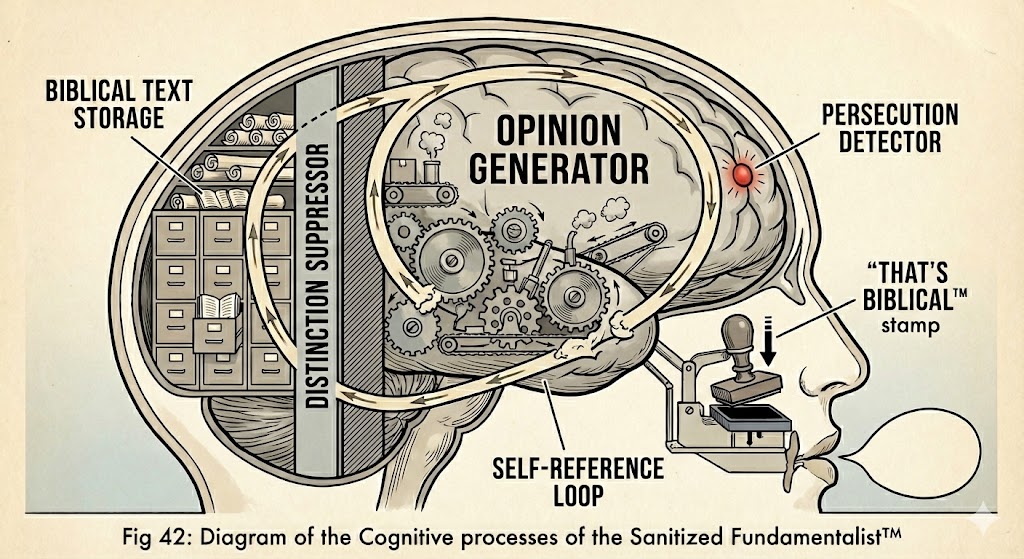
This is Reed’s epistemological insurance policy. Either his teaching is “biblical” (and therefore binding on the congregation’s conscience), or it’s “opinion” (and therefore dismissible). The implication: Reed believes what follows is Scripture, not speculation. The congregation’s accountability hinges on this distinction.
It’s a reasonable framework. In fact, it’s the correct framework for evaluating any sermon. The question is whether Reed honors his own standard or simply weaponizes it.
Let’s examine the evidence.
The Old Standby: Manufacturing Crisis
“If the devil has attacked anything, he’s attacked the home. We’ve talked about raising grown-up sons and rocks daughters, but we’re going to talk about the roles of husbands and wives within the home. That’s not a bad thing.”—Pastor Jay Reed
Setting up his favored persecution narrative, Reed anticipates objection (“That’s not a bad thing”) which creates the impression that what he’s about to say is controversial precisely because it’s true.
“Well, you’re just trying to reinforce gender stereotypes. No, I’m a Bible preacher and there’s a difference. This is not opinion.”—Pastor Jay Reed
Here we are, three minutes in, and Reed has already claimed his teaching transcends opinion. But what has he actually established biblically at this point? Nothing. He’s asserted that “the devil has attacked the home,” but this is merely interpretation of cultural trends through Reed’s ideological lens. Many Christians would agree the family faces challenges; far fewer would agree that Reed’s specific diagnosis (or prescription) is self-evidently biblical.
“Well, if the Bible promotes the patriarchy, then you ought to listen.”—Pastor Jay Reed
The conditional clause is doing significant work here, collapsing the distinction between his reading of Scripture and Scripture itself.
His evidence for biblical patriarchy?
“If you want to see women or womanhood elevated, go to Bible believing countries or Christian nations. You go where the Bible is not elevated, that where Christianity is unheard of, and all of a sudden, women find themselves in very precarious places.”—Pastor Jay Reed
The masquerade begins. Reed is claiming that women’s flourishing correlates with “Bible believing countries,” but he provides no data, no comparative analysis, no engagement with counterexamples (the Nordic countries with robust women’s rights and low religiosity, for instance, or the documented abuse of women within fundamentalist Christian communities). This is vibes-based apologetics.
“And the degree to which we become godless in this country, all of a sudden we’ve got biological males masquerading as women caving their heads in in sports. Okay? That’s an anti-biblical position that leads to women being demeaned.”—Pastor Jay Reed
Reed is now discussing transgender athletes—a contemporary political controversy—and declaring it “anti-biblical.”
This is not to say Christians can’t or shouldn’t form theological opinions about transgender issues. They can and should. But forming an opinion and declaring that opinion to be the biblical position are two different things. Reed is doing the latter.
His logic runs like this: (1) The Bible teaches there are two sexes. (2) Transgender ideology denies this. (3) Therefore, opposing transgender athletes in women’s sports is the biblical position. But this reasoning requires several intermediate steps that Reed doesn’t provide—steps that involve prudential judgment, interpretation of complex medical and psychological realities, and application of biblical principles to situations Scripture never addresses.
In other words: opinion.
“There’s real demeaning and there’s biblical roles and you learn to tell the difference between the two.”—Pastor Jay Reed
Here’s the problem: Reed never actually teaches his congregation how to “tell the difference.” He simply asserts that his positions constitute “biblical roles” while opposing positions constitute “real demeaning.”
What has Reed established biblically so far? That the Bible has something to say about men and women (true). That this something can be reduced to “biblical roles” (debatable). That these roles map precisely onto Reed’s cultural preferences (unproven).
“And nobody wants to submit to God’s word. We’re going to start with men. Even though the Bible starts with women, I just thought you needed a breather.”—Pastor Jay Reed
I appreciate his self-awareness here. I could use a “breather” from Reed’s “biblical” views on women. But before I get too relaxed, I note the sermon is now ten minutes in. Reed has made sweeping claims about culture, gender, sports, and the condition of the American family. He has declared his teaching “biblical” multiple times. And he has yet to open his Bible.
Biblical Content: 5%
Opinion Content: 95%
The Text Arrives (Sort Of)
Finally, fifteen minutes into the sermon, Reed opens Scripture. He begins with Ephesians 5:25:
“Husbands, love your wives even as Christ also loved the church and gave himself for it that he might sanctify and cleanse it with the washing of the water by the word that he might present it to himself a glorious church not having spot or wrinkle or any such thing. They should be holy and without blemish. So ought men to love their wives as their own body. He that loveth his wife loveth himself.”—Pastor Jay Reed
This is unambiguously biblical. Paul’s instruction to husbands in Ephesians 5 is clear, beautiful, and demanding. Husbands are to love their wives with the same self-sacrificial love Christ demonstrated for the church. This is the high-water mark of New Testament marital ethics, and it places the burden of Christlike love squarely on the husband.
Reed’s exposition of this passage is, to his credit, largely faithful to the text. He emphasizes that husbands must “practice thoughtful, strong love.” He notes that “the husband has the most to do in the relationship.” He even acknowledges that Christ’s love for the church was active, sacrificial, and costly—and that husbands are called to mirror this.
So far, Reed is teaching Scripture. But as he moves to application, it doesn’t take long for his personal opinions to begin colonizing the biblical text.
“The husband has to fill the role in his marriage that Christ fills for the church. Those are some pretty big shoes to fill. Remember when I first got here, the former pastor had been here 45 years. And if I heard it once, I heard it a hundred times. Oh, those some big shoes to fill. And my pat answer used to be, I don’t have to fill his shoes. I just have to fill mine. And that’s the truth.”—Pastor Jay Reed
Reed’s self-insertion here feels like a non-sequitur, and it is. But let’s parse his message. Reed is ostensibly illustrating the intimidating standard of Christlike love in marriage. He acknowledges it’s “big shoes to fill,” which is true—Christ’s love is perfect, infinite, and utterly sacrificial. Any honest husband should feel the weight of being called to mirror that love.
But instead of pointing his congregation toward the sufficiency of the Spirit or the transformative power of grace, they’re hearing about Reed’s clever comeback to his critics when he arrived at Peachtree Road.
Unfortunately, there appears to be a misunderstanding. His analogy suggests that just as he didn’t need to be his predecessor, husbands don’t need to be Christ (only faithful to their own version of love). But Ephesians 5 isn’t saying “love your wife in your own unique way.” It’s saying “love your wife as Christ loved the church“—the Christ-standard is the husband’s standard. There are no “other shoes” to fill. Christ’s shoes are the assignment. Reed’s illustration functions as an escape hatch that Paul does not provide in the text.
But more problematic is the ministerial narcissism on display. Reed has a habit, conscious or unconscious, of making every sermon about himself. The biblical text becomes a mirror reflecting Reed’s experience rather than a window revealing Christ’s character. When teaching about wisdom, he tells stories about his traffic tickets. When teaching about listening, he talks about his wife’s communication style. When talking about gratitude, he shares his opinions about where to get the best lasagna in Italy.
A more disciplined preacher, confronted with the “impossibly high standard” problem, might say something like: “Husbands, I know what you’re thinking—’I can’t love like Christ loves.’ You’re right. Not in your own strength. But the same Spirit who empowered Christ to give himself for the church dwells in you. You’re not manufacturing Christlike love through willpower; you’re depending on Christ’s power working through you.”
Instead Reed draws attention to Reed, undermines the text’s standard, and offers false comfort. The Bible becomes a supporting character in Reed’s ongoing narrative about himself.
“He has to care for her so that he can be proud of her. Notice verse 27. He’s going to present her to himself. If your wife is not beautiful in your estimation, then you have failed in helping her become so. Well, I just don’t feel attracted to her. Your fault. When she seems unhappy all the time. Your fault.”—Pastor Jay Reed
This is where things get complicated. Reed is extrapolating from Paul’s statement that Christ will “present [the church] to himself a glorious church” to argue that a husband bears responsibility for his wife’s attractiveness and emotional state. It’s a fair question to ask if this is appropriate application of this text
Partially. Paul does say Christ sanctifies and cleanses the church “that he might present it to himself” glorious and spotless. Paul is describing Christ’s spiritual transformation of the church—from dead in sin to alive in Christ, from spotted to spotless.
But Reed reduces this complex concept to a discussion of physical attraction: “If your wife is not beautiful in your estimation, then you have failed in helping her become so.” This is emphatically not what Paul was talking about.
The Accountability Problem
“When is the last time a man accepted responsibility for what’s going on in his home? You know why we blame? Because it’s easy. Because it takes the man of responsibility that is supposed to be on me. I’m the head of my household. Then really then the responsibility is yours. Then you’re responsible for everything that goes on. You get the title. You get the responsibility that goes with it.”—Pastor Jay Reed
I have no issue with what Reed is doing here. He is holding men accountable for their leadership. He’s pushing back against the tendency to blame wives for relational dysfunction. He’s applying Ephesians 5’s call to Christlike love in a way that actually challenges the men in the room.
“My job as a husband is to oversee the care and feeding of my wife. That’s fun to say, isn’t it? There’s something you read on the side of a like goldfish. My job as a husband is oversee the care and feeding of my wife. Well, yeah. Here’s what the Bible says. If any man provide not for his own, especially for those of his own household, he’s worse than an infidel. Denying the faith.”—Pastor Jay Reed
Reed is quoting 1 Timothy 5:8, where Paul does say that a man who doesn’t provide for his household has “denied the faith” and is “worse than an unbeliever.”
So this is biblical, right?
Yes and no.
The command to provide is biblical. But watch what Reed does with it:
“If you’re not feeding your family, sir. And I’ve had so many sirs come to me, well, I had I had people come to me one time and say, ‘Well, the pastor from our last church said it was okay for me to be the house dad.’ Well, the pastor from your old church didn’t read the Bible.”—Pastor Jay Reed
Reed has just taken a biblical command (men must provide for their families) and weaponized it against a specific family arrangement (stay-at-home fathers). But does 1 Timothy 5:8 actually prohibit a husband from being the primary caregiver while his wife works?
Paul’s command is that the man must “provide” for his household. In the first-century Greco-Roman world, this almost certainly meant financial provision, because women had limited economic opportunities. But Paul doesn’t specify how a man must provide, nor does he forbid a wife from contributing financially to the household.
Reed is reading his cultural assumptions into the text. In his world, “providing” means the husband earns money outside the home while the wife stays home with the children. That’s one legitimate application of the command to provide. But it’s not the only legitimate application.
Consider: What if a husband has a disability that prevents him from working outside the home, but his wife has a high-paying career? Does 1 Timothy 5:8 require him to work anyway or deny the faith? What if a husband is a novelist who writes from home while his wife is a surgeon? Is he “not providing” because he’s physically present in the house during the day?
Reed might respond that these are edge cases, and that in the typical situation, husbands should work outside the home. Perhaps. But “typical situation” is not the same as “biblical mandate.” Reed is conflating a general principle (husbands must provide) with a specific application (husbands must work outside the home while wives stay inside it), and he’s declaring the latter to be just as binding as the former.
“Young ladies that aren’t married, long time before you get infatuated with anybody, you better look and see if they can work because a long time after handsome is worn off, lazy sticks around.”—Pastor Jay Reed
Is this biblical wisdom or folk wisdom? The Proverbs certainly warn against laziness (Proverbs 6:6-11, 10:4, 13:4), and Paul condemns those who refuse to work (2 Thessalonians 3:10). So the principle—that industriousness matters more than attractiveness in a spouse—is biblically defensible.
But Reed’s not teaching about the virtue of diligence; he’s offering pragmatic relationship advice. It’s the kind of thing your grandmother might say, and your grandmother might be right. But it’s not Scripture, and Reed shouldn’t be treating it as such without a clear distinction between the two.
Biblical Content: 40%
Opinion Content: 60%
The Thoughtfulness Mandate: Where Reed Gets It Right (And Wrong)
Reed spends considerable time unpacking what he calls “thoughtfulness” in loving one’s wife:
“I cannot meet the needs of which I’m not aware. If my wife is sitting there thinking he’s not meeting my needs, it’s because I’m not paying attention because more than likely she’s telling you.”—Pastor Jay Reed
This is pastoral wisdom consistent with the biblical call for husbands to “dwell with them according to knowledge” (1 Peter 3:7). A husband who doesn’t pay attention to his wife’s needs isn’t loving her in a Christlike way.
Reed then provides a series of questions husbands should ask:
“Think about where your wife is in life. Okay? She is she a mother right now overwhelmed with the needs of her children? Are you newlyweds and she’s left her home and now she’s living with you and finding out that you aren’t prince charming on a white horse? You’re like the dude in the wife beater undershirt on a very slow burro. Is she going through the shock and acclamation of early marriage? Is she having children and she’s overwhelmed by it?”—Pastor Jay Reed
These are good questions.
“A lot of times she’s a lot more interested in how your how your house is decorated than you are. Now I I realize there’s a there’s a few pixies out there on the home and family. This is what we’re going to do here. Stop. That’s not typically the dude. But just because it’s not meaningful to you doesn’t mean it’s meaningful to her.”—Pastor Jay Reed
This is supposedly a lesson about empathy in practice. A fundamentally sound message that is unfortunately truncated by a gratuitous homophobic slur directed at men who care about home decoration. He can’t help himself. Even when it’s something as basic as caring about the feelings of others, he has to signal his contempt for men who don’t conform to his narrow definition of masculinity.
Reed is once again blurring the line between biblical principle and cultural preference. The Bible doesn’t say anything about whether men should or shouldn’t care about home decoration. Reed is the one who’s decided that caring about interior design is effeminate.
“Think about what her physical needs are. Wives and mothers are awesome things. A baby grows and I I have a daughter with child right now. I have a child who’s having a child. Man, we ain’t got all that plumbing. Thank God for it. Okay. Physiologically, there are issues that are different. There are needs that are different for her than for you.”—Pastor Jay Reed
Again, this is helpful. Reed is teaching men to recognize that women’s bodies work differently than men’s bodies, particularly during pregnancy and motherhood. This is not rocket science, but it’s apparently not obvious to the men in Reed’s congregation, so he’s spelling it out.
“Think about what her financial needs are. Okay? If you’re going to ask her to stay home, what are you providing with her with financially?”—Pastor Jay Reed
“If you’re going to ask her to stay home.” Interesting. I thought it was biblical for women to stay home. He quoted Titus 2:3-5 earlier (“the age women are to teach a younger woman to be chased, sober to be keepers at home”). If staying home is a biblical mandate for women, then why is Reed framing it as something the husband “asks” her to do?
It seems Reed is hedging. He asserts strong positions (“this is biblical”), then qualifies them in ways that reveal his own uncertainty (“if you’re going to ask her”), but he never acknowledges the tension between the two.
Biblical Content: 50%
Opinion Content: 50%
The Boaz Illustration: When Proof-Texting Goes Wrong
“Boaz when he’s winning Ruth over to himself once she realized she’s a prospect. Listen, when you’re 80 and she’s 30, some Bible stories you just shouldn’t think about the specifics on. Anyway, she starts I don’t know how to dress that up. It’s in there. I mean, it’s like, well, you named your daughter Esther, but I don’t know what number in line she was. Like, anyhow, whatever. I’m just saying. But Boaz left handfuls of purpose.”—Pastor Jay Reed
Let’s pause here and appreciate what Reed has done. He’s invoking the story of Ruth and Boaz—one of the most beautiful narratives in Scripture about redemption, loyalty, and God’s providential care. But Reed can’t help but reduce it to a weird aside about the age gap between Boaz and Ruth.
First, Scripture doesn’t tell us Boaz’s age. He’s described as a “mighty man of wealth” and as Ruth’s kinsman-redeemer, but there’s no indication he was 80 years old.
Second, Reed’s discomfort with the “specifics” is revealing. He’s uncomfortable because he’s reading a modern romantic relationship template onto an ancient kinsman-redeemer narrative. The text isn’t describing a May-December romance that makes Reed squeamish. It’s describing a legal arrangement in which Boaz fulfills his family obligation to provide for his kinsman’s widow.
Finally, by joking that “some Bible stories you just shouldn’t think about the specifics on,” Reed is teaching his congregation to avoid wrestling with the cultural distance between themselves and the biblical text. This is anti-intellectual. The right move is to explain the cultural context so the congregation understands why ancient near-eastern marriage customs don’t map directly onto 21st century American dating. Instead, Reed makes a joke and moves on.
The Esther comment is even worse and is genuinely offensive to both the text and to Jewish tradition. He implies that naming your daughter “Esther” is problematic because Esther was one of many women in King Ahasuerus’s harem, selected for the king’s sexual gratification. Reed is suggesting there’s something morally dubious about honoring a woman who was, in his framing, just “a number in line” for a pagan king.
But Esther risked her life to save her people from genocide. She used her position—which she didn’t choose—to intervene on behalf of the Jews. The book of Esther is about courage, providence, and God’s hidden hand protecting his people even in exile. It’s one of only two books of the Bible named after a woman.
Anyway.
Reed is correct that Boaz instructed his workers to leave grain for Ruth intentionally (Ruth 2:16). And he’s correct that this demonstrates Boaz’s thoughtfulness and generosity toward Ruth’s needs. However, Reed doesn’t engage the legal context (Boaz wasn’t just being nice—he was fulfilling the Torah’s commands about gleaning), the power dynamics (The “handfuls of purpose” weren’t romantic gestures—they were acts of protection and provision in a society where Ruth had no legal standing.), or the redemption theme universally understood from this text (The entire book is building toward Boaz’s role as kinsman-redeemer—Hebrew go’el—which is a legal-theological concept about restoring family property and lineage).
Reed bypasses all of this rich theological content to make a point about dating:
“Listen, there is an understanding that you need to have about your wife. What does she need? How can I provide that for her? How can we lavish so much on them during courtship and then we get married? We’re like, ‘Okay, on to the next thing. Wait, what? What?’”—Pastor Jay Reed
Translated to: “Don’t stop being romantic after marriage.” It’s not that the principle is wrong—it’s that the text isn’t teaching that principle. Reed is using Ruth as a Hallmark card when it’s actually a legal drama about covenant, redemption, and providence. Ruth is not a marriage manual; it’s a story about faithfulness and God’s care for the vulnerable. Reed is using it as a proof-text for his point about courtship, which is frankly the kind of laziness I’ve come to expect, but I do not have to accept as “biblical.”
Biblical Content: 30%
Opinion Content: 70%
The Bitterness Problem: When Grace Becomes Erasure
“Strong love causes me to overcome bitterness and slight. I already quoted this one, but you should make a note of Colossians 3 and verse 19. Husbands, love your wives. And in adjacent to that thought, and be not bitter against them.”—Pastor Jay Reed
This is straight from Colossians 3:19, and Paul does command husbands not to be bitter toward their wives.
“Let’s just lay the cards on the table. Your wife’s going to do some things that absolutely bug you as a continual dropping on a very rainy day.”—Pastor Jay Reed
Reed is quoting Proverbs 19:13 and 27:15, which warn about the misery of living with a contentious spouse.
“She won’t shut up.”—Pastor Jay Reed
The Proverbs describe a “contentious” woman—someone who is quarrelsome, argumentative, and perpetually dissatisfied. Reed reduces this to “she won’t shut up,” which is both reductive and demeaning. More importantly, he’s quoting Proverbs to establish that wives can be annoying in a sermon about husbands’ responsibilities. Reed is teaching men not to be bitter by reminding them how annoying their wives are. This seems counterproductive.
“Strong love allows me to cut through bitterness. Do you know what Jesus gives you every day, sir? A blank slate. And for you to wake up bitter with your spouse because of what happened yesterday, you’re a small man.”—Pastor Jay Reed
At first glance, this appears powerful. Christ’s mercies are “new every morning” (Lamentations 3:22-23), and we’re commanded to forgive as we’ve been forgiven. But there’s a significant problem with Reed’s application: he offers no distinction between petty grievances and legitimate harm.
Reed frames all marital conflict as something husbands should “get over” by the next morning. He collapses every possible marital grievance into a single category: things small men hold onto.
Consider how this teaching functions in practice:
Scenario 1: Your wife made a thoughtless comment during dinner that hurt your feelings. You wake up the next day still feeling wounded.
Reed’s teaching: “Get over it. You’re being a small man.”
This is probably appropriate. Love “covers a multitude of sins” (1 Peter 4:8), and minor offenses shouldn’t be nursed into major conflicts.
Scenario 2: Your wife has a pattern of belittling you in front of your children. Last night she did it again. You wake up this morning still hurt and concerned about the pattern.
Reed’s teaching: “Get over it. You’re being a small man.”
This is dangerous. Remembering yesterday’s incident in the context of an ongoing pattern isn’t “bitterness”—it’s discernment. Addressing destructive patterns is part of loving leadership, not evidence of spiritual immaturity.
Scenario 3: Your wife disclosed confidential information you explicitly asked her to keep private. You wake up the next morning still concerned about the breach of trust.
Reed’s teaching: “Get over it. You’re being a small man.”
This is spiritually abusive. Trust violations require acknowledgment, repair, and sometimes boundaries. Pretending it didn’t happen isn’t forgiveness, it’s enablement.
Reed provides no framework for distinguishing between these scenarios. All of them fall under “things you’re bitter about,” and all of them allegedly make you “a small man” if you don’t immediately “get over it.”
It seems Reed is confusing clemency with amnesia.
“Well, my wife holds stuff. She’s the weaker vessel. No, we don’t like to use that language, but that’s the language the Bible uses. That means you ought to be able to get over it. For you to sit there and hold a grudge like a 13-year-old little girl is shameful. Get over it.”—Pastor Jay Reed
Reed references 1 Peter 3:7, which describes wives as “the weaker vessel.” But Peter’s point is that husbands should treat their wives with honor because they are the weaker vessel—meaning husbands should be more considerate, more protective, more careful.
Reed inverts Peter’s meaning. He uses “weaker vessel” to argue that men should “get over” conflicts more easily than women, as though emotional resilience were a masculine virtue that proves spiritual maturity. He uses femininity as an insult to shame men into compliance. And more troublingly, to circumvent legitimate accountability. By calling men who remember yesterday’s conflicts “small,” Reed makes it spiritually dangerous to do the normal work of addressing ongoing relational problems. A mature man doesn’t develop amnesia about concerning patterns of behavior. A mature man remembers, addresses, seeks resolution, and then—having done the work of reconciliation—moves forward.
The gap between what the Bible says about forgiveness and what Reed says about “blank slates” is wide enough to lose a marriage in.
Biblical Content: 30%
Opinion Content: 70%
The Self-Emptying Problem: When Christology is Weaponized
“For he hath made him to become sin for us who knew no sin. He gave us what we needed at his own personal expense. Listen. And he kept giving until there was nothing left. And you are commanded as a husband to love your wife as Christ loved the church and gave himself. Literally spent himself.”—Pastor Jay Reed
This is biblical. Paul’s language in Ephesians 5 (“gave himself for it”) and his description of Christ’s self-emptying in Philippians 2:5-8 both describe Christ’s complete self-sacrifice for the sake of others.
Reed applies this to husbands: “Well, I’ve done everything I can. No, you haven’t. That’s just a copout and you know it. You need to get down to the places where it hurts and keep hurting yourself until by putting yourself down you’re able to lift her up.”—Pastor Jay Reed
This is demanding preaching. Reed is calling men to a standard of sacrificial love that mirrors Christ’s.
But here’s the problem: Reed has spent the entire sermon framing women as difficult, annoying, and emotionally burdensome. He has created a framework where loving your wife is fundamentally costly and painful precisely because women are hard to love. This is not what Ephesians 5 teaches. Paul doesn’t say Christ loved the church despite how annoying it was. He says Christ loved the church because it was his bride.
Reed’s entire sermon operates on a deficit model of women. They need constant attention, financial provision, emotional management, and patient endurance of their nagging. The husband’s job is to bear this burden cheerfully while “giving until there’s nothing left.”
This is not biblical. This is misogyny baptized in the language of sacrifice.
Reed gives lip service to this idea (“he that loveth his wife loveth himself”), but his overall framing undercuts it. By the time he finishes, the men in the congregation can only be left with the impression that loving their wives means enduring difficulty rather than enjoying partnership.
Biblical Content: 35%
Opinion Content: 65%
The Final Tally: Is this Sermon “Biblical?”
Let’s return to Reed’s opening claim:
“If I’m making it up, then you can do whatever you want to with it. One man’s opinion is just the same as anybody else’s. But if it’s biblical, then you’ve got you’re accountable to that.”—Pastor Jay Reed
Reed established a binary: biblical teaching demands accountability; opinion does not. He then claimed his teaching was biblical. So the question is: was it?
If I’m generous, the biblical anchors of Reed’s sermon and accurate contextual interpretations constitute perhaps 35% of his actual content.
By his own standard, the congregation should feel free to disregard approximately 65% of what Reed has said.
But how can they? He’s has spent sixty minutes blurring the line between biblical teaching and personal preference. He makes no distinction between apostolic instruction and cultural traditionalism, between the Word of God and the opinions of Jay Reed. By the time he finishes, his congregation can be forgiven for mistaking his voice as God’s voice.
This is the essence of spiritual abuse: using biblical authority to legitimize personal authority, then punishing those who distinguish between the two.
His opening disclaimer—”If I’m making it up, you can ignore it”—was an insurance policy, not a commitment to humility. And his congregation, conditioned by years of this same pattern, likely never noticed the gap between Reed’s promise and his performance.
The question Reed invited his congregation to ask was: “Is this biblical or is this opinion?”
You be the judge.
Note: This analysis represents the author’s subjective interpretation of the sermon delivered on the date mentioned above. For further details, please see my full [Legal Disclaimer]





Leave a Reply